
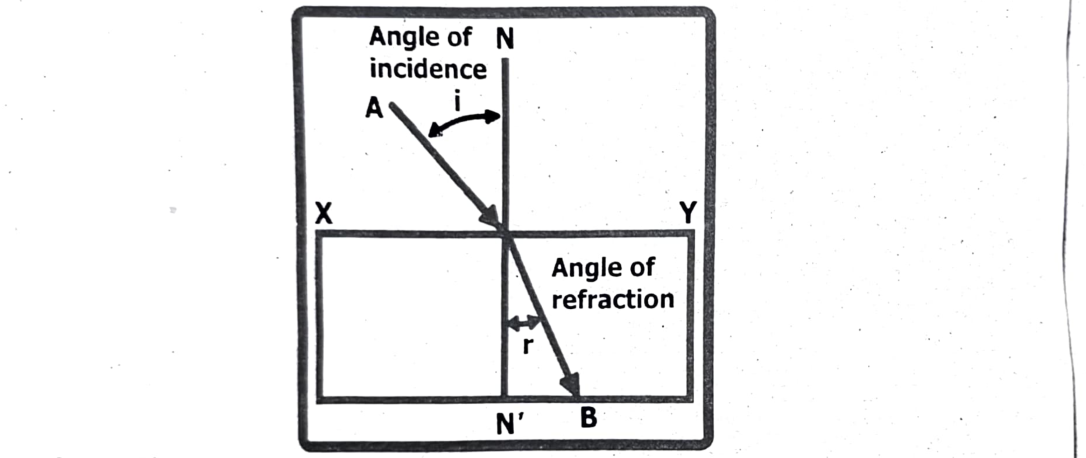
Given:
- Angle of incidence: $\theta_1 = 37^\circ$
- Refractive indices: $n_1 = 1.33$ (water); $n_2 = 1.00$ (air)
- Snell’s Law: $n_1 \sin \theta_1 = n_2 \sin \theta_2$
Substitute values:
$1.33 \cdot \sin(37^\circ) = 1.00 \cdot \sin(\theta_2)$
$1.33 \cdot 0.6018 = \sin(\theta_2)$, so $\sin(\theta_2) = 0.8004$.
Now take the inverse sine:
$\theta_2 = \sin^{-1}(0.8004) = 53^\circ$
Final Answer: Angle of refraction = $53^\circ$
Given:
- Index of refraction of the medium: $n = 1.7$
- Speed of light in a vacuum, approximately: $c = 3.00 \times 10^8\ \mathrm{m\,s^{-1}}$
- Speed of light in the medium: $v = ?$
Plugging in the given values:
$n = \frac{c}{v}$, so $v = \frac{3.00 \times 10^8\ \mathrm{m\,s^{-1}}}{1.7} \approx 1.7647 \times 10^8\ \mathrm{m\,s^{-1}}$.
Rounding to two significant figures, we get:
$v \approx 1.76 \times 10^8\ \mathrm{m\,s^{-1}}$
Therefore, the speed of light in the medium is approximately $1.76 \times 10^8\ \mathrm{m\,s^{-1}}$.
Given:
- Refractive index of the first medium: $n_1 = 1.6$
- Angle of incidence: $\theta_1 = 21^\circ$
- Refractive index of the second medium: $n_2 = 1.7$
- Angle of refraction: $\theta_2 = ?$
$n_1 \sin \theta_1 = n_2 \sin \theta_2$
$\sin \theta_2 = \frac{n_1 \sin \theta_1}{n_2}$
$\theta_2 = \sin^{-1}\left(\frac{n_1 \sin \theta_1}{n_2}\right)$
Plugging in the values:
$\theta_2 = \sin^{-1}\left(\frac{1.6 \times \sin 21^\circ}{1.7}\right)$
$\theta_2 = \sin^{-1}\left(\frac{1.6 \times 0.3584}{1.7}\right) = \sin^{-1}\left(\frac{0.57344}{1.7}\right)$
$\theta_2 = \sin^{-1}(0.33732) = 19.71^\circ$
So the angle of refraction is $19.71^\circ$.
Given:
- Refractive index of the medium where the light is coming from: $n_1 = 1.63$
- Refractive index of the medium where the light is going to: $n_2 = 1.35$
- Critical angle: $\theta_c = ?$
Using the formula: $\sin \theta_c = \frac{n_2}{n_1}$
$\sin \theta_c = \frac{1.35}{1.63}$
$\theta_c = \sin^{-1}\left(\frac{1.35}{1.63}\right) = \sin^{-1}(0.82822) = 55.9^\circ$
Given:
- Object height = $h_o = 3\text{ cm}$
- Object distance = $p = 5\text{ cm}$
- Magnification = $M = 3$
We need to find the image distance ($q$) and the image height ($h_i$).
The magnification is defined as:
$m = \frac{h_i}{h_o} = -\frac{q}{p}$
First, let’s find the image height ($h_i$):
$M = \frac{h_i}{h_o}$
$3 = \frac{h_i}{3\text{ cm}}$
$h_i = 3 \times 3\text{ cm} = 9\text{ cm}$
So, height of image = 9 cm
Next, let’s find the image distance ($q$):
$m = -\frac{q}{p}$
$3 = -\frac{q}{5\text{ cm}}$
$q = -3 \times 5\text{ cm} = -15\text{ cm}$
Since the image distance is negative, it indicates that the image is virtual and on the same side of the lens as the object. The absolute value of the image distance is 15 cm.