
Printed answer: 4.18 J g⁻¹ °C⁻¹.
To convert the specific heat of water from J kg⁻¹ K⁻¹ to J g⁻¹ °C⁻¹, we need to consider the relationship between kilograms and grams, and the relationship between Kelvin and Celsius.
(i) Kilograms to Grams:
1 kg = 1000 g
Therefore, $1\,\mathrm{kg}^{-1}=\frac{1}{1000}\,\mathrm{g}^{-1}$.
(ii) Kelvin to Celsius:
A change of 1 Kelvin is equal to a change of 1 degree Celsius.
Therefore, $1\,\mathrm{K}^{-1}=1\,^{\circ}\mathrm{C}^{-1}$.
Now, we can convert the specific heat of water:
$4180\,\frac{\mathrm{J}}{\mathrm{kg}\cdot\mathrm{K}}=4180\times\frac{\mathrm{J}}{1000\,\mathrm{g}\cdot^{\circ}\mathrm{C}}=\frac{4180}{1000}\times\frac{\mathrm{J}}{\mathrm{g}\cdot^{\circ}\mathrm{C}}=4.18\,\frac{\mathrm{J}}{\mathrm{g}\cdot^{\circ}\mathrm{C}}=4.18\,\mathrm{J\,g}^{-1}\,^{\circ}\mathrm{C}^{-1}$.
So, the specific heat of water in the desired units is 4.18 J g⁻¹ °C⁻¹.
Printed answer: 5.25 MJ.
We can use the formula: $Q=mc\,\Delta T$.
- Given:
- Mass of the water = $m=25\,\mathrm{kg}$
- Change in temperature = $\Delta T=50^{\circ}\mathrm{C}$
- Specific heat capacity of water $c=4186\,\mathrm{J\,kg}^{-1}\,^{\circ}\mathrm{C}^{-1}$
- Required:
Amount of heat energy (in joules) = $Q=?$ - Solution:
Plug in the values:
$Q=mc\,\Delta T\quad\Rightarrow\quad Q=25\times4186\times50\quad\Rightarrow\quad Q=5232500\,\mathrm{J}$.
Convert joules to mega joules:
$Q=5232500\,\mathrm{J}=5.2325\,\mathrm{MJ}\quad[\because\ 1\,\mathrm{MJ}=10^{6}\,\mathrm{J}]$.
Rounding to two decimal places, we get:
$Q\approx5.23\,\mathrm{MJ}$.
So, the amount of heat required is approximately 5.23 MJ.
Printed answers: 760 J kg⁻¹ K⁻¹; 17.1 kJ.
(a) Calculate the specific heat capacity of the metal:
We use the formula: $Q=mc\,\Delta T$.
- Given:
- Mass of the metal = $m=0.5\,\mathrm{kg}$
- Heat energy = $Q=19\,\mathrm{kJ}=19000\,\mathrm{J}$
- Change in temperature = $\Delta T=80^{\circ}\mathrm{C}-30^{\circ}\mathrm{C}=50^{\circ}\mathrm{C}$
- Required:
Specific heat capacity of the metal (in J kg⁻¹ K⁻¹) = $c=?$ - Solution:
Rearrange the formula to solve for $c$.
Plug in the values:
$c=\frac{Q}{m\Delta T}\quad\Rightarrow\quad c=\frac{19000}{0.5\times50}=\frac{19000}{25}=760\,\mathrm{J\,kg}^{-1}\,\mathrm{K}^{-1}$.
So, the specific heat capacity of the metal is 760 J kg⁻¹ K⁻¹.
(b) Calculate the additional heat energy needed:
Now, we need to find the heat energy required to raise the temperature from 80°C to 125°C.
Given:
- Mass of the metal = $m=0.5\,\mathrm{kg}$
- $c=760\,\mathrm{J\,kg}^{-1}\,\mathrm{K}^{-1}$
- Change in temperature = $\Delta T=125^{\circ}\mathrm{C}-80^{\circ}\mathrm{C}=45^{\circ}\mathrm{C}$
Required:
Additional heat energy needed = $Q=?$
Solution:
Use the formula:
$Q=mc\,\Delta T\quad\Rightarrow\quad Q=0.5\times760\times45\quad\Rightarrow\quad Q=17100\,\mathrm{J}$
Convert joules to kilojoules:
$Q=17100\,\mathrm{J}=17.1\,\mathrm{kJ}$
So, the additional heat energy needed is 17.1 kJ.
Printed answer: 400°C.
To calculate the change in temperature of the water, we can use the formula: $Q=mc\,\Delta T$.
Given:
- Heat energy (in joules) = $Q=8.4\,\mathrm{MJ}=8.4\times10^6\,\mathrm{J}$
- Volume of water = 5 liters
- Specific heat capacity of water = $4200\,\mathrm{J\,kg}^{-1}\,\mathrm{K}^{-1}$
Required:
Change in temperature = $\Delta T=?$
Solution:
First, we need to find the mass of the water. We know that the density of water is approximately 1 kg/L, so:
Mass of water = $m=?$
$m=\text{density}\times\text{volume}=1\,\frac{\mathrm{kg}}{\mathrm{L}}\times5\,\mathrm{L}=5\,\mathrm{kg}$
$m=5\,\mathrm{kg}$
$c=4200\,\mathrm{J\,kg}^{-1}\,\mathrm{K}^{-1}$
Now, we can rearrange the formula to solve for $\Delta T$.
$\Delta T=\frac{Q}{mc}$; plug in the values.
$\Delta T=\frac{8.4\times10^6\,\mathrm{J}}{5\,\mathrm{kg}\times4200\,\mathrm{J\,kg}^{-1}\,\mathrm{K}^{-1}}$
$\Delta T=\frac{8400000}{5\times4200}\,\mathrm{K}\quad\Rightarrow\quad\Delta T=\frac{8400000}{21000}\,\mathrm{K}\quad\Rightarrow\quad\Delta T=400\,\mathrm{K}$
Since a change in Kelvin is the same as a change in Celsius:
$\Delta T=400^{\circ}\mathrm{C}$
So, the change in temperature of the water is 400°C.
Printed answer: 40°C.
To solve this problem, we will use the principle of conservation of energy, which states that the heat lost by the hotter water is equal to the heat gained by the colder water, assuming no heat is lost to the surroundings.
Given:
- Mass of the hotter water = $m_1=100\,\mathrm{g}$
- Initial temperature of the hotter water = $T_1=80^{\circ}\mathrm{C}$
- Mass of the colder water = $m_2=200\,\mathrm{g}$
- Initial temperature of the colder water = $T_2=20^{\circ}\mathrm{C}$
- Specific heat capacity of water = $c=4.2\,\mathrm{J\,g}^{-1}\,^{\circ}\mathrm{C}^{-1}$
Required:
Final temperature of the mixture = $T_f=?$
Solution:
The heat lost by the hotter water is: $Q_1=m_1\cdot c\cdot(T_1-T_f)$
The heat gained by the colder water is: $Q_2=m_2\cdot c\cdot(T_f-T_2)$
Since heat lost equals heat gained: $m_1\cdot c\cdot(T_1-T_f)=m_2\cdot c\cdot(T_f-T_2)$
We can cancel out $c$ from both sides: $m_1(T_1-T_f)=m_2(T_f-T_2)$
Plug in the values:
$100\,\mathrm{g}\cdot(80^{\circ}\mathrm{C}-T_f)=200\,\mathrm{g}\cdot(T_f-20^{\circ}\mathrm{C})$
Now, solve for $T_f$.
$100\cdot(80-T_f)=200\cdot(T_f-20)$
$8000-100T_f=200T_f-4000$
$8000+4000=200T_f+100T_f$
$12000=300T_f\quad\Rightarrow\quad T_f=\frac{12000}{300}\quad\Rightarrow\quad T_f=40$
So, the final temperature of the mixture is 40°C.
Printed answer: 890 J kg⁻¹ K⁻¹ or 0.89 J g⁻¹ K⁻¹.
Given:
- Mass of solid cylinder = $m_s=200\,\mathrm{g}$
- Initial temperature of solid cylinder = $T_{s,i}=110^{\circ}\mathrm{C}$
Mass of water = $m_w=200\,\mathrm{g}$.
Initial temperature of water = $T_{w,i}=20^{\circ}\mathrm{C}$.
Mass of calorimeter = $m_c=60\,\mathrm{g}$.
Specific heat capacity of calorimeter = $c_c=0.9\,\mathrm{J\,g}^{-1}\,^{\circ}\mathrm{C}^{-1}$.
Final temperature of the system = $T_f=35^{\circ}\mathrm{C}$.
Specific heat capacity of water = $c_w=4.2\,\mathrm{J\,g}^{-1}\,^{\circ}\mathrm{C}^{-1}$.
Required:
Specific heat capacity of the solid cylinder = $c_s=?$
Solution:
Since no heat is lost to the surroundings, the heat lost by the solid cylinder is equal to the heat gained by the water and the calorimeter.
Heat lost by the solid cylinder: $Q_s=m_s\cdot c_s\cdot(T_{s,i}-T_f)$.
Heat gained by the water: $Q_w=m_w\cdot c_w\cdot(T_f-T_{w,i})$.
Heat gained by the calorimeter: $Q_c=m_c\cdot c_c\cdot(T_f-T_{w,i})$.
According to the conservation of energy:
$Q_s=Q_w+Q_c$
$m_s\cdot c_s\cdot(T_{s,i}-T_f)=m_w\cdot c_w\cdot(T_f-T_{w,i})+m_c\cdot c_c\cdot(T_f-T_{w,i})$
Plug in the given values:
$200\,\mathrm{g}\cdot c_s\cdot(110^{\circ}\mathrm{C}-35^{\circ}\mathrm{C})=200\,\mathrm{g}\cdot4.2\,\frac{\mathrm{J}}{\mathrm{g}^{\circ}\mathrm{C}}\cdot(35^{\circ}\mathrm{C}-20^{\circ}\mathrm{C})+60\,\mathrm{g}\cdot0.9\,\frac{\mathrm{J}}{\mathrm{g}^{\circ}\mathrm{C}}\cdot(35^{\circ}\mathrm{C}-20^{\circ}\mathrm{C})$
Simplify:
$200\cdot c_s\cdot75=200\cdot4.2\cdot15+60\cdot0.9\cdot15$
$15000\cdot c_s=12600+810$
$15000\cdot c_s=13410$
Solve for $c_s$:
$c_s=\frac{13410}{15000}=0.894\,\frac{\mathrm{J}}{\mathrm{g}^{\circ}\mathrm{C}}$
Convert to $\mathrm{J\,kg}^{-1}\,\mathrm{K}^{-1}$:
$c_s=0.894\,\frac{\mathrm{J}}{\mathrm{g}^{\circ}\mathrm{C}}\times\frac{1000\,\mathrm{g}}{1\,\mathrm{kg}}=894\,\mathrm{J\,kg}^{-1}\,\mathrm{K}^{-1}$ or $0.894\,\mathrm{J\,g}^{-1}\,\mathrm{K}^{-1}$.
Therefore, the specific heat capacity of the solid cylinder is approximately $894\,\mathrm{J\,kg}^{-1}\,\mathrm{K}^{-1}$ or $0.894\,\mathrm{J\,g}^{-1}\,^{\circ}\mathrm{C}^{-1}$.
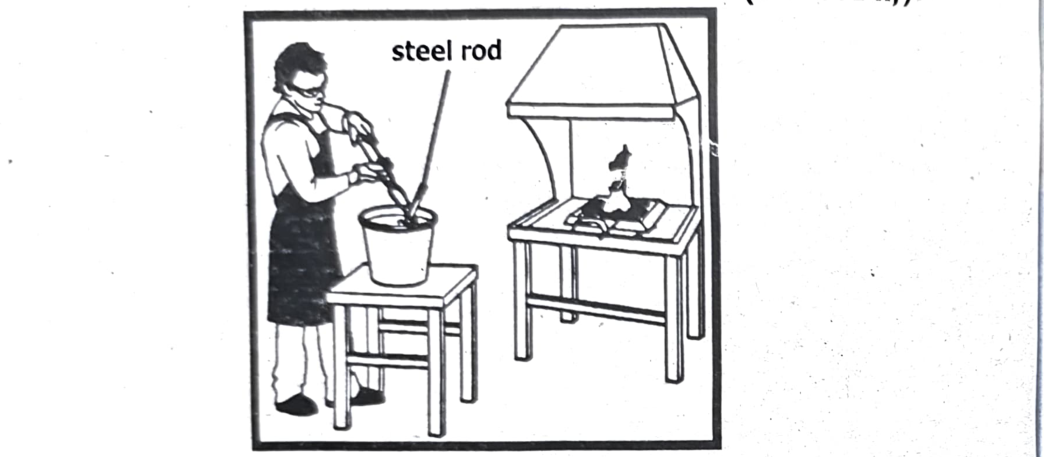
Printed answer: 552 kJ.
To calculate the thermal energy (heat) lost by the steel rod, we use the formula:
$Q=mc\,\Delta T$
Given:
- Mass of the steel rod = $m=3\,\mathrm{kg}$
- Specific heat capacity of steel = $c=460\,\mathrm{J\,kg}^{-1}\,^{\circ}\mathrm{C}^{-1}$
- Change in temperature: $\Delta T=T_{\mathrm{final}}-T_{\mathrm{initial}}=50^{\circ}\mathrm{C}-450^{\circ}\mathrm{C}=-400^{\circ}\mathrm{C}$
Required:
Heat energy (in joules) = $Q=?$
Solution:
Plug in the values:
$Q=3\,\mathrm{kg}\times460\,\frac{\mathrm{J}}{\mathrm{kg}\cdot^{\circ}\mathrm{C}}\times(-400^{\circ}\mathrm{C})$
$Q=3\times460\times(-400)\,\mathrm{J}$
$Q=-552000\,\mathrm{J}$
Convert joules to kilojoules:
$Q=-552000\,\mathrm{J}=-552\,\mathrm{kJ}$
Since we are looking for the heat lost by the steel rod, the negative sign indicates that the heat is released. The amount of heat lost is $552\,\mathrm{kJ}$.
Therefore, the thermal energy (heat) lost by the steel rod as it cools to $50^{\circ}\mathrm{C}$ is $552\,\mathrm{kJ}$.