
Specific heat
Specific heat capacity or specific heat of a material is the amount of heat absorbed or lost to change the temperature of 1 kg of its substance by 1 kelvin or 1 degree Celsius.
$$c=\frac{Q}{m\Delta T}$$
Here, $c$ is the specific heat of the material, $Q$ is the amount of heat absorbed or lost, $m$ is the mass of the substance, and $\Delta T$ is the change in temperature of the substance, i.e. $T_{\text{final}}-T_{\text{initial}}$.
Unit of specific heat
The SI unit of specific heat is joule per kilogram per kelvin ($\text{J kg}^{-1}\text{K}^{-1}$). Other units in use are $\text{J kg}^{-1}\,^{\circ}\text{C}^{-1}$ and $\text{J g}^{-1}\,^{\circ}\text{C}^{-1}$.
For example, the specific heat of aluminum is $900\ \text{J kg}^{-1}\text{K}^{-1}$. Its value in other units can be written as $900\ \text{J kg}^{-1}\,^{\circ}\text{C}^{-1}$ and $0.9\ \text{J g}^{-1}\,^{\circ}\text{C}^{-1}$.
Some materials require a small amount of heat, like metals (for example aluminium, copper, iron and diamond, etc.). These materials have low values of specific heat. Such materials are good conductors of heat. We can say that these materials cannot retain heat for a longer time. These materials heat up and cool down quickly. Therefore, such materials are used in heat sinks.
Materials with large specific heat values are used for temperature control because they can absorb or release large amounts of heat with only a small change in temperature. This property makes them useful in applications like thermal energy storage, where they can store heat for later use, or in systems that need to moderate temperature fluctuations.
Examples
Water is a classic example of a material with a high specific heat capacity. Other examples include certain metals and some plastics.
Measurement of specific heat of solids and liquids
There are different experiments which can be used to determine specific heat of solids and liquids. The most common methods are “method of mixtures” and “electrical heating method”.
Method of mixtures
The experiments for measurement of unknown specific heat capacity of solids and liquids by method of mixtures are discussed below:
Measurement of unknown specific heat capacity of solids
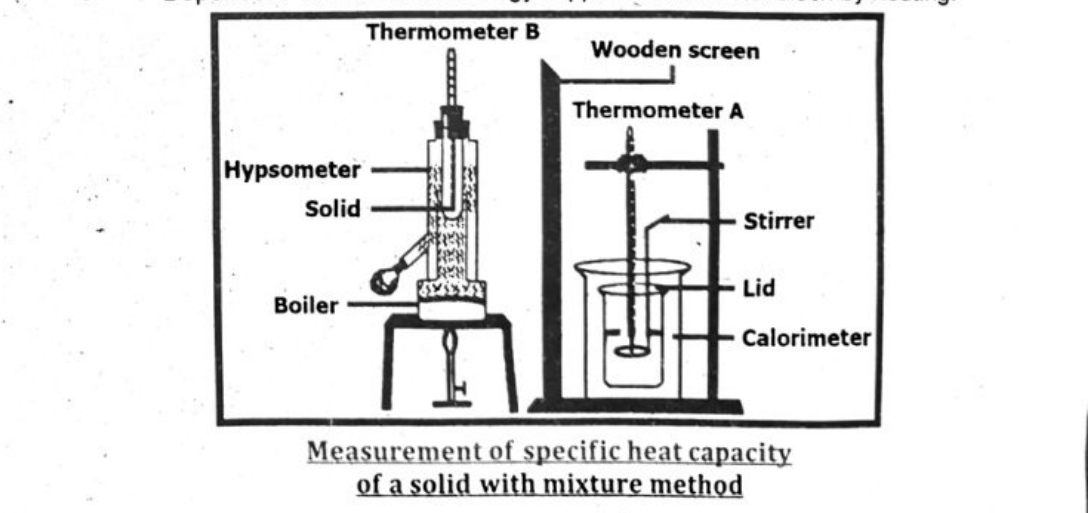
This method uses a calorimeter to determine the heat capacity of a substance. In this method, when the hot sample, e.g. a solid, is added to water in the calorimeter, heat is exchanged between them as well as the calorimeter. From the law of conservation of energy, the heat lost by hot bodies will be equal to the heat gained by cold bodies. Then we form the equation after measuring the change in temperature of the water in the calorimeter and masses of substances. After careful analysis, we can calculate the specific heat capacity of the sample.
Apparatus
A Bunsen burner or hot plate, copper calorimeter with lid, stirrer and insulating cover, a metallic solid cylinder (e.g. brass or copper cylinders), weighing machine, water, beaker, laboratory stand and two thermometers.
Key Variables
- Independent Variable is the temperature of the metal block.
- Dependent Variable is the energy supplied to the metal block by heating.
Measurement of specific heat of solids and liquids
There are different experiments which can be used to determine specific heat of solids and liquids. The most common methods are “method of mixtures” and “electrical heating method”.
Method of mixtures
The experiments for measurement of unknown specific heat capacity of solids and liquids by method of mixtures are discussed below:
Measurement of unknown specific heat capacity of solids
This method uses a calorimeter to determine the heat capacity of a substance. In this method, when the hot sample e.g. a solid is added to water in the calorimeter, heat is exchanged between them as well as the calorimeter. From the law of conservation of energy, the heat lost by hot bodies will be equal to the heat gained by cold bodies. Then we form the equation after measuring the change in temperature of the water in calorimeter and masses of substances. After careful analysis, we can calculate the specific heat capacity of the sample.
Apparatus
A Bunsen burner or hot plate, copper calorimeter with lid stirrer and insulating cover, a metallic solid cylinder (e.g. brass or copper cylinders), weighing machine, water, beaker, laboratory stand and two thermometers.
Key Variables
- Independent Variable is the temperature of the metal block.
- Dependent Variable is the energy supplied to the metal block by heating.
Procedure
- Take an empty calorimeter of known heat capacity $C_c$. Measure the mass of the calorimeter $m_c$ with the stirrer and lid.
- Fill the calorimeter with enough water to completely submerge the solid later. Weigh the calorimeter with water ($m$). The difference in masses, $(m-m_c)$, is equal to the mass of water ($m_w$) in the calorimeter.
- Place the calorimeter in its insulating cover and insert a thermometer in it. Measure the temperature of the water, $T_1\,^{\circ}\mathrm{C}$ (equal to the temperature of the surroundings).
- Measure the mass of the given solid using a weighing machine and note down its mass as $m_s$.
- Boil water in a beaker with the solid submerged. Measure the boiling water temperature ($T_2\,^{\circ}\mathrm{C}$). In this step, ensure that the solid attains the same temperature as the boiling water on heating.
- Remove the solid from boiling water, shake off excess water, and quickly place it in the calorimeter. Cover the calorimeter immediately.
- Stir the water continuously with the stirrer for uniform distribution of heat (and temperature).
- Measure the final temperature of the mixture once it becomes constant on attaining equilibrium; record this temperature as $T_3\,^{\circ}\mathrm{C}$.
- Calculate the increase in temperature of water and calorimeter, equal to $(T_3-T_1)$, and the decrease in temperature of the solid, equal to $(T_2-T_3)$.
- From the principle of calorimetry, i.e. the law of conservation of energy, heat given by the solid in cooling from $T_2$ to $T_3$ is equal to heat gained by the water and calorimeter in raising their temperature from $T_1$ to $T_3$. Thus:
Heat loss by solid = Heat gained by water in calorimeter + Heat gained by calorimeter
$$Q_s=Q_w+Q_c$$
$$m_s c_s(T_2-T_3)=m_w c_w(T_3-T_1)+m_c C_c(T_3-T_1)$$
By rearranging the above equation, we can find the specific heat capacity of the solid:
$$c_s=\frac{m_w c_w(T_3-T_1)+m_c C_c(T_3-T_1)}{m_s(T_2-T_3)}$$
Here, $$c_s=\frac{(m_w c_w+m_c C_c)(T_3-T_1)}{m_s(T_2-T_3)}\qquad\text{(i)}$$
Result
Equation (i) is used to find the specific heat of a solid ($c_s$). By putting the measured masses of solid, water and calorimeter, specific heat capacities of water and calorimeter, and temperatures $T_1$, $T_2$ and $T_3$ in equation (i), we can calculate the specific heat capacity of the solid.
Measurement of unknown specific heat capacity of a liquid
To measure the unknown specific heat capacity of a liquid, we follow the same procedure. But in this experiment, we take a solid of known specific heat capacity, but a liquid of unknown specific heat capacity $c_l$ is taken. The same experiment is performed to measure the unknown specific heat capacity of a liquid; fro this experiment, the law of conservation of energy can be written as:
$$m_s c_s(T_2-T_3)=m_l c_l(T_3-T_1)+m_c C_c(T_3-T_1)$$
By rearranging the above equation, we get:
$$m_l c_l(T_3-T_1)=m_s c_s(T_2-T_3)-m_c C_c(T_3-T_1)$$
Hence, $$c_l=\frac{m_s c_s(T_2-T_3)-m_c C_c(T_3-T_1)}{m_l(T_3-T_1)}\qquad\text{(ii)}$$
Electrical Heating Method
The experiments for measurement of unknown specific heat capacity of a solid and liquids are discussed below:
Measurement of unknown specific heat capacity of solids
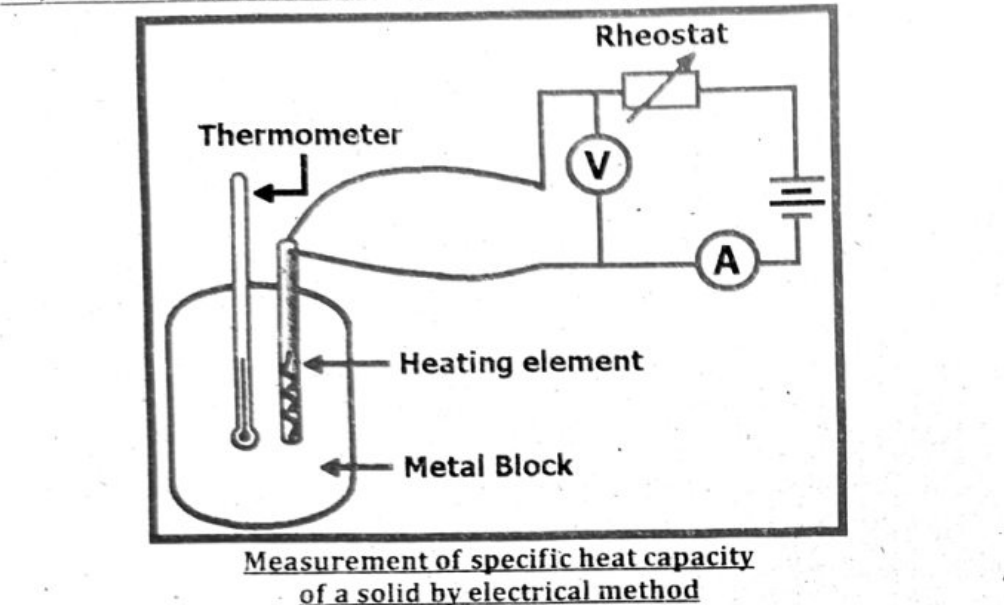
In this method, we measure the amount of heat transferred to a material and measure its temperature change.
Apparatus
A solid block or cylinder, e.g. aluminium, with a hole in it for a heater and a smaller hole for a thermometer, an immersion heater, voltmeter, ammeter, thermometer.
Procedure
- Calculate the mass of the solid block.
- Place an electrical immersion heater into the central hole at the top of the weighed metal block. Connect the heater with an ammeter to measure current and with a voltmeter to measure voltage (potential difference) applied on the heater.
- Place the thermometer into the smaller hole. Add a few drops of oil into the hole to make sure the thermometer is surrounded by hot material.
- Insulate the block by wrapping it with cotton wool.
- Record the initial temperature of the block.
- Connect the heater to the power supply and turn it on for ten minutes. Record the current and potential difference.
- After ten minutes, turn the heater off. Record the highest temperature that it reaches (temperature readings will rise even after the heater is turned off).
- Calculate the heat energy generated by water.
Result
Calculate the specific heat capacity of the solid block using the formula:
$$c=\frac{Q}{m\Delta T}\qquad\text{(i)}$$
Measurement of unknown specific heat capacity of liquids
Apparatus
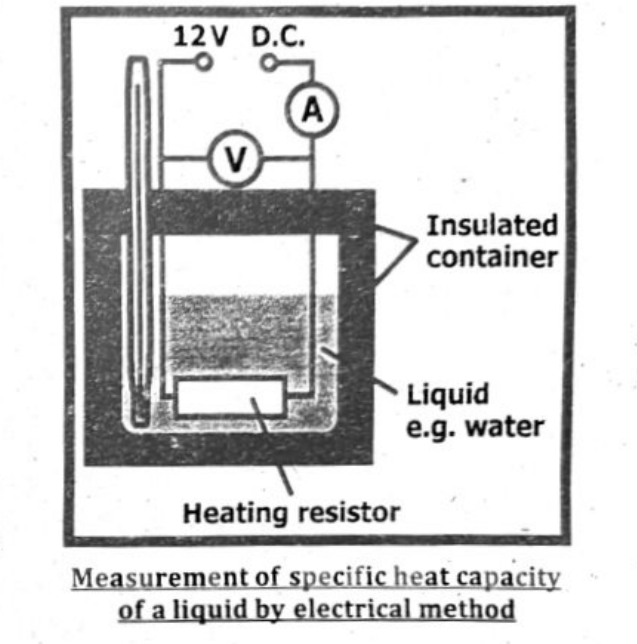
An immersion heater, voltmeter, ammeter, thermometer, water and calorimeter.
Procedure
- Calculate the mass of the empty calorimeter ($m_c$).
- Add some liquid, e.g. water, in the calorimeter and measure the mass of the calorimeter plus liquid ($m$). The difference of the masses, $(m-m_c)$, gives the mass of liquid ($m_w$).
- Measure the initial temperature of the calorimeter plus liquid using a thermometer.
- Place an electrical heater inside the liquid and connect an ammeter and voltmeter with it. Switch it ON. Measure the voltage and current passing through the heater.
- The temperature will start to rise. When the temperature rises by $10^{\circ}\mathrm{C}$, switch off the heat, stir the liquid well and measure the highest temperature of the liquid. Then find the temperature difference between the highest temperature and the initial temperature of the liquid.
- From the law of conservation of energy:
Energy supplied = Heat gained by liquid + Heat gained by calorimeter
$$Q_{\text{heater}}=Q_w+Q_c$$
$$Q_{\text{heater}}=m_l c_l(T_f-T_i)+m_c C_c(T_f-T_i)$$
Rearranging:
$$c_l=\frac{Q_{\text{heater}}-m_c C_c(T_f-T_i)}{m_l(T_f-T_i)}\qquad\text{(i)}$$
Result
By putting the measured values of heat energy produced by the heater, masses of liquid and calorimeter, and initial and final temperatures, we can measure the specific heat capacity of the liquid.
Information
Heat generated by the heater is calculated by:
Heat energy = electrical energy supplied to heater
Heat energy = Voltage × current × time
Thermal equilibrium
Heat transfer occurs when thermal energy is transferred from one object to another because of a difference in temperature. This process continues until both objects reach the same temperature, which is known as thermal equilibrium.
USES OF LARGE SPECIFIC HEAT OF WATER:
Water has large specific heat (4200 J kg−1K−1). Due to it, it has significant uses in our daily life.
Temperature Variation in Land and Coastal Areas:
Coastal areas tend to have less temperature variation compared to inland areas due to the high heat capacity of water, which moderates the temperature. Water absorbs heat more slowly and releases it more slowly than land, resulting in cooler summers and warmer winters in coastal regions. This effect is amplified by ocean currents, which can transport warm or cold water to coastal areas.
The specific heat of dry soil (800 J kg−1K−1) is smaller than that of water. It is about five times smaller than that of water. It is why land area quickly heats up in summer and temperature rises from about 45°C to 50°C, and also because land quickly cools down in winter, leading to low temperatures from 5°C to 0°C.
But in coastal areas, temperature variation is small. In Karachi, average temperature variation is from 19°C to 32°C. So, oceans and large lakes absorb a lot of heat from the sun during the summer and keep the heat stored in them.
On the other hand, in winters, oceans and lakes release heat into the atmosphere. This phenomena on keeps the temperature moderates between summer and winter in coastal areas.
| Materials | Specific heat J / kgK |
|---|---|
| Aluminum | 910 |
| Copper | 387 |
| Glass | 840 |
| Gold | 129 |
| Iron / steel | 452 |
| Lead | 128 |
| Silver | 235 |
| Ethanol | 2450 |
| Glycerin | 2410 |
| Mercury | 139 |
| Water | 4190 |
| Air | 721 |
| Carbon dioxide | 638 |
| Oxygen | 651 |
| Steam (100°C) | 1520 |
Maintaining stability of Ocean and Lake Temperatures:
Lakes and oceans heat up and cool down slowly due to high specific heat of water. This prevents changes in the temperature of the lake and oceans and thus provides a suitable environment for aquatic life.
Human Body Temperature Regulation:
The human body contains approximately 60% water. A healthy body maintains its temperature about 37°C. Now, we can relate how can our body maintain its temperature due to high specific heat of water.
Cooling system and Heat Exchangers:
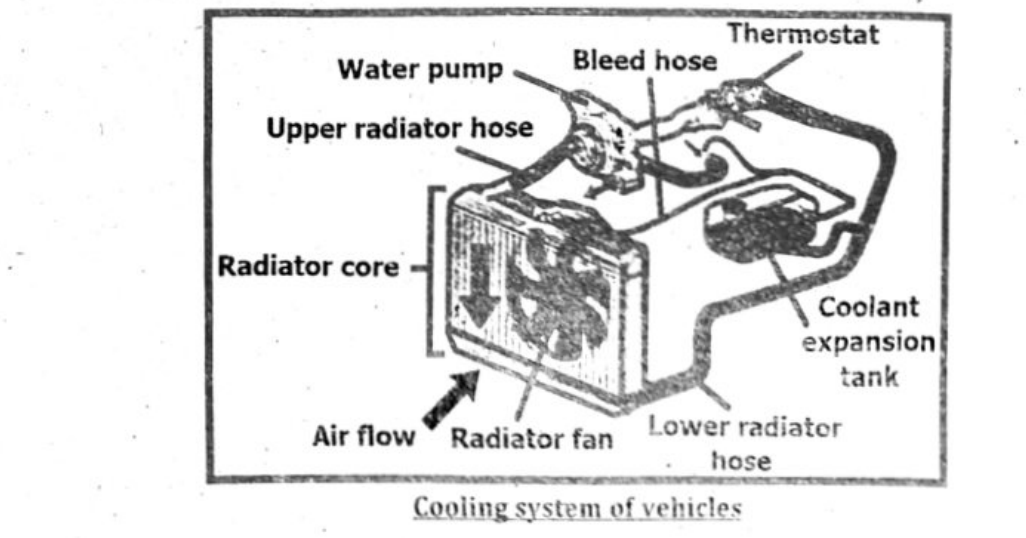
Water is used as coolant in power plants, different industrial process and cooling system of automobiles (radiators). Water takes large amount of excess heat from the machines and effectively transfers heat using heat exchanger. It prevents overheating in the machinery and maintains their high efficiency.
Cooking Process:
Water is good for cooking because of its high specific heat. It heats up slowly and distributes heat evenly. It ensures food cooking without burning. Hot drinks like tea and coffee stay hot for long time.
Experiment
Let's discuss an experiment to differentiate between good and bad conductors.
Apparatus
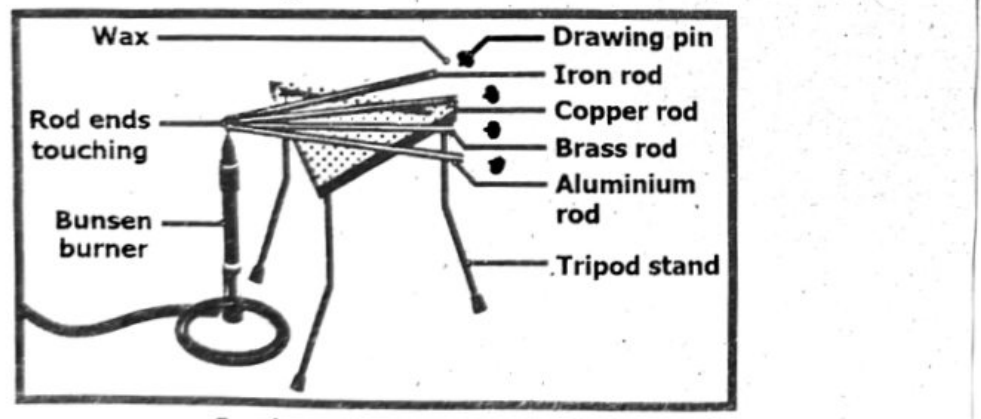
Three long thin strips of different metals (for example copper, iron, and aluminium rods). Vaseline or wax, drawing pins and a Bunsen burner.
Control variables
Length of metal rod, diameter of rods, position in the Bunsen flame.
Method
The following procedure is adopted.
- Apply small dots of wax at the ends of metal rods and fix the drawing pins in them.
- Position the other end of the metal rods into a Bunsen flame. Make sure that heat can reach every metal rods in the same amount.
- As the heat flows through metal rods, wax will melt and pin will drop. Record the time taken for the wax to melt and the drawing pin to drop off. The fastest time shows the best conductor of heat. It happens because good conductors allow heat to flow fast through them and cause Vaseline to melt soon.
Result
The drawing pin falls off the copper rod first followed by the aluminium.
Conclusion
When a drawing pin attached with wax to a copper rod and an aluminum rod is heated, the drawing pin will fall off the copper rod first, followed by the aluminum rod. This is because copper is a better conductor of heat than aluminum, while aluminium conducts better than iron and brass.
THERMAL CONDUCTION:
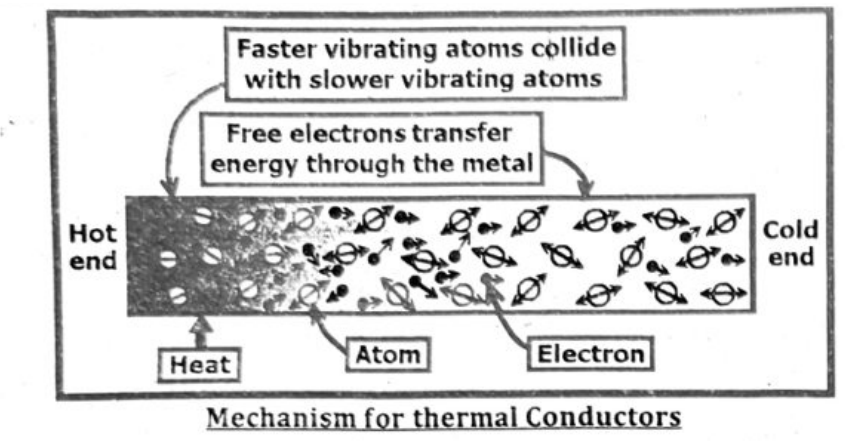
“It is method of transfer of heat due to collisions of atoms or molecules and motion of free electrons in solids from its hot part to cold part”.
This method of heat transfer takes place in solids. In conduction, heat is transferred from atoms to atoms. Metals are good conductors of heat because they have a large number of free electrons that travel faster across the metal when metal is heated. That's why heat energy is transferred quickly in metals.
Mechanism of thermal conduction:
When one of the ends of a rod is heated, atoms at this end start vibrating with larger amplitude. These atoms hit their neighbouring atoms and transfer them heat energy. Now, these atoms vibrate with larger amplitude and hit their nearby atoms, and process continues. Heat energy is transferred between the two ends in this manner.
When a copper rod and a wooden stick are heated simultaneously, we find that the copper rod's other end heats up more quickly than the wooden stick's other end.
This is due to the fact that metallic rods, such as copper rods, have a lot of free electrons. In comparison to vibrating atoms, these free electrons get energy from the hot end and transfer energy fast from one end of the rod to its second end. We can say that metals transfer heat energy quickly than other solids like wood, glass etc.

Factors Affecting Conduction
The rate of heat conduction in solids is influenced by factors like:
- Thermal Conductivity: This property measures how well a material conducts heat. Metals are generally good conductors, while materials like wood or styrofoam are poor conductors (insulators).
- Temperature Difference: A larger temperature difference between the hot and cold ends of a solid will lead to faster heat transfer by conduction.
- Material Structure: The way atoms are arranged in a material can affect its thermal conductivity.
- Examples: Common examples of thermal conduction include:
- Heat transfer through a metal pan on a stove.
- Feeling the heat from a hot object when touching it.
- Melting an ice cube held in your hand.
CONVECTION:
“The method of transfer of heat due to bulk movement of molecules in fluids is called convection”
We can also define it as “convection is the transfer of heat energy due to the transfer of fluid, itself.” Convection only takes place in liquids and gases. It cannot take place in solids.
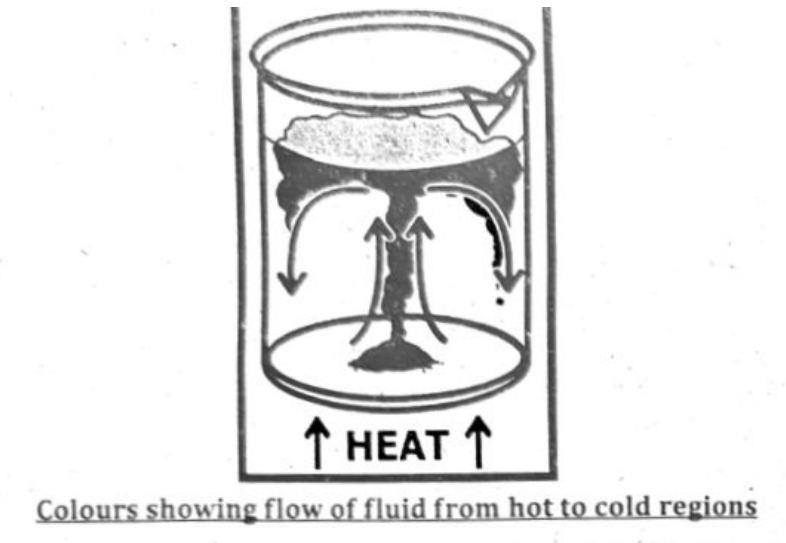
Convection in liquids and gases can be investigated through experiments that visualize the movement of fluids when heated. A simple experiment involves heating a beaker of water with potassium permanganate crystals to demonstrate convection currents. In gases, smoke rising from a candle can be used to visualize convection, showing how heated air rises and cooler air sinks.
Liquid Convection
Experiment
A beaker of water is heated, and a few potassium permanganate crystals are added to one side.
Observation
The potassium permanganate dissolves in the heated water and rises, revealing the convection current as the hot, less dense water moves upwards and cooler, denser water sinks.
Gas Convection
Experiment
A candle is placed in a box with two glass chimneys. A smoke match or incense is held near one chimney.
Observation
As the candle heats the air, it rises through the chimney. Cooler air is drawn into the box through the other chimney, causing the smoke to move in the opposite direction, as demonstrated on YouTube.
Key Principles
Density
When a fluid is heated, its particles move faster and spread out, making it less dense. The less dense, heated fluid rises, while cooler, denser fluid sinks.
Convection Currents
The continuous movement of fluids due to temperature differences creates convection currents.
Applications
Convection plays a crucial role in various phenomena, including heating, cooling, and weather patterns.
Convection currents in a liquid
The movement of hotter areas in a liquid can be seen using potassium permanganate as a dye.
This cycle is called a convection current.
Convection and Marine Life:
Convection in seawater, driven by temperature and salinity differences, is crucial for supporting marine life by distributing heat, nutrients, and oxygen throughout the ocean. This process creates currents that transport these essential elements, preventing stratification and fostering a healthy marine ecosystem.
Here's a more detailed explanation:
Heat Distribution:
The sun's radiation heats the surface water, making it less dense and causing it to rise. As this warmer, less dense water moves away from the equator, it cools and sinks at higher latitudes. This sinking water then flows back towards the equator, creating a global conveyor belt of currents that distribute heat around the planet.
Nutrient and Oxygen Transport:
Convection currents also transport nutrients from the deep ocean to the surface, where they are essential for phytoplankton growth, the base of the marine food chain. Simultaneously, they bring oxygen from the surface to deeper waters, where it is needed by many marine animals.
Preventing Stratification:
Without convection, the ocean could become stratified, with a warm, nutrient-poor surface layer and a cold, nutrient-rich deep layer. This would limit the growth of phytoplankton and other marine organisms, impacting the entire ecosystem.
Examples of Convection:
Convection in seawater is evident in various forms, including:
- El Niño: A major weather pattern in the Pacific Ocean that affects global temperatures and ocean currents, as described on Earth Observatory.
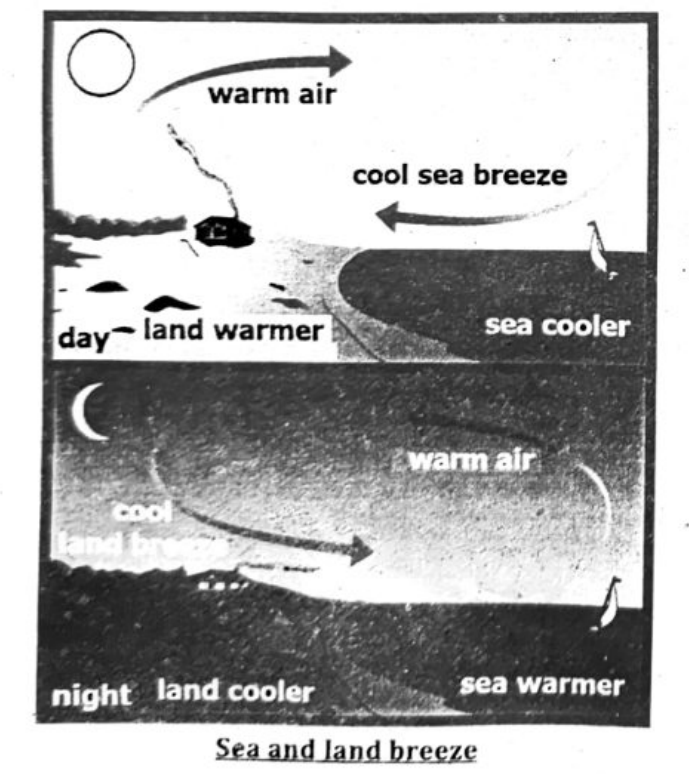
- Coastal currents: Convection currents in coastal regions are influenced by temperature differences between land and water, leading to land and sea breezes.
- Ocean deep-water circulation: A global system of currents driven by differences in temperature and salinity.
Information
Rubber is generally a better insulator than air. Rubber has a lower thermal conductivity than air, meaning it can reduce the transfer of heat energy more effectively. Rubber has tightly bound electrons which helps to resist transfer of heat. Rubber can resist the flow of heat energy about 4–8 times better than air.
Land Breeze and Sea Breeze:
Land and sea breezes help moderate coastal climates by reducing daily temperature swings. During the day, land heats up faster than the sea, causing cooler air to flow from the sea to the land (sea breeze). At night, the process reverses, and land cools down faster than the sea, resulting in cooler air flowing from the land to the sea (land breeze). This continuous cycle of breezes keeps coastal areas cooler during the day and warmer at night compared to inland regions.
Elaboration:
Unequal Heating:
Land absorbs and radiates heat much faster than water. Water has a high specific heat capacity, meaning it takes more energy to change its temperature. This difference in heating and cooling rates between land and water is the primary driver of land and sea breezes.
Sea Breeze (Daytime):
During the day, the land surface heats up, causing the air above it to warm and rise. This rising warm air creates a low-pressure area. Cooler, denser air from the sea rushes in to replace the rising air, creating a sea breeze. The sea breeze brings cooler, more humid air from the ocean to the land, which helps moderate the temperature.
Land Breeze (Nighttime):
At night, the land cools down faster than the sea. The air above the land becomes cooler and denser, causing it to sink. This sinking air creates a high-pressure area. Warmer air from the sea rushes in to replace the sinking air, creating a land breeze.
Moderation of Temperature:
The constant exchange of air between land and sea through sea and land breezes helps moderate temperature extremes. The sea breeze brings cooler air during the day, preventing temperatures from soaring too high, while the land breeze brings slightly warmer air at night, preventing them from plummeting too low.
Other Factors:
While land and sea breezes play a significant role, other factors like latitude, ocean currents, and atmospheric pressure patterns also contribute to coastal climates.
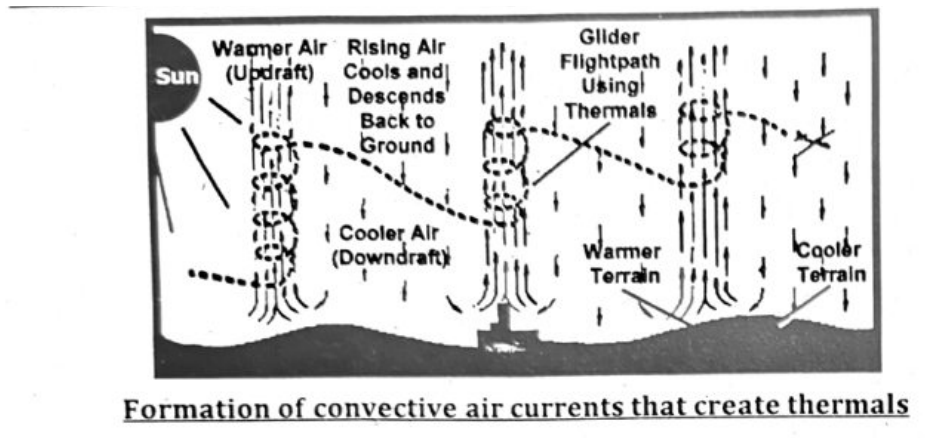
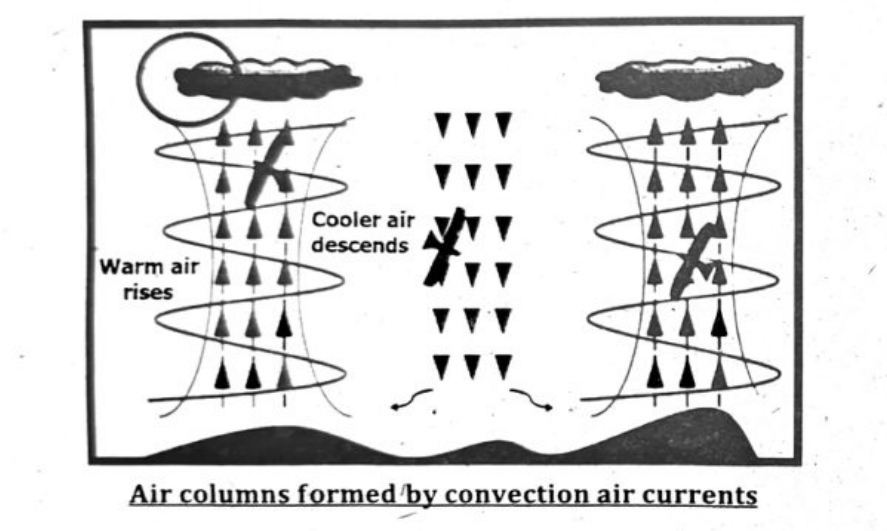
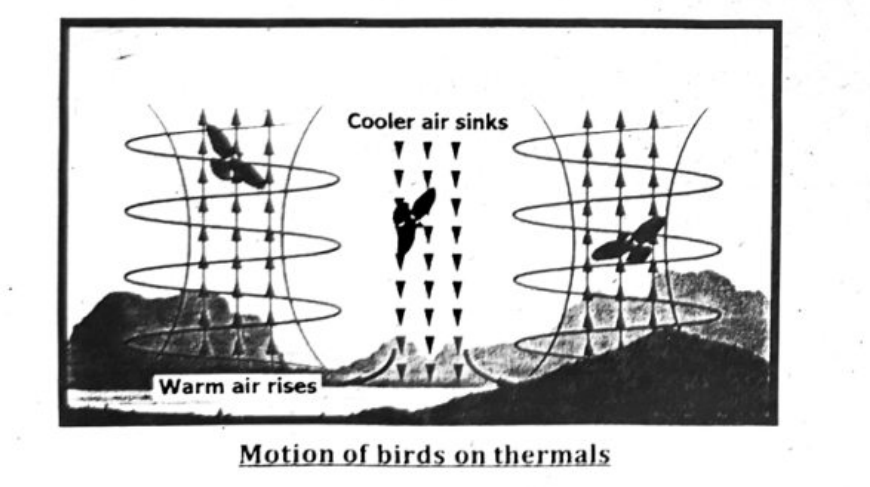
Birds can fly for extended periods without flapping their wings by using thermal currents, which are rising pockets of warm air. Gliders also utilize these thermals to gain altitude and stay aloft, mimicking the birds’ soaring behavior.
Here’s a more detailed explanation:
Birds and Thermals:
Thermal Soaring:
Birds like eagles, hawks, and vultures are expert thermal climbers. They actively seek out rising thermals and circle within them to gain altitude, essentially riding the updraft.
Passive Soaring:
After gaining altitude, birds can glide from one thermal to another, covering large distances with minimal wing flapping.
Wing Shape and Function:
The shape of a bird’s wings, particularly those of soaring birds, allows them to generate lift and maintain altitude while gliding.
Example:
Andean Condors, the heaviest soaring bird, can fly for hours while flapping very little.
Gliders and Thermals:
Thermal Riding:
Glider pilots also use thermals to stay aloft. They learn to recognize and enter rising air currents, circling within them to gain altitude.
Pilot Skill:
Glider pilots must be skilled at identifying and maneuvering within thermals, as the speed and direction of the current can change.
Gliding and Descent:
Gliders are designed to glide, meaning they are constantly descending, but the upward movement of the thermal counteracts this descent.
Thermalling:
Glider pilots use a technique called “thermalling,” where they circle within a thermal to climb, then glide to the next thermal, repeating the process to gain altitude and distance.
Hurricanes and Cyclones:
Hurricanes form over warm ocean waters. The warm water causes evaporation and this moist air rises due to convection. As it rises, it cools and forms clouds through condensation. This condensation releases latent heat which warms the surrounding atmosphere, making the air there lighter. As a result, the air continues to rise, lowering the atmospheric pressure at its surface. This decrease in pressure increases the rate of evaporation and causes more warm, moist air from oceans to move up. The Earth's rotation causes this rising air to spin, forming a cyclonic system. As the system gathers strength, it can develop into a hurricane with high wind speeds.
THERMAL RADIATIONS:
Thermal energy transfer by radiation involves the emission of electromagnetic waves, primarily infrared radiation, from a hot surface to a cooler surface. This process can occur through a vacuum, unlike conduction and convection, which require a medium. The heat waves are either absorbed, reflected, or transmitted by the colder body. There is vacuum between the Earth and the Sun but still heat (infra-red radiation also known as IR radiation) and light reaches the Earth.
Here's a more detailed breakdown:
Emission:
All objects with a temperature above absolute zero emit electromagnetic radiation, including infrared radiation. The hotter the object, the more infrared radiation it emits.
Transmission:
These electromagnetic waves travel through space or a medium, such as air, and can be absorbed by other objects.
Absorption:
When these waves are absorbed by another object, the energy of the waves is converted into heat, causing the object's temperature to rise.
Reflection and Transmission:
Some radiation may be reflected or transmitted by the colder body, meaning it is not absorbed and does not contribute to heating.
Examples of Radiation:
Sun's heat reaching Earth:
The sun emits electromagnetic radiation, including infrared radiation, which travels through the vacuum of space and heats the Earth.
Sitting by a fire:
The warmth felt from a fire is due to infrared radiation emitted by the flames.
Heat from a light bulb:
A light bulb also emits infrared radiation, causing the surrounding area to warm up.
Surface color and texture significantly impact how a material interacts with infrared (IR) radiation, affecting its emission, absorption, and reflection properties. Dark, matte surfaces tend to be good absorbers and emitters of (IR) radiation, while light shiny surfaces tend to reflect and absorb less (IR).
Here's a more detailed breakdown:
Emission:
Dark, matte surfaces:
Good emitters of (IR) radiation. They radiate more (IR) energy than lighter, shinier surfaces at the same temperature.
Light, shiny surfaces:
Poor emitters of (IR) radiation. They emit less (IR) energy than dark surfaces.
Example:
A black radiator heats a room faster than a white one, even though both are at the same temperature, because the black surface emits more (IR) radiation.
Absorption:
Dark, matte surfaces:
Good absorbers of (IR) radiation. They absorb more (IR) energy from their surroundings than lighter, shinier surfaces.
Light, shiny surfaces:
Poor absorbers of (IR) radiation. They reflect more (IR) energy than they absorb, so they don't heat up as quickly as dark surfaces.
Example:
A dark t-shirt will feel warmer to the touch on a sunny day than a light-colored t-shirt because it absorbs more solar radiation (which includes (IR).
Reflection:
Dark, matte surfaces:
Reflect relatively little (IR) radiation.
Light, shiny surfaces:
Good reflectors of (IR) radiation. They reflect a significant portion of (IR) energy, preventing it from being absorbed and converted to heat.
Example:
Silver or white surfaces of a radiator are good reflectors of (IR) radiation, reducing heat loss.
In essence:
The color and texture of a surface determine how much (IR) radiation it emits, absorbs, and reflects, influencing its overall thermal properties.
We can have the following conclusions:
- Black surface is the best absorber and emitter but worst reflectors.
- Dark coloured surface is good absorber and emitter but bad reflector.
- White surface is good reflector while bad absorber and emitter.
- Shiny metal (shiny silver) surface is the best reflector while worst absorber and emitter.
| Colour | Absorbing | Emitting | Reflecting |
|---|---|---|---|
| Black | Best | Best | Worst |
| Dull / Dark | Good | Good | Bad |
| White | Bad | Bad | Good |
| Shiny silver | Worst | Worst | Best |
Effect of temperature on the rate of radiation:
The rate of radiation emission from an object increases with both its surface temperature and surface area. A higher temperature means more kinetic energy for the molecules, leading to more frequent and energetic collisions, resulting in greater radiation emission. A larger surface area simply provides more space for radiation to be emitted from, thus increasing the total amount of radiation emitted.
Here's a more detailed explanation:
Temperature:
The Stefan-Boltzmann Law:
This law states that the total power radiated by an object is proportional to the fourth power of its absolute temperature. This means that even a small increase in temperature can lead to a significant increase in the rate of radiation emission.
Wavelength Shift:
As the temperature of an object increases, the peak wavelength of its emitted radiation shifts towards shorter wavelengths (higher frequencies). This means that a hotter object emits more radiation in the visible and ultraviolet regions of the spectrum, making it appear brighter and more intense.
Surface Area:
More Emitting Surface:
A larger surface area simply means more points on the object's surface are emitting radiation.
Total Radiation:
With more emitting points, the total amount of radiation emitted over a given time period will be greater.
In essence, both temperature and surface area act as independent factors that influence the rate of radiation emission, with temperature having a much stronger and more significant effect due to the power-law relationship in the Stefan-Boltzmann Law.
The freezer compartment is typically placed at the top of refrigerators due to the principles of heat convection. Cold air, being denser than warm air, sinks, and placing the freezer on top allows this cold air to naturally circulate down, keeping the entire refrigerator cool. This design relies on the natural flow of air without the need for a fan, making it more efficient in earlier refrigerator models.
Experiments to differentiate between good and bad infrared radiation emitters and absorbers involve comparing the temperature changes of materials exposed to the same source of infrared radiation. Materials that quickly heat up or cool down are good absorbers or emitters, respectively, while materials that change temperature slowly are poor absorbers or emitters.
Justifications for Experiments:
Direct Observation of Temperature Changes:
By measuring the temperature of different materials under the same conditions, one can directly observe how well they absorb or emit infrared radiation.
Testing the Principle of Reciprocity:
A good absorber of infrared radiation is also a good emitter, and vice versa. Experiments can be designed to demonstrate this relationship, as the same material will be tested as both an absorber and an emitter.
Material-Specific Properties:
The experiment will highlight how different materials, like black, white, or shiny surfaces, behave differently in terms of their ability to absorb and emit infrared radiation.
Real-World Applications:
The results of the experiments can be used to understand why some materials, like solar panels or clothing, are designed to be good absorbers or emitters of infrared radiation, respectively.
Understanding Heat Transfer:
The experiment helps to understand how heat is transferred through radiation and the factors that affect this transfer.
Examples of Experiments:
Absorber Experiment:
Place a matte black and a white surface near a source of infrared radiation. Measure the temperature change of each surface over time. The black surface will heat up faster, demonstrating its superior absorption.
Emitter Experiment:
Fill two cans, one painted matte black and one white, with hot water. Measure the temperature of the water over time. The black surface will cool down faster, demonstrating its superior emission.
Leslie’s Cube Experiment:
Use a Leslie’s cube with different surfaces (matte black, gloss black, white, silver). Measure the (IR) radiation emitted from each surface using a thermal radiation detector. The surface that emits the most radiation is the best emitter.
The greenhouse effect, driven by heat radiation, is a natural process that keeps Earth warm enough to support life, but increased human-caused greenhouse gases are intensifying this effect, leading to global warming. This enhanced greenhouse effect traps more heat, causing average global temperatures to rise and leading to various consequences like rising sea levels, altered weather patterns, and potential disruptions to ecosystems.
Here's a more detailed look:
The Greenhouse Effect Explained:
Natural Process:
The Earth naturally emits heat radiation, and greenhouse gases in the atmosphere absorb some of this radiation.
Trapping Heat:
These gases then re-emit the heat in all directions, including back towards Earth, which contributes to the planet's overall temperature.
Essential for Life:
This natural greenhouse effect is crucial for maintaining a habitable temperature on Earth, as the planet would be much colder without it.
Human Impact on the Greenhouse Effect:
Increased Greenhouse Gases:
Human activities, like burning fossil fuels, release significant amounts of greenhouse gases into the atmosphere, such as carbon dioxide, methane, and nitrous oxide.
Enhanced Trapping:
These increased concentrations of greenhouse gases trap more heat in the atmosphere, leading to a warming effect.
Global Warming:
This enhanced trapping of heat is the primary driver of global warming, causing the average global temperature to rise.
Consequence of Heat Radiation in the Greenhouse Effect:
Rising Global Temperatures:
The main consequence is a gradual increase in the Earth's average surface temperature.
Altered Climate Patterns:
Global warming impacts weather patterns, leading to more frequent and intense heat waves, droughts, floods, and storms.
Rising Sea Levels:
Melting glaciers and ice sheets due to rising temperatures contribute to rising sea levels, which threaten coastal communities.
Impact on Ecosystems:
Changes in temperature and climate patterns can disrupt ecosystems, affecting species distributions and biodiversity.
Global Warming and its Effects:
Increased Mortality:
Higher temperatures can lead to increased heat-related illnesses and deaths, particularly among vulnerable populations.
Reduced Productivity:
Climate change can negatively impact agriculture and other industries, potentially leading to economic losses.
Damage to Infrastructure:
Extreme weather events and rising sea levels can damage infrastructure, causing financial losses and disrupting services.
Shifting Climate Zones:
Global warming can cause a shift in the geographical distribution of climate zones, impacting ecosystems and human populations.
Conduction, convection, and radiation are the three primary ways heat is transferred. Conduction occurs through direct contact, like a hot spoon in a pot, convection involves heat transfer through the movement of fluids (like warm air rising), and radiation transfers heat through electromagnetic waves, like the sun's warmth.
Conduction:
Everyday examples:
Touching a hot stove, feeling heat from a hot cup of coffee, or melting chocolate in your hand.
Mechanism:
Heat is transferred through direct contact between objects or within a material, as molecules collide and transfer energy.
Applications:
Cooking on a stovetop, heating a pan on the stove, or ironing clothes.
Example:
Heat from a hot iron transfers to the clothes being ironed, or heat is conducted from a hot stove to a pot placed on it.
Note:
Metals are good conductors of heat.
Convection:
Everyday examples:
Boiling water, warm air circulating from a radiator, or a fan cooling you down.
Mechanism:
Heat transfer occurs through the movement of fluids (liquids and gases).
Applications:
Heating systems, cooling systems, or boiling water.
Example:
Boiling water on a stovetop involves convection as hot water rises and cooler water sinks, creating a circular flow.
Note: Convection currents are created in fluids due to temperature differences.
Radiation:
Everyday examples:
Feeling the warmth from the sun or a fire, or using a microwave to heat food.
Mechanism:
Heat transfer occurs through electromagnetic waves, which can travel through a vacuum.
Applications:
Solar energy, microwaves, or heating systems.
Example:
The sun’s heat reaches Earth through radiation, or a microwave oven uses radiation to heat food.
Note:
Radiation does not require a medium to travel.
How Cyclones Are Formed (Using Convection):
Heating of Ocean Water:
- Cyclones usually form over warm ocean waters (typically above 26°C).
- The sun heats the surface of the sea, warming the air above it.
Warm Air Rises (Convection Begins):
- The warm, moist air becomes less dense and rises.
- This rising air carries water vapor with it.
Cooling and Condensation:
- As the air rises, it cools at higher altitudes.
- The water vapor condenses into clouds, releasing latent heat (heat energy).
More Rising Air (Strengthening Convection):
- The release of latent heat warms the air further, making it rise even more rapidly.
- This intensifies the convection current, pulling in more warm, moist air from surrounding areas.
Low Pressure Forms:
- As more air rises, a low-pressure area forms at the surface.
- Air rushes in from surrounding areas to fill this low-pressure zone.
Spinning Effect (Coriolis Force):
- Due to the Earth's rotation, the incoming air starts to spin (counterclockwise in the Northern Hemisphere and clockwise in the Southern Hemisphere).
Cyclone Develops:
- The continuous cycle of rising warm air and inflow of moist air, along with the spin, develops into a cyclone.
In Short:
Cyclones are formed due to convection currents created by warm ocean water, which cause warm, moist air to rise. As this air cools and condenses, it releases heat that fuels further convection, leading to a spinning, low-pressure system – a cyclone.
Global warming exacerbates extreme weather events by altering atmospheric moisture content and ocean temperatures, leading to more intense and frequent storms, droughts, and heat waves. Warmer temperatures cause more water to evaporate, fueling stronger storms and heavier precipitation, while also increasing the risk of droughts in dry regions. Additionally, warmer ocean temperatures provide more energy for tropical cyclones, making them more powerful.
Here's a more detailed explanation:
Increased Atmospheric Moisture:
- As the Earth warms, more water evaporates into the atmosphere, increasing the overall moisture content.
- This excess moisture can then condense and fall as more intense rainfall, leading to increased flooding and more destructive storms.
- The “wet-gets-wetter, dry-gets-drier” hypothesis suggests that this increased moisture is concentrated in already wet regions, while dry regions experience more intense droughts.
Warmer Ocean Temperatures:
- Warmer ocean temperatures provide more energy for tropical cyclones, making them stronger and more destructive.
- This can lead to more frequent and intense hurricanes and typhoons.
Changes in Weather Patterns:
- Global warming can alter existing weather patterns, leading to shifts in precipitation and temperature distribution.
- For example, some regions may experience more frequent and intense heat waves, while others could face more severe droughts and wildfires.
Increased Risk of Heat Stress:
- Heat waves become more frequent and intense, leading to increased heat stress, particularly in areas with high humidity.
- This can be particularly dangerous for vulnerable populations, such as the elderly and those with existing health conditions.
Impact on Agriculture and Ecosystems:
- Extreme weather events, such as droughts and floods, can severely impact agriculture and ecosystems.
- Droughts can lead to crop failures and water shortages, while floods can damage crops and destroy habitats.
- Changes in temperature and precipitation patterns can also disrupt ecosystems and lead to shifts in plant and animal ranges.
Hurricanes:
Global warming heats up the oceans, giving hurricanes more energy. This makes them stronger with faster winds and heavier rain. Warm air can hold more moisture, so hurricanes can drop even more rain.
Rainfall:
Rising temperature due to global warming have increased evaporation, causing greater moisture in the atmosphere and resulting in more intense rainfall in the area that already experience significant rainfall.
Droughts:
Due to greater evaporation rate, water in soil and plants is decreasing. It is causing the land to get drier and making it harder for plants to acquire enough water to grow healthily.
Wildfires:
Increased temperatures due to global warming are drying out more trees, vegetation, and bushes, increasing the amount of fuel available for fires. If a fire starts due to lightning or human activity, it can quickly spread over a large area, becoming uncontrollable. This results in huge amounts of smoke, significantly decreasing air quality.
Winter Storms:
Winter storms are events like snow, sleets and freezing rains with strong winds. Due to increased moisture in atmosphere results in heavier snowfall in winters.
Steps to fight the effects of this global warming:
We have to take steps to fight the effects of this global warming. We have to stop deforestation and increase forestation on the globe which are natural carbon dioxide absorbing source. This can reduce the about of carbon dioxide in the atmosphere. We have to find such energy efficient sources which releases no or minimum greenhouse gases. Beside this, we have to adapt with this global warming conditions as well. Make resilient infrastructure which could sustain the extreme weather events.
The gradual increase in the temperature of Earth's atmosphere and oceans is called global warming. This higher temperature is affecting our ecosystem, weather pattern (e.g. duration of season is changing) and human health. Due to global warming, we are facing effects like flooding, hurricanes, extreme rainfall, droughts etc.
The increased temperature of the Earth is causing fast melting of glacier, which is increasing the sea levels. Rising sea levels is a threat to coastal area life as it is increasing flooding and erosion and
There are three main reasons for increase in global fires:
Hotter, Drier Conditions:
A key factor is rising temperatures. A warmer climate means more evaporation, leading to drier soil and vegetation. This creates more flammable fuel for fires to spread quickly.
Longer Fire Seasons:
As temperatures rise, the window for hot and dry weather - prime fire season - gets longer. This extends the period when wildfires are most likely to ignite and spread.
Changes in Precipitation Patterns:
Rainfall patterns are also predicted to shift due to climate change. Some areas may experience less rain, further exacerbating drought conditions and increasing fire risk.
INFORMATION
Recent Heat waves and Floods in Pakistan due to Global Warming:
Heat-waves May- June 2022:
Devastating heat wave gripped Pakistan and India with temperatures exceeding 51°C (123.8 T). Scientists linked this event to global warming.
Devastating Floods 2022:
Severe monsoon rains and rapid glacial melt, both influenced by climate change, caused disastrous floods in the whole country, especially provinces Sindh, major areas of Khyber Pakhtunkhwa and Balochistan, and some areas of Punjab.
MINI LAB
Activity: “Carbon Footprint of Daily Transportation”
Carbon Footprint:
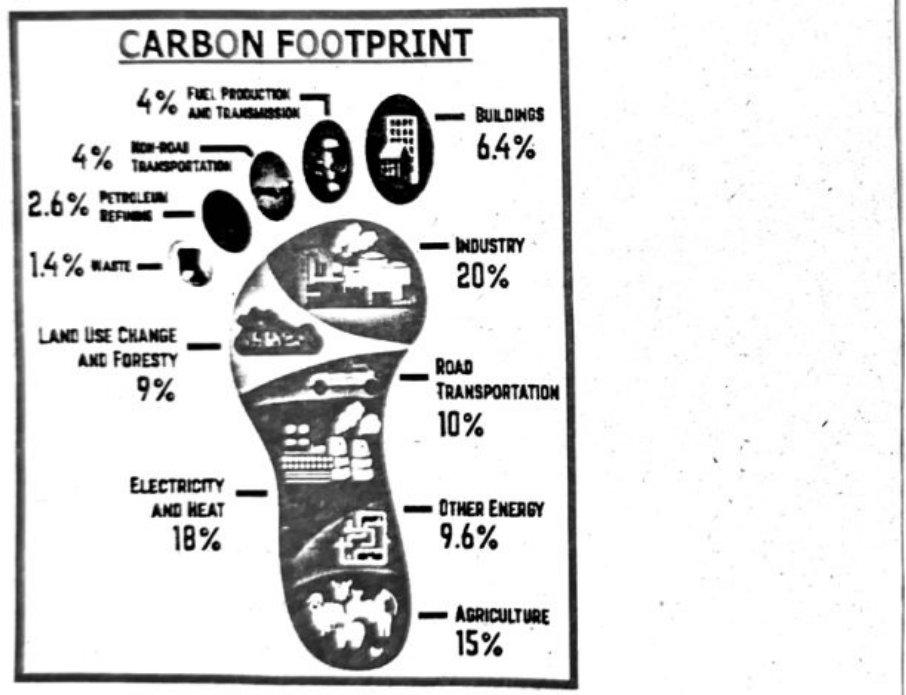
A carbon footprint measures greenhouse gas emissions from activities like fossil fuel burning, deforestation, and industrial processes. It can be reduced by unplugging devices, using energy-efficient technologies, and adopting renewable energy sources.
Ecological Footprint:
The ecological footprint measures the resources needed to support a lifestyle, including land, water, and waste absorption. A larger footprint means higher environmental impact, so reducing it helps protect the planet.
Activity:
We can estimate carbon footprints using simple calculations. For example, a car emits approximately 0.2 kg of $CO_2$ per kilometre travelled. If a student travels 5 km to school every day by car, he can calculate his daily carbon emissions from transportation as:
Daily $CO_2$ emission = $5\ \mathrm{km} \times 0.2\ \mathrm{kg}\ CO_2/\mathrm{km} = 1\ \mathrm{kg}\ CO_2/\mathrm{day}$
Then, calculate for a week (assuming 5 days per week of school):
Weekly $CO_2$ emission = $1\ \mathrm{kg/day} \times 5\ \mathrm{days} = 5\ \mathrm{kg}\ CO_2/\mathrm{week}$
Q. Class Activity:
All students of the class are asked to calculate the carbon footprint of their own daily transportation and compare results with classmate. Discuss actions to lower your carbon footprint?
Ans: Transportation:
Reduce car use:
Walk, bike, or use public transportation for shorter trips.
Drive efficiently:
Maintain tires, drive at a moderate speed, and avoid idling.
Consider electric or hybrid vehicles:
Switching to electric or hybrid vehicles reduces tailpipe emissions.
Support carbon offsetting projects:
Donate to organizations that invest in projects that reduce greenhouse gas emissions, such as reforestation or renewable energy.
Consider individual carbon footprint calculators:
Use online tools to calculate your carbon footprint and identify areas where you can make a difference.
FLOW OF HEAT IN GEOTHERMAL ACTIVITIES:
The structure of the earth is divided into three parts; core, mantle, and crust as shown in figure. The core is the central part of the earth. It is the hottest part. Its temperature is about 6000°C. It is mainly composed of iron and nickel. The core is so hot due to different factors, involving left-over heat during the formation of the earth, radioactive decay of elements like uranium and thorium inside the core, and extra pressure applied by the earth’s gravity. The inner core is the portion of the core that is solid. The core’s solid form is maintained by the extreme pressure. The molten portion of the core is referred to as “the outer core”. It is molten because the core’s pressure has dropped.
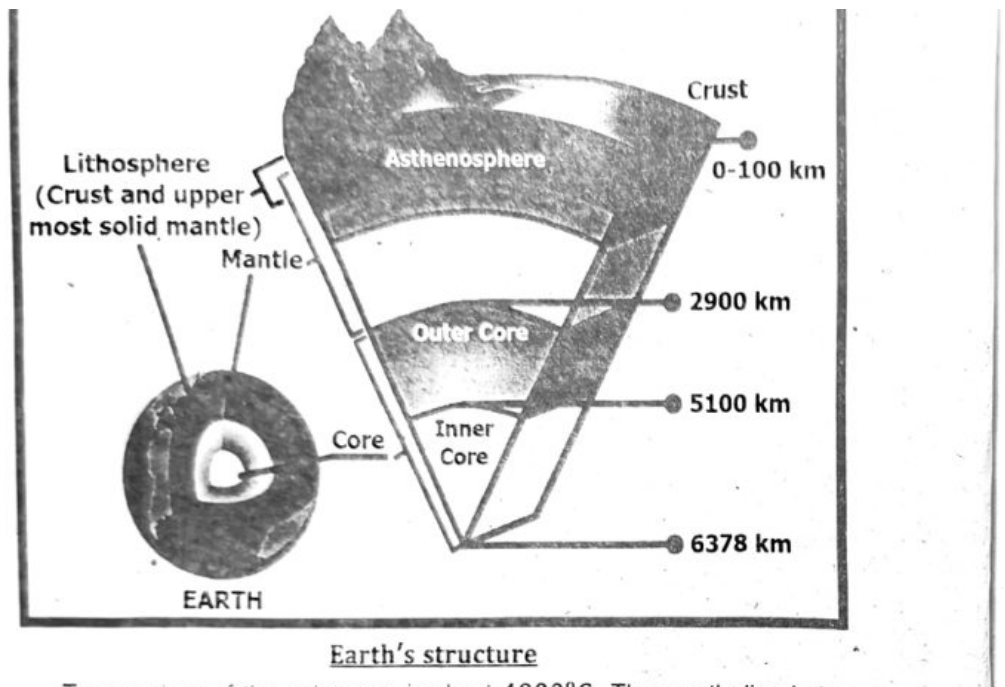
Temperature of the outer core is about 4000°C. The mantle lies between core and crust. It is the thickest part. It floats on the outer core. It is composed of the silicate minerals mainly containing iron and magnesium. It is solid but shows plasticity (permanent change in shape of solid material) under high pressure due to gravity. The crust is the outer part of the earth's structure. It is composed of silicate materials. It is divided into continental crust and oceanic crust. The lithosphere is the layer between the crust and the upper mantle. The asthenosphere lies just beneath the lithosphere and plays a critical role in plate tectonics. Magma is molten or partially molten rock located beneath the Earth's crust. It forms from the partial melting of the mantle and crust due to various geological processes.
FLOW OF MAGMA BENEATH THE EARTH:
There is extremely high temperature around 2,000°C to 6,000°C between core to crest. This intense heat within the mantle can cause some solid rock to partially melt, forming magma. This molten material i.e. magma is less dense than the surrounding solid rock. Heat is transferred from core to mantle through conduction as there is temperature difference between core and mantle. In the mantle, magma gets heat, becomes less dense and rises up i.e. it transfers heat through convection. Hot magma rises up and cold magma sinks. This process develops convectional current as shown in figure. In this way, magma flows from bottom of mantle towards crust. Hotter magma flows easily than colder one. When magma flows, it melts the rocks on the way which may change its composition. When magma cools down, it solidifies and forms rocks deep underground. If magma finds a path to the surface through vents or fissures, it erupts as lava, shaping volcanic landscapes.
VOLCANIC ERUPTIONS:
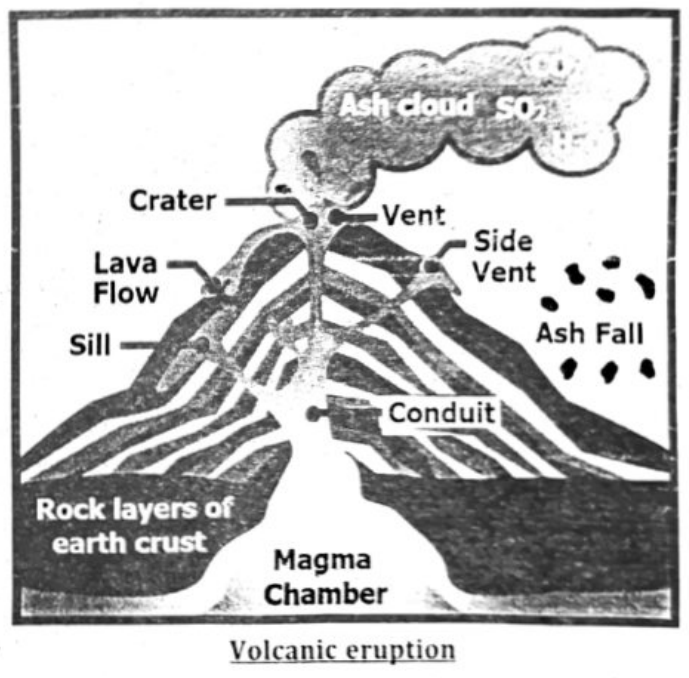
Magma rises from the mantle due to convectional currents and pressure difference in mantle and crust. It is stored in the crust at the place, called magma chamber.
As magma rises, its pressure decrease. This allows the dissolved gases such water vapor, carbon dioxide, and other volatiles to release and it increases the internal pressure of the magma chamber. When this pressure exceeds the strength of the covering rock, magma fractures it and creates pathways (main and secondary vents) for itself to reach the crust. This leads to a forceful volcanic eruption through crater (main opening), driven by high-pressure gases and magma as shown in figure. The hot magma that flows out during an eruption is called lava. Volcanic eruption depends upon factors like magma composition, temperature, amount of gas and interaction with water etc.
MOVEMENT OF TECTONIC PLATES:
Tectonic plates are very large, rigid parts of the Earth's crust and upper most mantle. These plates float on the molten mantle (semi-fluid asthenosphere). These tectonic plates interact with other tectonic plates and generate geothermal activities like earthquakes, volcanic eruptions etc.
Movement of Tectonic plate is basically due to the process of magma convection current in mantle. Convectional currents of magma drag the plates along with it and cause horizontal movement in tectonic plates. Similarly, sinking of dense and cold magma due to convection applies a pull on the tectonic plates and helps them to move. Movement of tectonic plates is very slowly, few centimeters per year. Due to their movement, tectonic plates can move apart (diverge or spreading). come together (converge), or slide past each other (transform faulting).
There are seven major tectonic plates:
- Pacific Plate
- North American Plate
- South American Plate
- Eurasian Plate
- African Plate
- Indo-Australian Plate (It is considered as two separate tectonic plates i.e. Indian plate and Australian plate)
- Antarctic Plate.
Apart from these there are eight minor plates (Arabian plate, Caribbean plate, Indian plate etc.) and many micro plates (Rivera Plate, Somali Plate etc.) as well.
EARTH’S CORE MAINTAINING ITS TEMPERATURE:
The Earth’s core maintains its high temperature through a combination of primordial heat, frictional heating from sinking material, and radioactive decay. Primordial heat is heat left over from the planet’s formation. Friction generated by denser core material sinking to the center also contributes to heat generation. Additionally, the decay of radioactive elements within the Earth’s interior continuously adds heat.
Here’s a more detailed breakdown:
Primordial Heat:
When Earth formed billions of years ago, the collisions and accretion of material generated a significant amount of heat, much of which remains trapped within the core.
Frictional Heating:
As denser material, like iron, sinks towards the center of the planet, friction is generated, converting kinetic energy into heat.
Radioactive Decay:
Radioactive elements, like uranium, thorium, and potassium, are present in the Earth’s interior and decay, releasing energy in the form of heat. This process is a continuous source of heat, slowing down the core’s overall cooling process.
Examples:
GIVEN:
- Mass ‘m’ = 200 g = 0.2 kg
- Change in temperature ‘ΔT’ = 75°C − 25°C = 50°C = 50 K (Change in temperature in Celsius and kelvin scales is same)
- Heat energy ‘Q’ = 3,500 J
REQUIRED:
Specific heat of metal ‘c’ = ?
SOLUTION:
Specific heat capacity is given by: $c = \frac{Q}{m\Delta T}$
Putting values: $c = \frac{3{,}500\ \mathrm{J}}{(0.2\ \mathrm{kg})(50\ \mathrm{K})}$
Therefore, $c = \frac{3{,}500\ \mathrm{J}}{(0.2\ \mathrm{kg})(50\ \mathrm{K})}$ [ANSWER]
Therefore, the specific heat of the metal is $350\ \mathrm{J\ kg^{-1}\ K^{-1}}$.
GIVEN:
- Mass ‘m’ = 0.5 kg
- Specific heat ‘c’ = 900 J kg⁻¹ K⁻¹
- Initial temperature ‘Tinitial’ = 25°C
- Final temperature ‘Tfinal’ = 100°C
- Change in temperature ‘ΔT’ = 100°C − 25°C = 75°C = 75 K
REQUIRED:
Heat absorbed ‘Q’ = ?
SOLUTION:
Specific heat capacity is given by: $c=\frac{Q}{m\Delta T}$ or $Q=mc\Delta T$.
Putting values: $Q=(0.5\ \mathrm{kg})\times(900\ \mathrm{J\ kg^{-1}\ K^{-1}})\times(75\ \mathrm{K})$
Therefore: $Q=33{,}750\ \mathrm{J}=33.75\ \mathrm{kJ}$ [ANSWER]
The amount of heat required by the sample of aluminum is 33.75 kJ.
GIVEN:
- Mass of solid cylinder, $m_s=150\ \mathrm{g}$
- Mass of water in calorimeter, $m_w=200\ \mathrm{g}$
- Mass of calorimeter, $m_c=50\ \mathrm{g}$
- Initial temperature, $T_1=25^\circ\mathrm{C}$
- Temperature of solid cylinder, $T_2=100^\circ\mathrm{C}$
- Final temperature, $T_3=30^\circ\mathrm{C}$
- Specific heat of water, $c_w=4.18\ \mathrm{J/g^\circ C}$
- Specific heat of calorimeter, $c_c=0.9\ \mathrm{J/g^\circ C}$
REQUIRED:
Specific heat capacity, $c_s=?$ (in J/g°C)
SOLUTION:
From the principle of calorimetry, we have:
$$c_s=\frac{(m_wc_w+m_cc_c)(T_3-T_1)}{m_s(T_2-T_3)}$$
Putting values:
$$c_s=\frac{[(200\ \mathrm{g})(4.18\ \mathrm{J/g^\circ C})+(50\ \mathrm{g})(0.9\ \mathrm{J/g^\circ C})]\times(30^\circ\mathrm{C}-25^\circ\mathrm{C})}{(150\ \mathrm{g})\times(100^\circ\mathrm{C}-30^\circ\mathrm{C})}$$
Therefore, $c_s=0.42\ \mathrm{J/g^\circ C}$ [ANSWER]
The specific heat capacity of the solid is 0.42 J/g°C.
Summary
- Heat Capacity is the amount of heat required to raise the temperature of any amount of substance by 1°C or 1 K.
- Specific Heat Capacity is the amount of heat required to raise the temperature of one gram of a substance by 1°C or 1 K.
- Conduction is the mode of transfer of heat due to direct contact of medium particles, which do not change their positions. It occurs in solids because of difference in temperatures.
- Convection is the mode of transfer of heat due to the motion of particles. It occurs in liquids and gases because of the density difference between different regions.
- Radiation is the mode of transfer of heat due to electromagnetic waves. It does not require material medium for its motion.
- Land Breeze is the breeze that blows from the land. It normally occurs during the night and early morning.
- Sea Breeze is the breeze that blows from the massive water bodies. It normally occurs during the summer and spring season.
- Greenhouse Effect is the process through which heat is trapped near Earth's surface by substances known as greenhouse gases.
- Global Warming is the long-term heating of Earth's surface observed since the pre-industrial period (between 1850 and 1900) due to human activities, primarily fossil fuel burning.
- Cyclones are large revolving tropical storms caused by winds blowing around a central area of low atmospheric pressure.
- Hurricane is a tropical system with winds that have reached a constant speed of 74 miles per hour or more.
- Heat Wave is a period of abnormally hot weather generally lasting more than two days and can occur with or without high humidity.
- Flooding is an overflow of water onto normally dry land.
- Drought is a prolonged dry period (deficiency of precipitation) in the natural climate cycle that can occur anywhere in the world.
- Accretion is a process in which particles of matter, such as dust and gas, gradually come together due to gravitational attraction to form large objects, like planets, moons etc.
- Debris refer to the fragments rock, dust, and other material that were scattered into space as a result of collision between Theia an Earth.
- Geothermal Activity is a group of natural heat transfer processes, caused by the presence of excess heat in the subsurface of the affected area, occurring on Earth's surface.