
Ans:
Positive test charge = $q = 30\ \mu\mathrm{C} = 30 \times 10^{-6}\ \mathrm{C}$
Force = $F_e = 0.600\ \mathrm{N}$
Magnitude of the electric field = $E = ?$
$$F_e = qE$$
We can rearrange this equation to solve for the electric field $E$.
$$E = \frac{F_e}{q}$$
Now, we can plug in the given values:
$$E = \frac{0.600\ \mathrm{N}}{30 \times 10^{-6}\ \mathrm{C}} = \frac{0.600}{30 \times 10^{-6}}\ \mathrm{N/C}$$
$$E = 0.02 \times 10^6\ \mathrm{N/C} = 2.00 \times 10^4\ \mathrm{N/C}$$
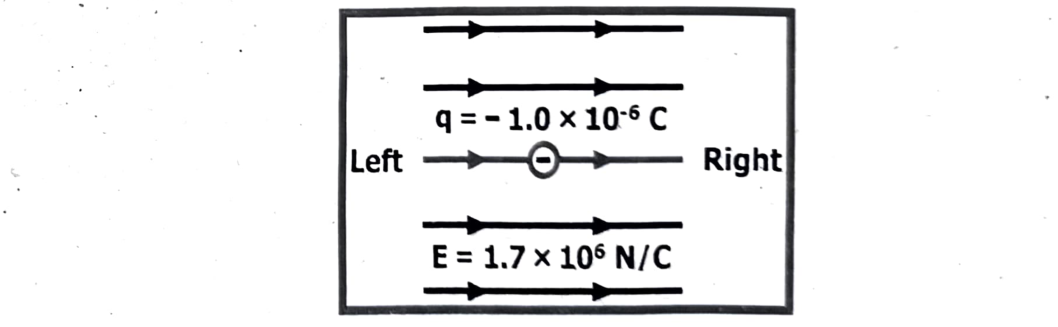
Ans: Given:
- Electric force = $\vec F = q_1 = -1.0 \times 10^{-6}\ \mathrm{C}$
- Electric field = $\vec E = E_1 = 1.7 \times 10^6\ \mathrm{N/C}$ (to the right)
- Charge = $q = ?$
So, the force on the first charge is:
$$\vec F = q\vec E$$
$$\vec F_1 = (-1.0 \times 10^{-6}\ \mathrm{C}) \times (1.7 \times 10^6\ \mathrm{N/C})$$
$$\vec F_1 = -1.7\ \mathrm{N}$$
The negative sign indicates that the force is in the opposite direction to the electric field. Since the electric field is directed to the right, the force on the negative charge is directed to the left.
Now, let’s calculate the force on the positive charge when the electric field is doubled.
Given:
$q_2 = +1.0 \times 10^{-6}\ \mathrm{C}$
$E_2 = 2 \times E_1 = 2 \times (1.7 \times 10^6\ \mathrm{N/C}) = 3.4 \times 10^6\ \mathrm{N/C}$ (to the right)
So, the force on the second charge is:
$$\vec F_2 = (1.0 \times 10^{-6}\ \mathrm{C}) \times (3.4 \times 10^6\ \mathrm{N/C})$$
$$\vec F_2 = 3.4\ \mathrm{N}$$
Since the charge is positive, the force is in the same direction as the electric field, which is to the right.
Therefore, the answers are: $F_1 = 1.7\ \mathrm{N}$ [left] ; $F_2 = 3.4\ \mathrm{N}$ [right]
Ans: Given:
- Force on the charge (in Newtons, N) = $\vec F = 0.5\ \mathrm{N}$
- Electric field strength (in N/C) = $\vec E = 2.0\ \mathrm{N/C}$
- Magnitude of the charge (in Coulombs, C) = $q = ?$
We need to find $q$. Rearranging the formula to solve for $q$.
$$\vec F = q\vec E \qquad\Rightarrow\qquad q = \frac{F}{E}$$
Plugging in the values:
$$q = \frac{0.5\ \mathrm{N}}{2.0\ \mathrm{N/C}} \qquad\Rightarrow\qquad q = 0.25\ \mathrm{C}$$
So, the magnitude of the positive test charge is 0.25 C.
Ans: Given:
- Force on the charge (in Newtons, N) = $\vec F = ?$
- Electric field strength (in N/C) = $\vec E = 1.5\ \mathrm{N/C}$
- Magnitude of the charge (in Coulombs, C) = $q = 3.0\ \mu\mathrm{C} = 3.0 \times 10^{-6}\ \mathrm{C}$
We need to find $F$. Plugging in the values:
$$\vec F = q\vec E \qquad\Rightarrow\qquad F = (3.0 \times 10^{-6}\ \mathrm{C}) \times (1.5\ \mathrm{N/C})$$
$$F = 4.5 \times 10^{-6}\ \mathrm{N} \qquad\Rightarrow\qquad F = 4.5\ \mu\mathrm{N}$$
Ans: Where:
- $F$ is the force on the charge (in Newtons, N)
- $q$ is the magnitude of the charge (in Coulombs, C)
- $E$ is the electric field strength (in N/C)
Given:
- Force on the charge (in Newtons, N) = $\vec F = 0.01\ \mathrm{N}$
- Magnitude of the charge (in Coulombs, C) = $q = 1.6 \times 10^{-19}\ \mathrm{C}$
- Electric field strength (in N/C) = $\vec E = ?$
We need to find $E$. Rearranging the formula to solve for $E$:
$$\vec F = q\vec E \qquad\Rightarrow\qquad E = \frac{F}{q}$$
Plugging in the values:
$$E = \frac{0.01\ \mathrm{N}}{1.6 \times 10^{-19}\ \mathrm{C}} \qquad\Rightarrow\qquad E = \frac{1 \times 10^{-2}}{1.6 \times 10^{-19}}\ \mathrm{N/C}$$
$$E = \frac{1}{1.6} \times 10^{17}\ \mathrm{N/C} \qquad\Rightarrow\qquad E = 0.625 \times 10^{17}\ \mathrm{N/C}$$
$$E = 6.25 \times 10^{16}\ \mathrm{N/C}$$
So, the electric field strength is $6.25 \times 10^{16}\ \mathrm{N/C}$.
Ans: Given:
- Force on the charge (in Newtons, N) = $\vec F = ?$
- Magnitude of the charge (in Coulombs, C) = $q = -1.6 \times 10^{-19}\ \mathrm{C}$
- Electric field strength (in N/C) = $\vec E = 20\ \mathrm{N/C}$
We need to find $F$. Plugging in the values:
$$F = (-1.6 \times 10^{-19}\ \mathrm{C}) \times (20\ \mathrm{N/C})$$
$$F = -32 \times 10^{-19}\ \mathrm{N}$$
$$F = -3.2 \times 10^{-18}\ \mathrm{N}$$
The magnitude of the force is $3.2 \times 10^{-18}\ \mathrm{N}$. The negative sign indicates that the force on the electron is in the opposite direction to the electric field.
$$F = 3.2 \times 10^{-18}\ \mathrm{N}$$