
There are two types of electric charges: positive and negative. These charges are carried by subatomic particles: protons have a positive charge, while electrons carry a negative charge. The interaction between these charges is fundamental to understanding electricity and magnetism, with opposite charges attracting and like charges repelling. Electric charge is a fundamental property of matter and is measured in coulombs (C).
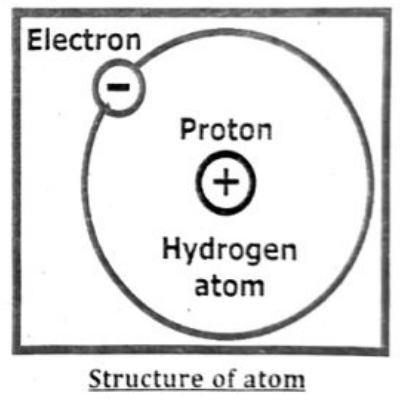
The statement that “unlike charges attract and like charges repel” is a fundamental principle of electrostatics, also known as Coulomb's Law. The fundamental principle of electrostatics is that unlike charges attract, while like charges repel. This means that a positively charged object will be attracted to a negatively charged object, and two positively charged objects, or two negatively charged objects, will repel each other. The force is attractive when the charges have opposite signs and repulsive when the charges have the same sign.
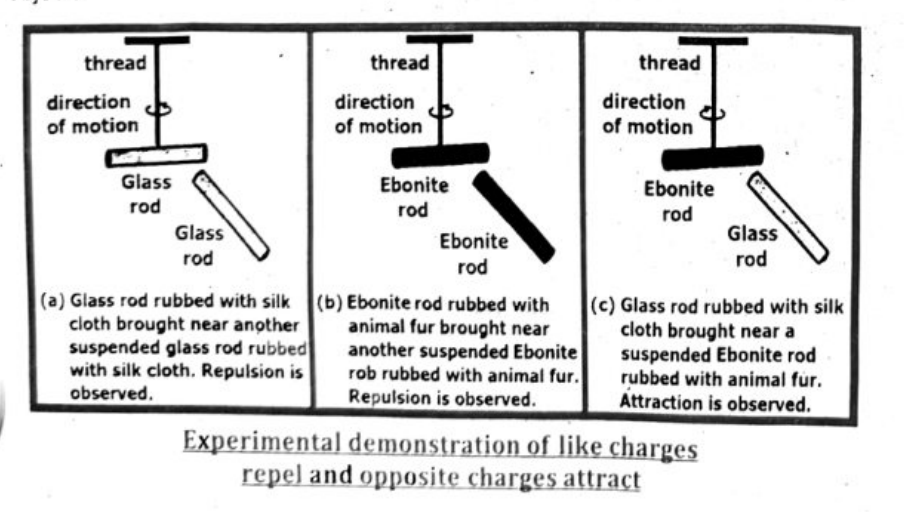
When you rub a glass rod vigorously with a silk cloth and hang it up, then bring another glass rod rubbed with silk close to it, the glass rods will push away from each other. The same goes for ebonite (hard rubber) rods rubbed with fur — when you hang one up and bring another close, they will also repel.
Now, if you hang a glass rod rubbed with silk and bring an ebonite rod rubbed with fur near it, they will be attracted to each other. The same thing happens when you hang an ebonite rod rubbed with fur and bring a glass rod rubbed with silk close — they will attract.
This experiment proves that there are two types of charges: like charges repel, while opposite charges attract as shown in the figure. According to Newton's third law of motion, the repulsive and attractive forces are balanced and act on different objects.
Electrostatic charging by friction can be demonstrated through several simple experiments. When two different insulating materials are rubbed together, electrons transfer from one material to the other, creating static electricity. One material becomes positively charged (lost electrons), and the other becomes negatively charged (gained electrons).
Here are some experiments to demonstrate this:
(i) Balloon and Hair:
- Inflate a balloon and rub it vigorously on your hair (or a wool sweater).
- The friction causes electrons to transfer from your hair (or sweater) to the balloon.
- The balloon becomes negatively charged, and your hair (or sweater) becomes positively charged.
- You can then stick the balloon to a wall or other surface, or observe the attraction of small pieces of paper.
(ii) Rod and Cloth:
- Rub a plastic (like a polythene or acetate) rod with a cloth (like wool or duster).
- Electrons transfer from the cloth to the rod.
- The rod becomes negatively charged, and the cloth becomes positively charged.
- You can then test the charge by bringing the rod near a stream of water or small pieces of paper.
- If the material is repelled by the polythene rod, then the materials have the same charge. For example, the polythene rod would be repelled by a second polythene rod, as they have the same charge.
- If the material is attracted to the polythene rod, then they have opposite charges. For example, the polythene rod would be attracted to an acetate rod, as they have opposite charges.
Analysis of results:
- When two insulating materials are rubbed together, negative charge (electrons) will transfer from one insulator to the other.
- A polythene rod gains a negative charge when rubbed with a cloth.
- This is because electrons are transferred to the polythene from the cloth.
- An acetate rod gains a positive charge when rubbed with a cloth.
CHARGING BY FRICTION:
Friction is a basic way for charge transfer between objects. The direction and amount of charge transfer rely on two properties of atoms: ionization energy and electron affinity. Atomic nuclei attract mobile electrons in their outer orbitals. The stronger the attraction, the more energy needed to remove the electrons. Removing electrons ionizes the atom. The energy needed to remove the outermost electron is called ionization energy.
CHARGING BY CONTACT (CONDUCTION):
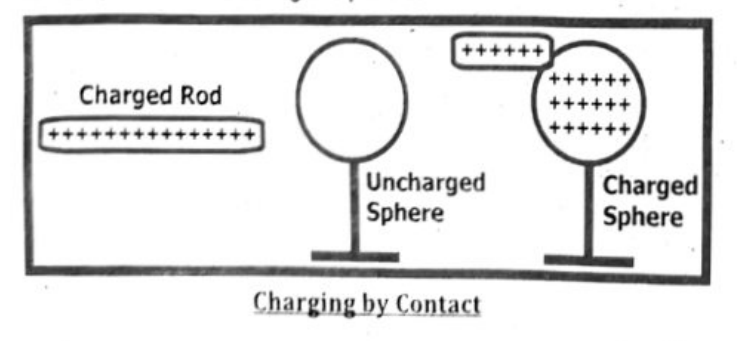
When a charged object comes into contact with a neutral object, the excess or deficit of electrons in the charged object causes the transfer of charge to the previously neutral object. A negatively charged object transfers some of its excess electrons to the neutral object, thereby causing it to become negatively charged. A positively charged rod draws electrons out of a neutral object, leaving it with an overall positive charge.
CHARGING BY FRICTION:
Charging of solids by friction involves the transfer of negative charge, specifically electrons, from one object to another. When two neutral objects are rubbed together, electrons can be transferred from one material to the other due to differences in their electron affinities. The material that loses electrons becomes positively charged, while the material that gains electrons becomes negatively charged. Protons, being tightly bound within the nucleus, do not move during this process.
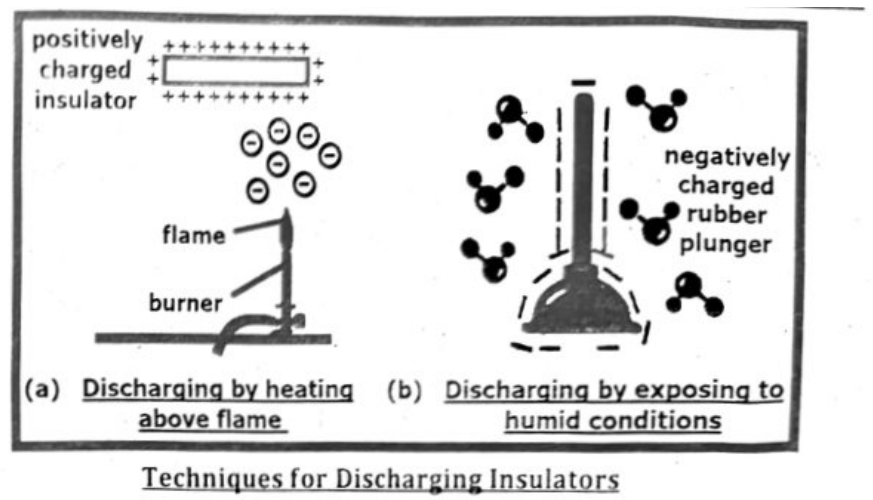
A charged insulator can be discharged by placing it near a flame or in damp conditions because both scenarios introduce a pathway for the excess charge to dissipate. A flame ionizes the air, creating a conductive path for the charge to flow away. Damp conditions provide a conductive layer on the surface of the insulator, allowing charges to move and neutralize.
Explanation:
(a) Putting it above a flame:
- Ionization:
Flames contain hot, ionized gases, meaning they have a mix of positively and negatively charged particles. - Charge Neutralization:
When a charged insulator is brought near a flame, the charged particles in the flame are attracted to the insulator’s opposite charge, neutralizing it. - Conductive Path:
The ionized air around the flame provides a temporary conductive path for the charge to flow away from the insulator. - Heat Transfer:
The heat from the flame can also cause electrons in the insulator to gain energy and escape into the surrounding air, further contributing to discharge.
(b) Exposing it to damp conditions:
- Moisture Absorption:
Insulators can absorb moisture from the air, especially in humid conditions. - Conductive Surface:
Water molecules can create a thin, conductive layer on the surface of the insulator. - Charge Dissipation:
This conductive layer allows charges to move more freely across the surface and neutralize each other, discharging the insulator. - Ageing and Degradation:
In the long term, dampness can degrade the insulating material, increasing its conductivity and making it more susceptible to discharge.
Insulators can be discharged using several methods that introduce a conductive path for charge to dissipate. These methods include earthing, using conductive materials to draw charge away, and even relying on natural processes like attracting oppositely charged ions from the air.
METHODS TO DISCHARGE INSULATORS:
- Earthing (Grounding):
- This is a common method for discharging conductors, but it can also be applied to insulators in certain situations.
- A conductive wire is connected to the charged insulator and grounded, providing a path for the excess charge to flow to the earth, neutralizing the insulator.
- Conductive Materials:
- Bulk Conduction:
If the insulator has some inherent conductivity (even if low), a conductive path can be created through its bulk to allow charge to flow out. - Surface Conduction:
Many insulators have a conductive surface layer due to factors like moisture or contamination. A conductive path can be created along this surface to facilitate charge dissipation.
- Bulk Conduction:
- Attraction of Oppositely Charged Ions:
Insulators can be discharged by attracting oppositely charged ions from the surrounding air. This process is more effective in humid conditions where there is more free moisture and ions in the air. - Heating:
In some cases, heating an insulator can increase its conductivity, allowing charges to move more freely and dissipate. However, this method is not suitable for all insulators and can damage those that are heat-sensitive. - Using a Neutralizing Device:
Specialized devices like static eliminators or ionizers can be used to introduce a high concentration of ions of the opposite polarity to neutralize the charge on the insulator. - Natural Dissipation:
Insulators can naturally discharge over time due to factors like humidity, air currents, and even the presence of small amounts of conductive contaminants on the surface.
Important Considerations:
- Material Properties:
The effectiveness of these methods depends heavily on the type of insulator material and its specific properties. - Safety:
When working with charged insulators, especially high-voltage equipment, it’s crucial to take proper safety precautions to avoid electric shock.
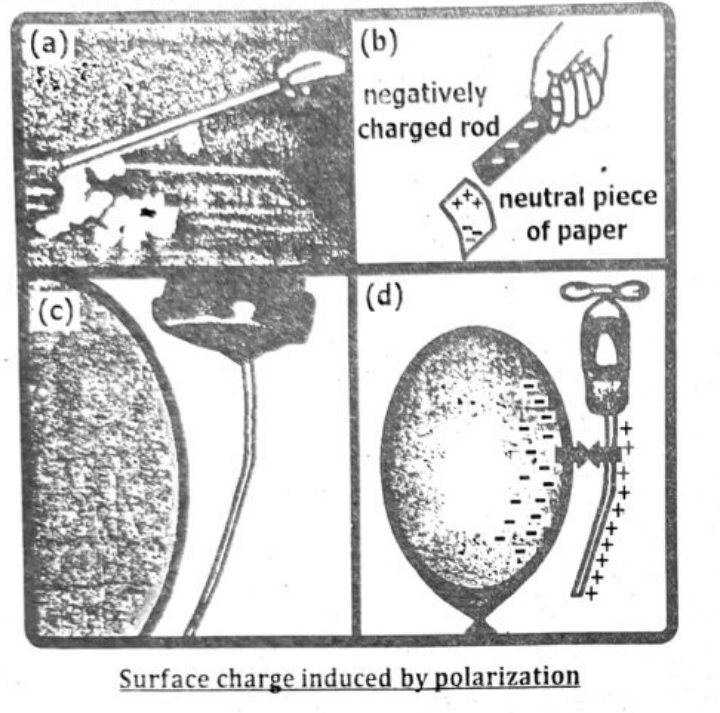
Yes, surface charges can be induced on insulators through polarization. When a charged object is brought near an insulator, the electric field from the charged object causes a redistribution of charge within the insulator’s molecules. This process, called polarization, creates a separation of charge, resulting in a temporary surface charge on the insulator, even though it remains overall neutral.
Explanation:
- Polarization:
In insulators, electrons are tightly bound to individual atoms and cannot move freely like in conductors. However, the electric field from a charged object can distort the electron clouds around these atoms, causing a slight shift in charge distribution. - Induced Surface Charges:
This shift in charge creates a temporary separation of charge within the insulator. The side of the insulator closest to the charged object will develop a slight excess of opposite charge, while the far side will have a slight excess of like charge. - Example:
Imagine bringing a positively charged glass rod near a neutral piece of plastic (an insulator). The electrons in the plastic molecules will be attracted towards the rod, while the positive nuclei will be repelled. This creates a slight negative charge on the side of the plastic closest to the rod and a slight positive charge on the far side. - Attraction:
Although the insulator remains overall neutral, the induced surface charges create an electrostatic attraction between the insulator and the charged object.
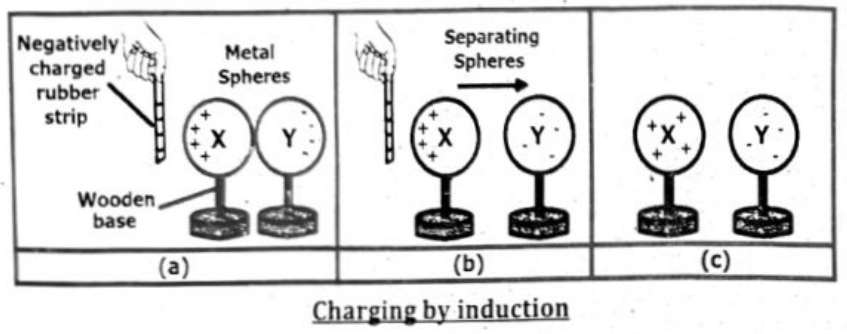
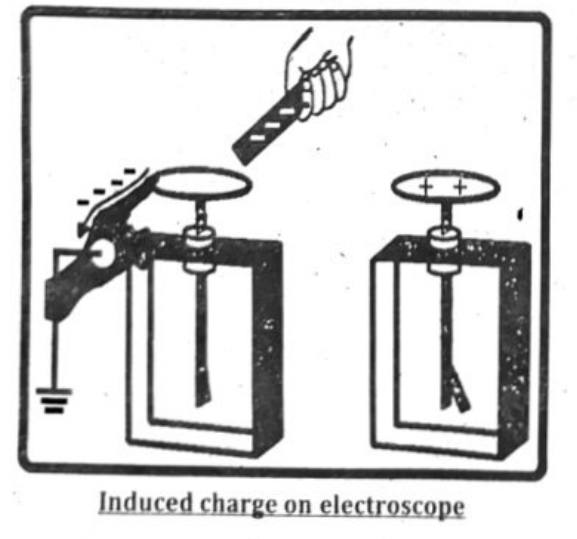
A conductor can be charged by induction by bringing a charged object near it, causing a separation of charges within the conductor. Then, “earthing” the conductor allows the induced charges to flow to the ground, leaving the conductor with a net charge of the opposite sign to the charged object. A conductor can be charged by induction by bringing a charged object near it, causing a redistribution of charges within the conductor without direct contact. This process involves polarization, where opposite charges are attracted and like charges are repelled, and a grounding step to remove or add electrons and permanently charge the conductor.
Following are the steps to Charge a Conductor by Induction and Earthing:
- Induction:
- Bring a charged object close:
When a charged object (e.g., a charged rod) is brought near a conductor (e.g., a metal sphere), the electric field of the charged object interacts with the free electrons within the conductor.
- Bring a charged object close:
- Charge separation:
The free electrons in the conductor are repelled by the like charges of the charged object and move to the opposite end of the conductor, leaving a net positive charge on the end closer to the charged object. - Temporary charge:
This charge separation creates a temporary imbalance of charges within the conductor. The conductor as a whole remains electrically neutral because the total positive and negative charges still balance each other out.
- Earthing:
- Connect to ground:
Earthing involves connecting the conductor to the earth (ground) through a conductive path. - Charge transfer:
If the conductor is grounded, the excess charge on the end farthest from the charged object can flow into the ground (or electrons can flow from the ground into the conductor). - Permanent charge:
When the connection to ground is removed, and the charged object is also moved away, the conductor will retain a permanent charge of the opposite sign to the original charged object. - Example:
Imagine a neutral metal sphere. Bring a negatively charged rod close to the sphere. The positive charges in the sphere are attracted to the negative rod, and the negative electrons are repelled and move to the other side of the sphere. Now, ground the sphere. The excess negative charge on the far side of the sphere will flow into the ground, leaving the sphere with a net positive charge.
- Connect to ground:
Charging, specifically static electricity, can lead to several problems, with lightning being a dramatic example of a large-scale static discharge. Other issues include damage to electronic components, fires and explosions in flammable environments, and the discomfort of static shocks.
- Lightning:
- Lightning is a large-scale discharge of static electricity that occurs when a region of a cloud accumulates a surplus of electrical charge.
- This charge separation is caused by collisions between particles (like ice and hail) within the cloud, leading to a buildup of positive and negative charges.
- When the charge differential becomes large enough, it overcomes the insulating properties of the air, resulting in a discharge of electricity (lightning) either between clouds or between a cloud and the ground.
- Lightning can cause significant damage to structures, ignite fires, and pose a serious threat to life.
- Damage to Electronic Components:
- Static electricity can damage sensitive electronic components in devices like computers and other circuits.
- This damage occurs when a sudden discharge of static electricity (static shock) passes through the component, potentially disrupting its delicate circuitry.
- Fires and Explosions:
- In environments where flammable vapors or dust are present (e.g., in the petroleum industry), static electricity can be a major hazard.
- A static discharge can ignite these flammable materials, leading to fires and explosions.
- This is a concern during the handling and transfer of fuels, chemicals, and other flammable substances.
- Static Shocks:
- You've likely experienced the shock you get when touching a doorknob after walking across a carpeted room or when you touch another person.
- These shocks are caused by the transfer of static electricity when a charged object comes into contact with a grounded object or another object with a different charge.
- While usually harmless, these shocks can be startling and uncomfortable.
- Other Issues:
- Static cling, where clothes stick together after being in a dryer, is another example of static electricity's effects.
- Static electricity can also cause dust and other particles to cling to surfaces, making cleaning and maintenance more difficult.
OR (Second Answer)
| Example | Problem Caused by Charging |
|---|---|
| Lightning | During a thunderstorm, charge separation occurs in clouds (top becomes positively charged, bottom negatively charged). When the charge imbalance becomes large, a discharge occurs as lightning, which can cause fires, injury, or damage to buildings. |
| Static Electricity in Electronics | When people walk on carpets, they can build up static charges. Touching sensitive electronic components (e.g., computer chips) can cause a sudden discharge, damaging the components. |
| Example | Problem Caused by Charging |
|---|---|
| Fuel Tankers or Aircraft | Movement of fuel can generate static electricity due to friction. If not properly grounded, a spark could ignite fuel vapors, leading to explosions. |
| Photocopiers and Printers | Although they rely on static charges to operate, malfunctioning static control can lead to paper jams, smudges, or equipment failure. |
| Industrial Dust Explosions | In factories, charged dust particles (e.g., grain dust, coal dust) can cause sparks that ignite explosions if not controlled properly. |
| Clothing in Dry Weather | Synthetic clothes can build up static charges, causing discomfort through shocks or making clothes cling due to attraction and repulsion of charges. |
CHARGING BY INDUCTION:
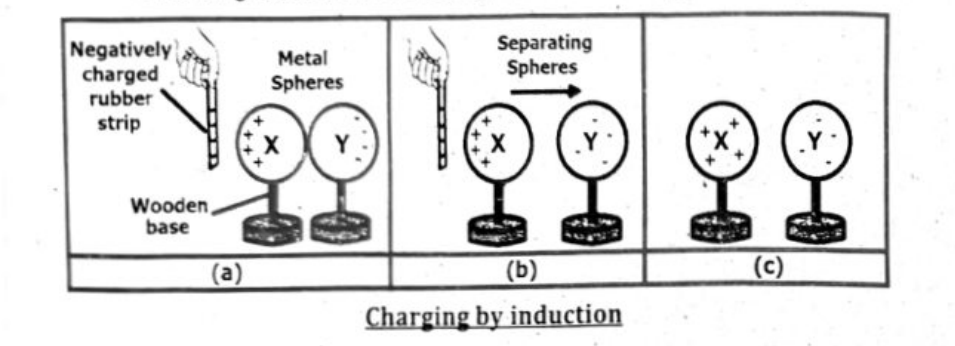
Charging by induction is a method of transferring charge to an object without direct contact. It involves using a charged object to induce a charge separation in a neutral object, and then separating the charges to leave the initially neutral object with a net charge. This process relies on the attraction & repulsion of charged particles, specifically electrons, within the conductor.
Explanation:
- Bring a charged object near a neutral object:
A charged object, such as a negatively charged rod, is brought near a neutral conductor (e.g., a metal sphere) without touching it.
- Charge separation:
The charged object's electric field induces a separation of charges within the conductor. If the charged object is negative, electrons in the conductor will be repelled and move away from the charged object, creating a region of negative charge on the far side and a region of positive charge on the side closest to the charged object.
- Grounding:
If the conductor is then grounded (connected to the earth, which acts as a large reservoir of charge), electrons will flow either into or out of the conductor depending on its initial charge. For example, if the conductor was initially positively charged due to the induced charge separation, grounding would allow electrons to flow from the ground into the conductor, neutralizing the positive charge.
- Separation and Removal:
The ground connection is removed, and then the charged object is taken away. The conductor now retains a net charge opposite to the original charged object.
Key points about charging by induction:
- No direct contact:
The charged object never touches the object being charged. - Opposite charges:
The final charge on the object is always opposite to the charge of the object used to induce the charge. - Grounding is crucial:
Grounding is essential for creating a permanent charge on the object.
When a person touches a Van de Graaff generator, the hairs on their head stand on end due to electrostatic repulsion. The generator transfers a large amount of charge to the person, and since all the hairs acquire the same type of charge (either positive or negative), they repel each other, causing them to stand apart.
Here's a more detailed explanation:
- Charge Transfer:
A Van de Graaff generator builds up a large static charge on its dome. When a person touches the dome, this charge is transferred to their body and, consequently, to their hair. - Like Charges Repel:
Just like magnets with the same poles repel each other, electrical charges of the same type (either positive or negative) repel each other. - Hair as Conductors:
Hair, like most materials, can conduct electricity to some extent, allowing the charge to spread throughout the hairs on the head. - Repulsion Causes Lifting:
Because all the hairs are carrying the same type of charge, they push away from each other and from the scalp, causing them to stand up and spread out. - Importance of Insulation:
If the person were not standing on an insulated platform, the charge would quickly dissipate to the ground, and the hairs would not stand on end.
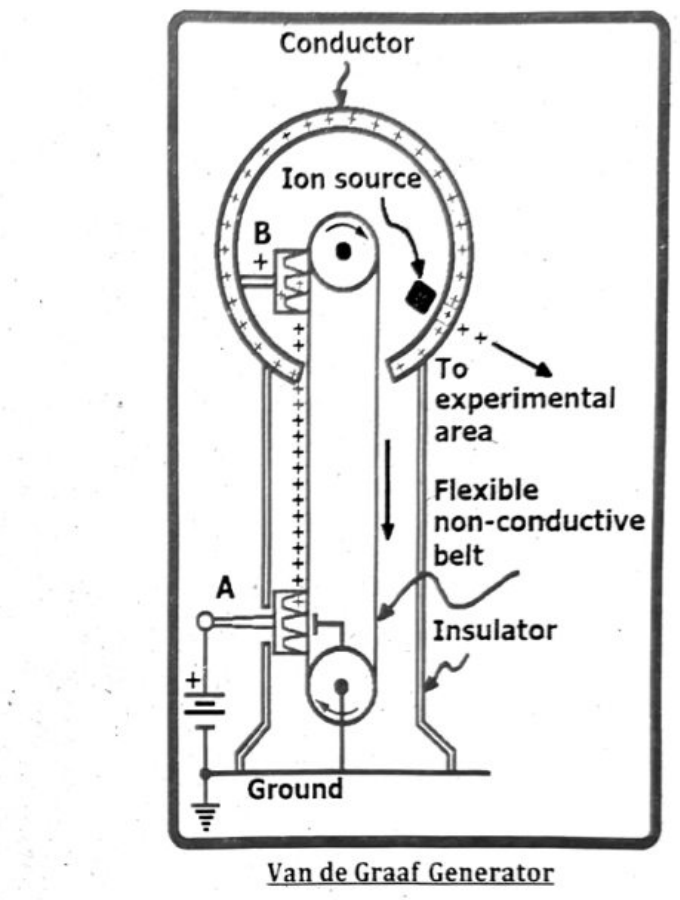
The strands of their hair all have the same net charge and therefore repel each other strongly, making them to lift off.
Charging and discharging of objects is a core principle behind how photocopiers and electrostatic precipitators function. In photocopiers, a charged drum attracts toner particles, which are then transferred to paper to create an image. Electrostatic precipitators use a similar principle, charging particles in the air to remove them from gas streams.
Photocopiers:
- Charging:
The photosensitive drum inside a photocopier is given a positive electrostatic charge. - Image Projection:
Light from the original document is reflected onto the drum. Where light hits, the charge on the drum is dissipated, leaving a pattern of charged and uncharged areas that match the original document. - Toner Application:
Negatively charged toner powder is then applied to the drum. The toner particles are attracted to the positively charged areas, creating a toner image on the drum that mirrors the original document. - Transfer and Fusing:
The toner image is transferred to paper, and heat is applied to fuse the toner to the paper, creating a permanent copy.
Electrostatic Precipitators:
- Charging:
Particles in a gas stream (like smoke or dust) are charged, often through a process called corona discharge where a high-voltage electrode ionizes the air. - Collection:
The charged particles are then attracted to oppositely charged collection plates. These plates are typically grounded, meaning they are connected to the earth and have no charge, or are charged with the opposite polarity of the particles. - Removal:
As particles accumulate on the plates, they are periodically removed (e.g., by rapping the plates or washing them).
In essence, both devices leverage the principle of static electricity. Photocopiers use controlled charging and discharging to create an image, while electrostatic precipitators use it to purify gas streams by removing particulate matter.
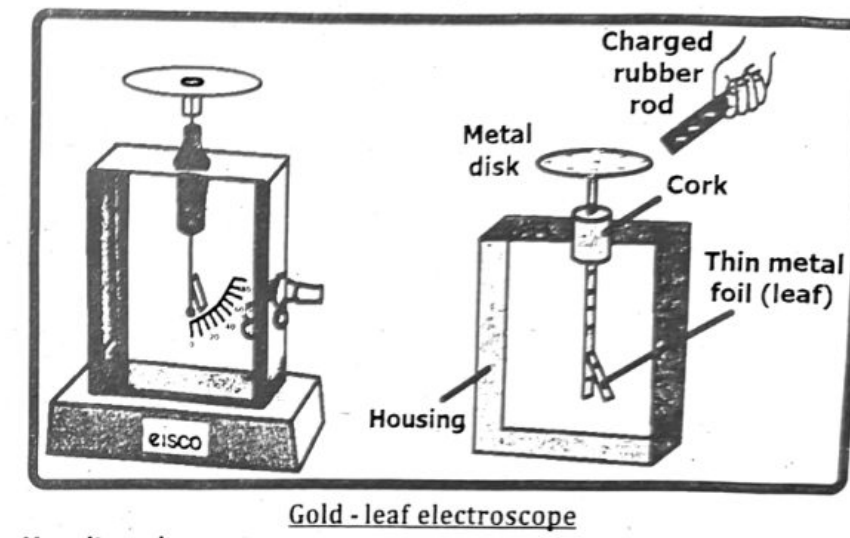
A gold leaf electroscope is a device that detects the presence and magnitude of electric charge. It consists of a metal knob connected to a thin gold leaf suspended inside a glass enclosure. When a charged object approaches the knob, the gold leaf deflects, indicating the presence and type of charge. The amount of deflection is roughly proportional to the charge's magnitude.
Here’s a more detailed explanation:
Construction:
A gold leaf electroscope typically has a metal knob or disc at the top, a thin metal rod, and a very thin gold leaf attached to the rod, all enclosed in a glass container (often with a metal base).
- The glass enclosure protects the gold leaf from air currents and dust, which could interfere with its movement.
- The gold leaf is chosen for its lightness and conductivity, allowing it to respond to small electrostatic forces.
How it works:
- Charging:
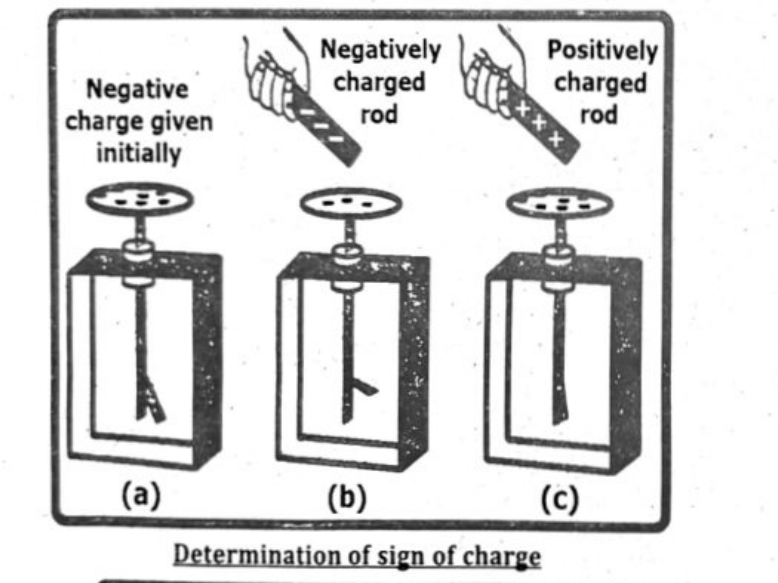
When a charged object (e.g., a charged rod) is brought near the metal knob, it attracts or repels the free electrons within the electroscope. - Charge Redistribution:
If the charged object is positive, it will attract electrons towards the knob, leaving the gold leaf and the rod with a net positive charge. If the charged object is negative, it will repel electrons, leaving the gold leaf and rod with a net negative charge. - Repulsion:
The gold leaf and the metal rod, now carrying like charges (either both positive or both negative), repel each other. This repulsion causes the gold leaf to deflect away from the rod. - Deflection Angle:
The greater the charge on the object, the more electrons are attracted or repelled, resulting in a larger separation and deflection angle of the gold leaf. - Discharging:
If the charged object is removed, the charges redistribute, and the gold leaf will return to its original position.
Applications:
- Detecting Charge:
The electroscope can detect the presence of static electricity on an object. - Determining Charge Type:
By observing whether the gold leaf diverges further (like charges) or converges (opposite charges) when a charged object is brought near, one can determine the charge type of the object. - Measuring Voltage (roughly):
The angle of deflection can give a rough indication of the potential difference (voltage) between the charged object and the electroscope’s ground. - Demonstrating Electrostatic Phenomena:
Gold-leaf electroscopes are often used in educational settings to demonstrate concepts like electrostatic induction, charge conservation, and the properties of conductors and insulators.
Static electricity is more noticeable on dry days because dry air is a poor conductor of electricity, allowing electric charges to build up and stay on surfaces longer. In contrast, humid or rainy days have more moisture in the air, and water molecules help dissipate static charges by allowing them to leak away more easily. The moisture acts as a conductor, reducing the buildup of charge and lowering the chance of noticeable shocks or static cling.
An electric field is a region of space surrounding an electric charge where any other electric charge will experience a force. This force is exerted by the electric field on the charge, and the direction of the force depends on the sign of the charge experiencing the force and the direction of the electric field. The electric field itself is a vector field, meaning it has both magnitude and direction.
- Force and Electric Field:
The electric field is defined as the force per unit charge experienced by a small positive test charge placed at a point in the field. This means if you know the electric field ($E$) at a point and the charge ($q$) placed there, you can calculate the force ($F$) acting on that charge using the equation: $$F=qE$$ - Direction of the Force:
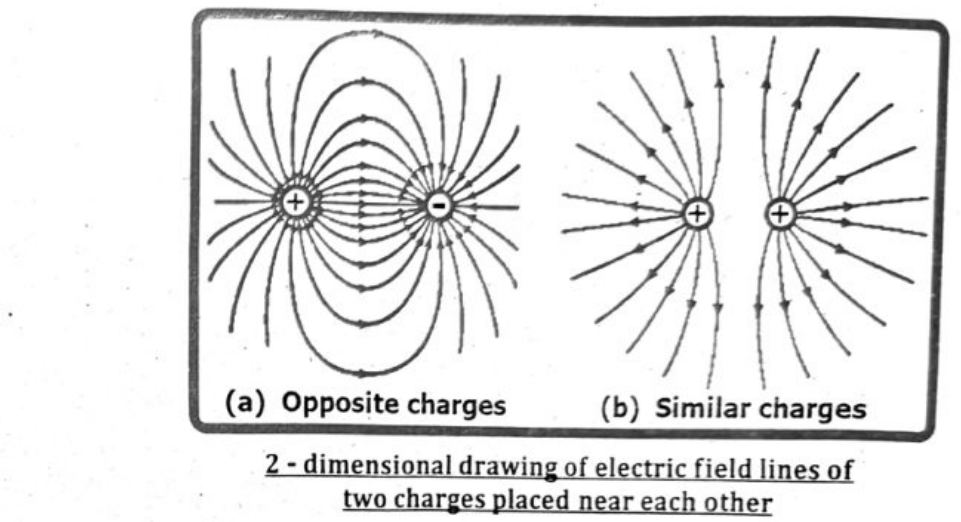
If the charge is positive, the force it experiences will be in the same direction as the electric field. If the charge is negative, the force will be in the opposite direction of the electric field. - Electric Field Lines:
Electric fields are often visualized using electric field lines. These lines represent the direction and strength of the electric field. They point away from positive charges and towards negative charges, and their density indicates the strength of the field (denser lines mean a stronger field). - Source of the Electric Field:
Every electric charge creates an electric field around itself. The electric field extends throughout space and can exert force on other charges that enter its region.
Electric field intensity is a measure of the force exerted on a unit positive charge at a specific point within an electric field. It’s a vector quantity, meaning it has both magnitude (strength) and direction. The intensity is essentially the strength of the electric field at that point.
Explanation:
- Electric Field: An electric field is a region around an electrically charged object where another charged object would experience a force.
- Force and Charge: When a positive charge is placed in an electric field, it experiences a force. The electric field intensity at that point is defined as the force experienced by a unit positive charge.
- Mathematical Representation: Electric field intensity ($E$) is calculated as the force ($F$) divided by the charge ($q$) experiencing the force: $$E=F/q$$
- Units: The standard unit for electric field intensity is Newtons per Coulomb (N/C) or Volts per meter (V/m).
- Direction: The direction of the electric field intensity is the same as the direction of the force on a positive test charge. For example, the electric field intensity due to a positive charge points away from the charge, while the electric field intensity due to a negative charge points towards it.
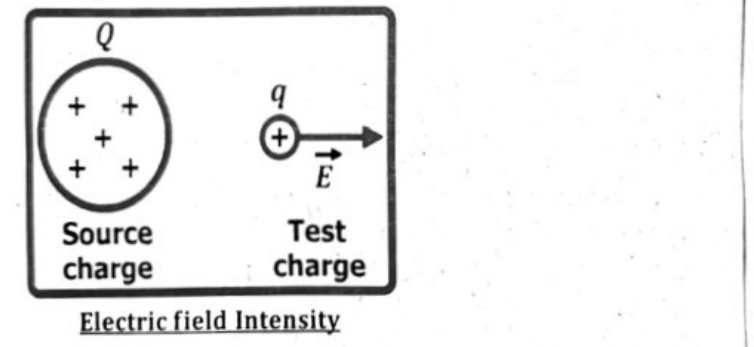
The direction of an electric field line at any given point is defined as the direction of the force that would be exerted on a positive test charge placed at that point. In simpler terms, if you were to put a tiny positive charge in the field, it would move in the direction of the electric field line at that location. The direction of the field is defined to be the direction of the force on a positively charged test particle. Positive charges always move away from other +ve charges and towards −ve charges.
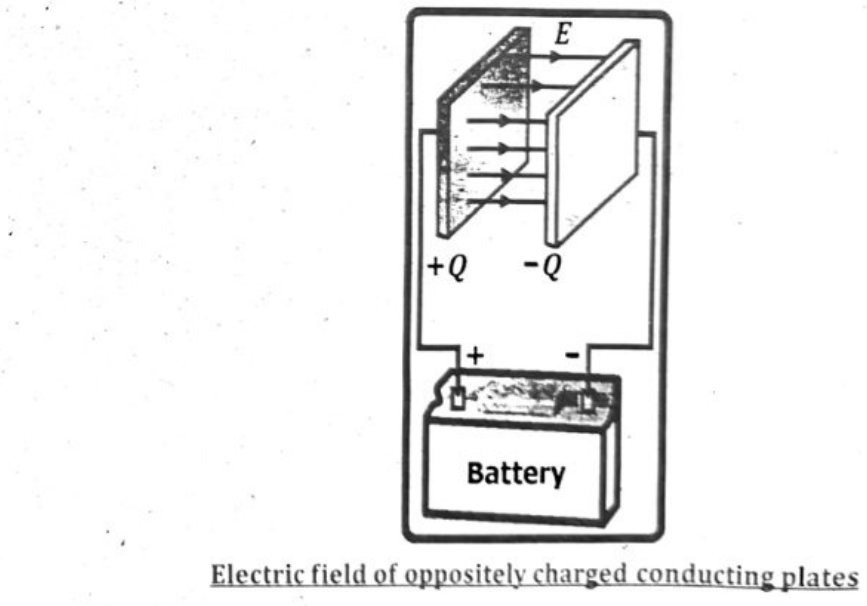
Electric fields, which describe the force exerted on a charged particle, have distinct patterns depending on the charge distribution. A point charge’s field radiates outwards for positive charges and inwards for negative charges. A charged conducting sphere’s field resembles a point charge outside, but is zero inside. Between oppositely charged parallel plates, the field is uniform and directed from positive to negative.
(a) Around a point charge:
- Positive charge: Field lines radiate outwards, away from the charge. The density of lines represents the field strength, being denser closer to the charge and becoming sparser further away.
- Negative charge: Field lines point inwards, towards the charge. Similar to the positive charge, the density of lines indicates the field strength.
- Illustration: Imagine the point charge as the center of a sphere. The field lines are like lines extending from the sphere’s center, either outwards (positive) or inwards (negative).
(b) Around a charged conducting sphere:
- Outside the sphere: The electric field behaves as if all the charge were concentrated at the sphere’s center, similar to a point charge. Field lines radiate outwards for a positive charge and inwards for a negative charge.
- Inside the sphere: The electric field is zero. Since conductors allow charges to move freely, they redistribute until the electric field inside is canceled out.
- Illustration: Imagine a charged sphere. Outside, the field lines are radial, as with a point charge. Inside, there are no field lines.
Outside the sphere, the electric field behaves similarly to that of a point charge, decreasing with distance according to the inverse square law. However, inside the sphere, the electric field is zero because the charges distribute themselves evenly on the surface, creating a balanced field within. In contrast, a point charge generates an electric field that spreads out from a single point and decreases with the inverse square of the distance, without any interior region.
(c) Between two oppositely charged parallel plates:
- Field direction: The field lines are directed from the positive plate to the negative plate.
- Field uniformity: In the central region between the plates, the field is nearly uniform, meaning the field lines are parallel, equally spaced, and point in the same direction.
- Field strength: The field strength is strongest near the center of the plates and weakens slightly near the edges.
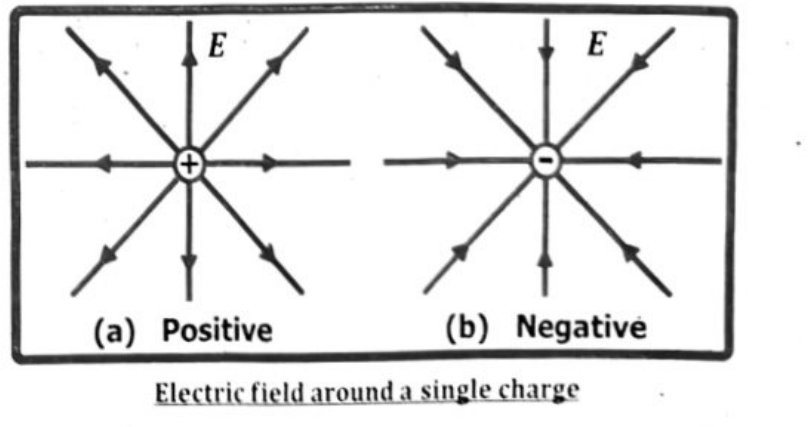
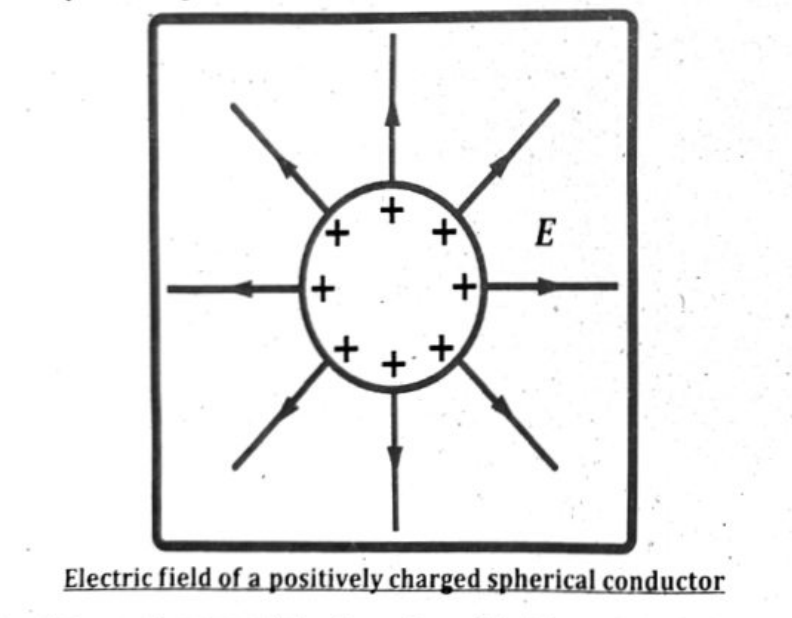
Illustration: Picture two parallel plates, one positively charged and the other negatively charged. The field lines would be straight and parallel between the plates, curving slightly at the edges.
Sharks are sensitive to the small electric field surrounding possible prey, such as fish. Experiments have shown that a shark will attack an artificial electric field and ignore a piece of food.
ELECTROSTATIC PRECIPITATOR AND DUST EXTRACTION:
Electrostatic precipitator and dust extractor works on the principle of electrostatics. Both electrostatic precipitators (ESPs) and dust extractors utilize electrostatic forces to remove particulate matter from gas streams, but they differ in their specific mechanisms and applications. ESPs primarily target fine particles like dust and smoke from industrial exhaust, while dust extractors can encompass a wider range of particulate removal, including from indoor environments.
Electrostatic Precipitators (ESPs):
- Mechanism: ESPs apply a high voltage to create an electric field between discharge electrodes and collecting plates.
- Charging: Dust particles in the gas stream become charged as they pass through the electric field.
- Collection: These charged particles are then attracted to the oppositely charged collecting plates, where they accumulate.
- Removal: The collected dust is periodically removed from the plates, often by rapping or vibration, and then collected in a hopper.
- Application: ESPs are widely used in industries like power plants, cement factories, and steel mills to remove particulate matter from flue gases.
Dust Extractors:
- Mechanism: Dust extractors utilize a variety of methods, including filters, wet scrubbers, and electrostatic forces, to remove dust from the air.
- Electrostatic Dust Extraction: Similar to ESPs, some dust extractors use electrostatic forces to charge and collect dust particles.
- Wider Scope: Dust extractors can be used for a broader range of applications, from industrial settings to indoor environments like homes and offices.
- Filters: Many dust extractors rely on filters to capture dust particles as air passes through them.
- Wet Scrubbers: Some dust extractors use liquid sprays to trap and remove dust particles.
Key Differences:
- Application Focus: ESPs are primarily focused on removing fine particulate matter from industrial emissions, while dust extractors have a broader range of applications.
- Mechanism Variety: ESPs rely solely on electrostatic forces, while dust extractors can utilize a wider range of techniques, including filters and wet scrubbers.
- Efficiency: Both can be very efficient, but ESPs are known for their high efficiency in removing fine particles.
- Ozone Production: Electrostatic precipitators can produce ozone as a byproduct, while other dust extraction methods like filters do not.
In essence, both electrostatic precipitators and dust extractors utilize electrostatic forces to remove particulate matter, but ESPs are a specific type of dust extractor focused on industrial applications and fine particulate removal, while dust extractors encompass a wider range of technologies and applications.
OR (Second Answer)
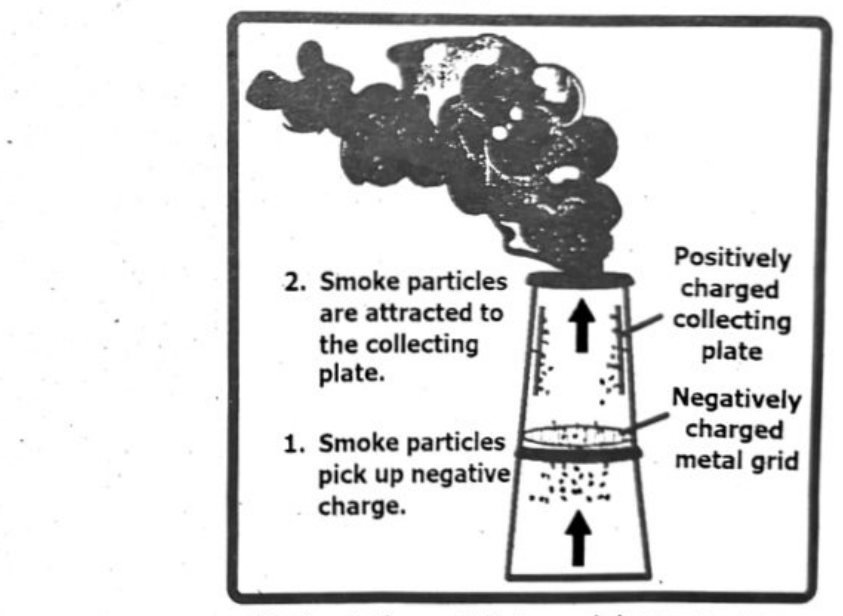
Electrostatic precipitator and dust extractor works on the principle of electrostatics. To reduce air pollution, coal-burning power stations use electrostatic precipitation phenomena to extract dust from the smoke in chimneys before releasing it to the environment, as shown in the figure. Air mixed with dust enters the device across a positively charged mesh. The airborne particles become positively charged when they make contact with the mesh. Then they pass through a second, negatively charged mesh. The electrostatic force of attraction between the positively charged particles in the air and the negatively charged mesh causes the particles to precipitate out on the surface of the mesh.
PHOTOCOPIER MACHINE:
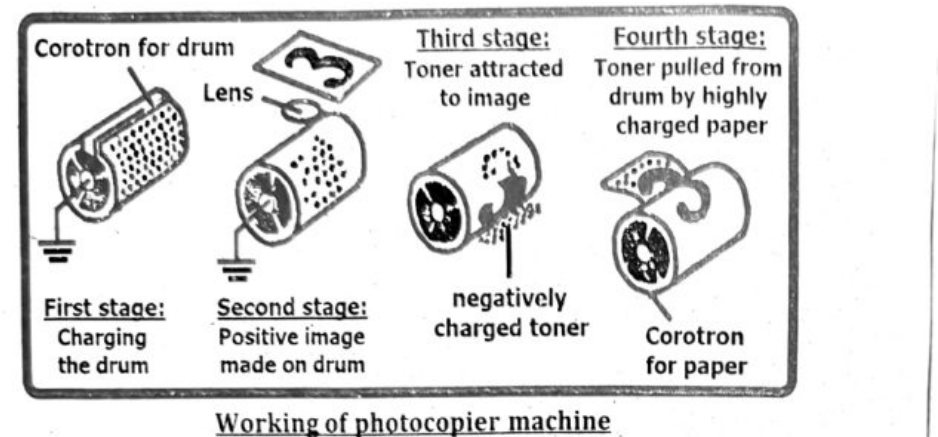
Most photocopy machines use an electrostatic process called xerography, derived from the Greek words “xeros” for dry and “graphos” for writing. The major steps in this process include charging the photo-conducting drum, transferring an image, creating a positive-charge duplicate, attracting toner to the charged parts of the drum, and transferring the toner to the paper as shown in the figure.
The paint is then pushed through the gun, rubbing against the side, and gaining a static electric charge as it moves. Opposite charges attract each other, which helps to distribute the paint particles evenly and get uniform coverage.
Laser printers create high-quality images on paper using the xerographic process. A laser beam scans across a photo-conducting drum, leaving a positively charged image. The drum is then charged and the image is transferred to paper, similar to xerography. Laser printers can produce high-quality images due to the precise control of laser light. They receive output from a computer and can achieve high-quality results.
The process begins with a selenium-coated aluminum drum, which is sprayed with a positive charge from a device called a corotron. Selenium
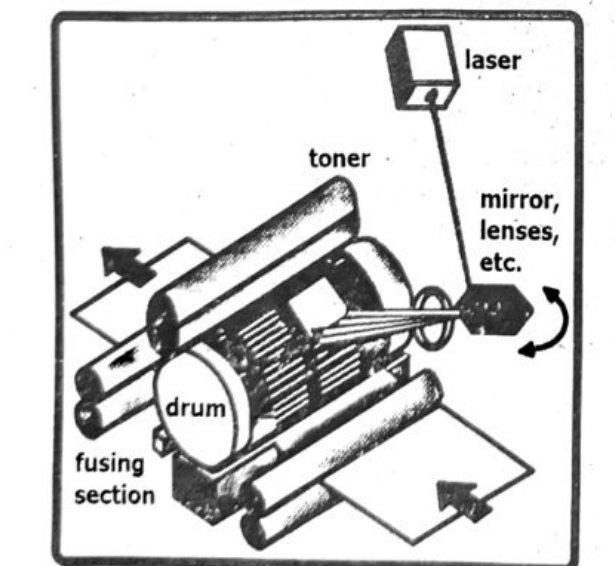
acts as a photoconductor, meaning it behaves as an insulator in the dark and becomes a conductor when exposed to light. This unique property allows the drum to hold a static charge in dark areas while discharging in areas exposed to light, thereby creating a latent image on the drum's surface. Toner particles, which are oppositely charged, are then attracted to the charged areas of the drum. Finally, the toner is transferred to a piece of paper and fused using heat and pressure, producing a clear copy of the original document.
Automobile manufacturers use electro painting to paint new cars. The body of a car is charged and then the paint is given the opposite charge by charging the nozzle of the sprayer. Charging is either by applying a negative electric charge to the paint while it is in the container or applying the charge in the barrel of the spray painter gun.
Electrical conductors, like metals (copper, silver, gold, aluminum), allow electricity to flow through them easily, while insulators, like rubber, plastic, and glass, resist electrical flow.
Examples of Conductors:
- Metals:
Copper, silver, gold, aluminum, iron, steel, brass, and bronze. - Graphite:
A form of carbon that can conduct electricity. - Aqueous solutions of salts:
Electrolytes like salt water can conduct electricity. - The human body:
The human body contains fluids that allow for electrical conduction.
Examples of Insulators:
- Plastics:
Many types of plastic, like those used in wiring insulation, are good insulators. - Rubber:
Rubber is commonly used for electrical insulation, like on wires. - Glass:
Glass is a common insulator used in many applications. - Wood:
Dry wood is a good insulator. - Paper:
Paper, especially when dry, can act as an insulator.
An experiment can be conducted to distinguish between electrical conductors and insulators using a charged insulator and a metal plate. Conductors allow electric charge to flow easily, producing a spark when a conductive object is brought near, while insulators do not allow this flow, showing no spark when a non-conductive object is near. This is due to free electrons in conductors versus tightly bound electrons in insulators.
Explanation:
- Conductors:
Materials that allow electrons to flow freely, enabling the current to pass through them and complete the circuit. - Insulators:
Materials that restrict the flow of electrons, preventing the current from passing through them and completing the circuit.
Example Materials:
- Conductors: Copper, aluminum, silver, iron.
- Insulators: Plastic, rubber, wood, glass.
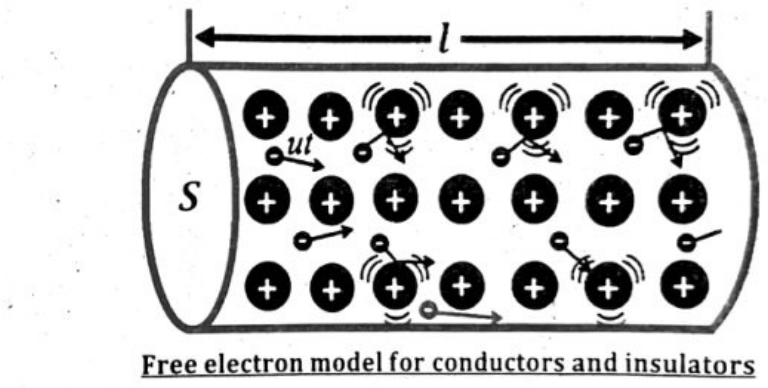
A simple electron model explains that conductors have “free electrons” that can move easily, allowing electricity to flow, while insulators have electrons tightly bound to their atoms, preventing free electron movement and electrical conductivity. In conductors, electrons are loosely bound to atoms and can move freely, allowing electric current to flow easily. In insulators, electrons are tightly bound to atoms and cannot move freely, thus hindering the flow of electric current.
Elaboration:
- Conductors:
Atoms in conductors have electrons in their outer shells that are not tightly held. These “free electrons” can easily move from one atom to another when an electric field is applied, enabling the flow of electric current. Examples of conductors include metals like copper, silver, and aluminum.
Insulators:
In contrast, insulators have electrons that are tightly bound to their atoms and are not free to move. When an electric field is applied, these tightly bound electrons cannot easily transfer energy from atom to atom, preventing the flow of electric current. Examples of insulators include rubber, glass, and plastic.
Key points:
- The key difference lies in the availability of free electrons and their ability to move freely within the material.
- Conductors facilitate the flow of electric current due to their free electrons, while insulators impede the flow due to tightly bound electrons.
- This difference is crucial for various electrical applications, with conductors used in wiring and insulators used in insulation and safety.
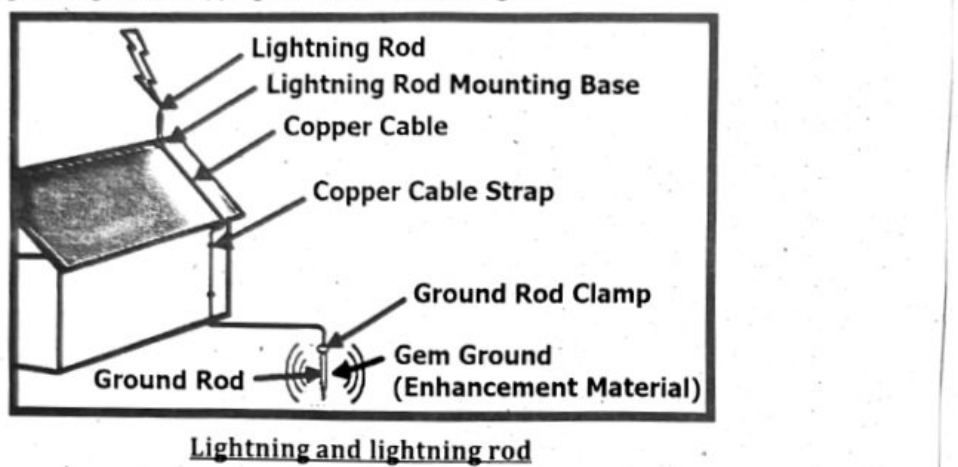
A lightning rod protects humans by providing a low-resistance path for a lightning strike to safely discharge into the ground, preventing the electrical energy from passing through the building or structure, and potentially harming people. This is achieved by intercepting the lightning strike and diverting the electrical current through a conductive path (like a metal rod and wire) to the ground.
Electrical breakdown is the process where an insulating material or gas loses its ability to resist the flow of electric current due to a high electric field, becoming conductive. This occurs when the applied voltage exceeds the material's breakdown strength, causing the material to lose its insulating properties and allow a significant amount of current to flow.
Electrical breakdown in a gas occurs when a strong electric field causes ionization, turning the insulating gas into a conductor. This happens when the electric field is strong enough to strip electrons from gas molecules, creating free electrons and positive ions, forming a plasma and allowing current to flow.
Explanation:
- Initial State:
Gases normally act as insulators, meaning they don't readily conduct electricity. This is because their atoms are neutral, with electrons tightly bound to the nucleus. - Strong Electric Field:
When a high voltage is applied across a gap filled with gas, it creates a strong electric field. - Ionization:
The electric field exerts force on the electrons in the gas atoms. If the field is strong enough, it can overcome the attraction between the electrons and the nucleus, causing electrons to be ejected from the atoms. - Free Electrons and Ions:
This ejection of electrons creates free electrons and positively charged ions (the remaining atoms that have lost electrons). - Conductivity:
These free electrons and ions can now move freely, allowing current to flow through the gas. The gas transitions from an insulator to a conductor. - Breakdown:
This process of ionization and current flow is called electrical breakdown. It can manifest as a spark, arc, or glow discharge, depending on the specific conditions. - Paschen’s Law:
The voltage at which breakdown occurs in a gas is not solely dependent on the gas type but also on the distance between the electrodes and the pressure. Paschen's law provides a formula that predicts the breakdown voltage for different electrode spacings and gas pressures.
Consequences:
Electrical breakdown can be a destructive process, damaging equipment or causing fires. However, it is also a fundamental process in many applications, such as fluorescent lights, gas lasers, and circuit breakers.
VISIBLE EXAMPLES:
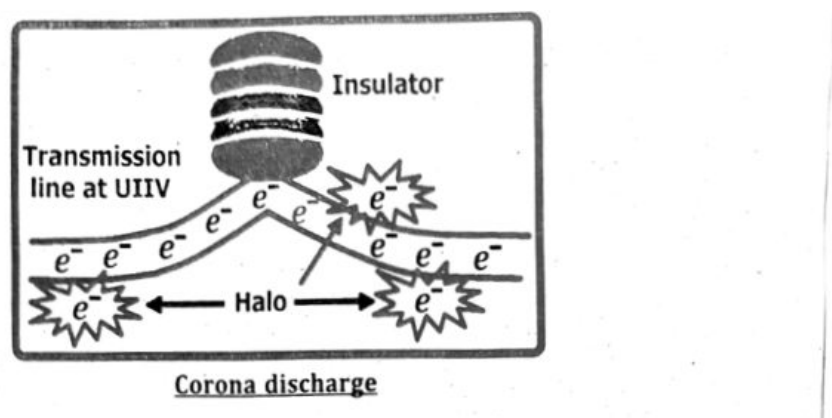
Yes, both corona discharge and Lichtenberg figures are visible manifestations of electrical breakdown. Corona discharge appears as a luminous glow or discharge around conductors carrying high voltage, while Lichtenberg figures are branching, tree-like patterns formed by electrical discharges within or on the surface of insulating materials.
Elaboration:
Corona Discharge:
When the electric field around a high-voltage conductor exceeds the dielectric strength of the surrounding air, the air molecules become ionized, leading to a visible glow. This glow, accompanied by a hissing sound, is known as corona discharge and represents a localized breakdown of the air's insulating properties.
Lichtenberg Figures:
These figures are the result of electrical breakdown within or on the surface of insulating materials, such as acrylic. When a high voltage discharge is applied to the material, it creates a branching, tree-like pattern of fractures and discoloration. It is named after Georg Christoph Lichtenberg, who first observed them in 1777.
OR (Second Answer)
Corona discharge and Lichtenberg show how electrical breakdown happens.
- Corona discharge appears as a faint glow around sharp points or edges of conductors at high voltages. This occurs because air molecules around the conductor become ionized, causing a localized breakdown. You can see this effect around power lines or during thunderstorms.
- Lichtenberg, on the other hand, are intricate branching patterns formed on insulating surfaces such as acrylic or glass when subjected to a high-voltage discharges. It is a representation of the path taken by the electric current as it propagates through the material, leaving behind permanent, tree-like patterns.
Both phenomena clearly demonstrate electrical breakdown in various situations.
Lightning in thunderstorms is generated by the friction and collision of water and ice particles within clouds, causing a separation of electrical charges. Similarly, volcanic lightning occurs when ash particles collide and create friction, leading to a charge separation and electrical discharge.
Thunderstorm Lightning:
Charge Separation:
In thunderstorms, strong updrafts and downdrafts cause water droplets and ice crystals (graupel) to collide and rub against each other within the cloud. This friction knocks electrons off some particles, transferring them to others.
Result:
The lighter, positively charged particles (ice crystals) tend to move upwards, while the heavier, negatively charged particles (graupel) are carried downwards. This creates a separation of charge within the cloud, with a positive charge at the top and a negative charge at the bottom.
Discharge:
When the electrical potential difference between these charged regions becomes large enough, a lightning strike occurs as electrons flow from the negatively charged area to the positively charged area, either within the cloud or to the ground.
Volcanic Lightning:
- Ash and Ice:
During a volcanic eruption, ash particles, ice crystals, and other volcanic material are ejected into the atmosphere. - Friction and Collisions:
These particles collide and rub against each other as they move rapidly within the volcanic plume. - Charge Separation:
This friction causes a separation of electrical charges, with some particles becoming positively charged and others negatively charged. - Discharge:
Similar to thunderstorms, when the charge separation reaches a critical level, a lightning strike occurs within the plume or even down to the ground.
Lightning streamers are a key part of how lightning is generated, specifically cloud-to-ground lightning. They are essentially upward-moving channels of positive charge that develop from the ground (or tall objects on the ground) in response to a downward-moving, negatively charged leader from a thunderstorm cloud. When these oppositely charged channels connect, a powerful electrical current flows, resulting in the visible flash we know as lightning. Yes, the statement is accurate. Lightning streamers, specifically upward streamers, do indeed provide a path for the electric current from the ground (or an object on the ground) to connect with the stepped leader descending from a cloud, allowing for the main lightning strike to occur.
Explanation:
- Stepped Leader:
A lightning strike begins with a stepped leader, a channel of negative charge that moves in steps from the cloud towards the ground. - Upward Streamers:
As the stepped leader approaches the ground, positive charges on the surface, often concentrated on tall objects, begin to move upwards in the form of streamers. - Connection and Return Stroke:
When the stepped leader and an upward streamer meet, they form a conductive channel. This allows for a massive flow of electrons from the cloud to the ground, creating the bright flash we see as the return stroke. - Multiple Strokes:
A single lightning flash can consist of multiple strokes, each using the same conductive channel, though the initial return stroke is usually the brightest.
Yes, that’s correct. In cloud-to-ground lightning, a strong electric field generated by a negatively charged cloud base induces a positive charge on the ground below. This happens because the negative charges in the cloud repel the electrons in the ground, leaving behind an excess of positive ions. This induced positive charge is what the lightning “leader” from the cloud is attracted to, resulting in the visible lightning strike.
Here’s a more detailed explanation:
- Charge Separation in Clouds:
Thunderclouds develop a separation of charge, with a negatively charged region at the bottom and a positively charged region at the top. - Electric Field:
This charge separation creates a strong electric field between the cloud and the ground. - Electrostatic Induction:
The negatively charged cloud base repels electrons in the ground, causing them to move away from the area directly below the cloud. - Positive Charge on Ground:
This leaves behind an excess of positive charge on the ground's surface, effectively inducing a positive charge distribution. - Lightning Stroke:
As the negative charge in the cloud builds up, it eventually initiates a “stepped leader”, which is a channel of negative charge moving towards the ground. - Return Stroke:
The stepped leader attracts the positively charged area on the ground, and a bright “return stroke” of positive charge moves upwards from the ground to meet the stepped leader, completing the circuit.
VARIETIES OF ATMOSPHERIC LIGHTNING:
Yes, there are indeed many types of atmospheric lightning beyond the common cloud-to-ground strikes, and many are still actively being researched. These include sprites, jets, elves, trolls, pixies, ghosts, and ball lightning, all of which are categorized as transient luminous events (TLEs). These phenomena occur high above thunderstorms and are not fully understood, with ongoing research aiming to clarify their mechanisms and characteristics.
Here’s a bit more about some of these less common lightning types:
- Sprites: These are large, reddish flashes that appear above thunderstorms, often as a burst of red light with blue tendrils. They occur in the mesosphere, typically at altitudes of 50–90 kilometers (31–56 miles).
- Jets: These are bright, blue upward-moving discharges that originate from thunderstorm clouds and extend into the stratosphere. They are less common than sprites and are typically observed during very powerful thunderstorms.
- Elves: ELVES (Emissions of Light and Very Low Frequency Perturbations) are brief, expanding rings of optical emissions that occur in the ionosphere above thunderstorms. They are triggered by intense lightning strikes.
- Ball Lightning: This is a mysterious and rare phenomenon that appears as a luminous, spherical object that can last for several seconds. Its size can range from a few centimeters to several meters, and it can occur during thunderstorms or even in clear weather.
Lightning isn’t limited to the common cloud-to-ground strike. Most lightning occurs entirely within a cloud (intra cloud discharges), where it cannot be seen. However, visible discharges do take place between clouds (cloud-to-cloud discharges) and between a cloud and the Earth (cloud-to-ground discharges). There are many fascinating, less-understood types of lightning that occur high in the atmosphere, such as:
- Sprites - Short-lived, red flashes above thunderstorms.
- Jets - Narrow, upward bursts of blue light
- Elves - Expanding rings of faint, white light
- And others with even more whimsical names - Trolls, Pixies, Ghosts, Ball Lightning - These are all being actively researched by scientists.
Uncontrolled electrical charging in nature can lead to serious issues, such as lightning. When clouds accumulate positive and negative electricity, the air can no longer insulate, resulting in a lightning strike that can damage property, harm people, and ignite fires:
outside, crouch with your feet together and avoid tall objects and water.
Lightning is destructive because it generates strong currents in poor conductors, creating extreme heat that can endanger buildings. A lightning rod, invented by Benjamin Franklin in the 1750s, helps protect structures. It consists of a pointed metal rod on a building, connected to a buried rod as shown in figure. This system attracts lightning and provides a safe path for the current to the ground, preventing damage and stopping harmful electrical surges.
Examples:
- GIVEN: Force $F = 0.40\,\mathrm{N}$; Test charge $q_0 = +2.2 \times 10^6\,\mathrm{C}$
- REQUIRED: Electric field strength $E = ?$
- SOLUTION:
The electric field intensity is: $E = \frac{F}{q_0}$
Putting values: $E = \frac{0.40\,\mathrm{N}}{2.2 \times 10^6\,\mathrm{C}}$
Therefore, $E = 1.8 \times 10^{-5}\,\mathrm{N/C}$ [ANSWER]
The field strength at this point will be $1.8 \times 10^{-5}\,\mathrm{N/C}$.
Summary
- Electrification is the process by which an object acquires an electric charge. This can happen through various methods like friction, contact, or induction.
- Conservation of charge is a fundamental law stating that the total electric charge in an isolated system remains constant. In simpler terms, charge can't be created or destroyed, only transferred between objects.
- Quantization of charge is the principle that electric charge exists in discrete units called electrons and protons. These fundamental particles have specific charges (negative for electrons, positive for protons), and charge cannot be further subdivided.
- Conductors are materials that allow electric charge to flow freely through them. They have loosely bound electrons that can easily move under the influence of an electric field. Examples include metals like copper and aluminum.
- Insulators are materials that resist the flow of electric charge. They have tightly bound electrons that are difficult to move. Examples include rubber, plastic, and wood.
- Charging by friction involves rubbing two dissimilar materials together transfers electrons from one material to the other.
- Charging by contact is the process when a charged object comes into contact with a neutral object, some electrons transfer between them, causing the neutral object to acquire the same charge type (positive or negative) as the charged object, but to a lesser degree.
- Charging by induction is a method where a charged object influences the distribution of charge in a nearby neutral object without physically touching it. This creates a temporary separation of charges in the neutral object.
- Discharging is the process by which an object loses its electric charge, it can happen through conduction (touching a grounded object), convection (charged particles carried by air), or a spark (sudden movement of charge).
- Induced polarization occurs when a charged object is brought near an insulator, the electric field from the charged object redistributes the charges within the insulator, creating a slight separation of positive and negative charges.
- Electroscope is a simple instrument used to detect the presence and sign (positive or negative) of electric charge. It typically consists of two thin metal leaves that diverge when charged.
- Electric field is a region of space where a charged object experiences a force. The strength and direction of the electric field depend on the amount and type of charge present.
- Electric field lines are imaginary lines that depict the direction and strength of an electric field. They point away from positive charges and towards negative charges, with the density of lines indicating the field's strength.
- Electrostatic precipitator is a device that uses an electric field to remove dust particles and other pollutants from air. Charged particles are attracted to collection plates, removing them from the air stream.
- Corona discharge is a faint glow or ionization of air caused by a strong electric field around a conductor. It can be seen around high-voltage power lines.
- Lichtenberg figures are branching, fern-like patterns left on an insulator's surface when a high-voltage discharge passes through it.
- Lightning Generation is the rapid discharge of electricity that occurs within a cloud or between a cloud and the ground. This is caused by the buildup of electric charge within the cloud due to various atmospheric processes.
- Lightning control rod are a well-established and effective method for protecting structures from lightning strikes.