
Answer
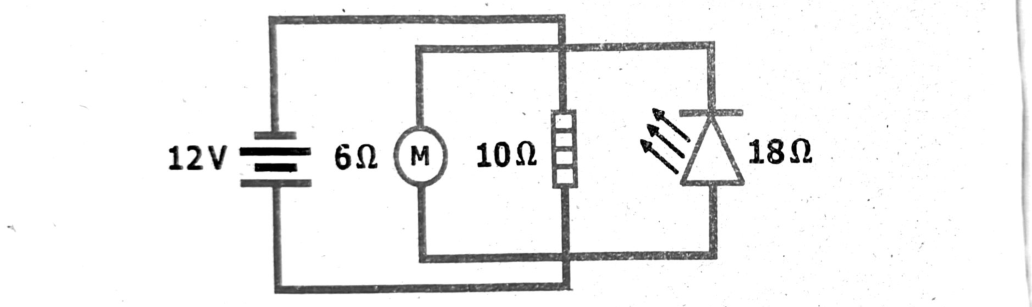
Find the equivalent resistance = Re = ?
For parallel combination:
Given Data:
- R1 = 6 Ω; R2 = 10 Ω; R3 = 18 Ω
Formula:
1/Re = 1/R1 + 1/R2 + 1/R3 ⇒ 1/Re = 1/6 + 1/10 + 1/18
⇒ 1/Re = (15 + 9 + 5)/90 ⇒ 1/Re = 29/90 ⇒ Re = 90/29 = 3.1 Ω
So, the equivalent resistance = 3.1 Ω.
Calculate the current passing through each device
For parallel combination
Given Data:
V = 12 V; R1 = 6 Ω; R2 = 10 Ω; R3 = 18 Ω; Re = ?
By the ohm’s law: V = IR
Current passing through each device:
I1 = V/R1 = 12/6 = 2 A
I2 = V/R2 = 12/10 = 1.2 A
I3 = V/R3 = 12/18 = 0.67 A
Ans. (a) 3.1 Ω, (b) 2 A, 1.2 A, 0.67 A
Answer
The resistors are R1 = 8 Ω, R2 = 12 Ω and R3 = 18 Ω.
The formula for the total resistance Rtotal of resistors in parallel is:
1/Rtotal = 1/R1 + 1/R2 + 1/R3
Plugging in the values:
1/Rtotal = 1/8 + 1/12 + 1/18 ⇒ 1/Rtotal = (9 + 6 + 4)/72 = 19/72
Finally, take the reciprocal to find Rtotal.
Rtotal = 72/19 ≈ 3.789 Ω
Ans. 3.789 Ω
Answer
We are given:
- Resistance = R = 10 Ω
- Voltage = V = 120 V
We want to find the power P consumed by the device.
We can use the formula:
P = V2/R
Plugging in the given values:
P = (120 V)2/10 Ω = 14400 V2/10 Ω = 1440 W
Ans. 1440 W
Answer
We are given:
- Power = P = 60 W
- Time = t = 5 hours
We want to find the energy E consumed by the light bulb.
The formula for energy is:
E = P × t
We can directly use the values in watts and hours to get the energy in watt-hours (Wh):
E = 60 W × 5 hours = 300 Wh
Answer
We are given:
- Number of cells = n = 100
- e.m.f of each cell = ε = 0.2 V
We need to find the resultant e.m.f when the cells are connected in series and in parallel.
(i) Series Connection:
When cells are connected in series, their e.m.fs add up. So, the total e.m.f (εseries) is:
εseries = n × ε = 100 × 0.2 V = 20 V
(ii) Parallel Connection:
When identical cells are connected in parallel, the total e.m.f remains the same as the e.m.f of a single cell, provided that all cells have the same e.m.f. So, the total e.m.f (εparallel) is:
εparallel = ε = 0.2 V
Answer
Given:
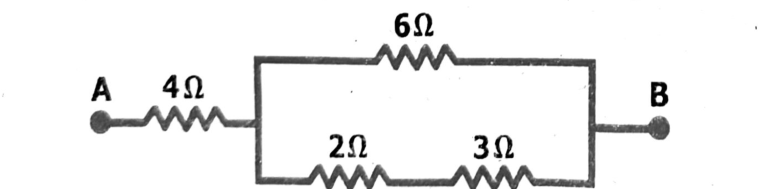
- R1 = 4 Ω (in series with the entire network)
- R2 = 6 Ω (upper branch of the parallel section)
- R3 = 2 Ω, R4 = 3 Ω (connected in series together in the lower branch)
Calculation:
Combining R3 and R4 (Series)
Since R3 and R4 in series.
R34 = R3 + R4 = 3 Ω + 2 Ω = 5 Ω
Combining R2 and R34 (Parallel)
Now, R2 = 6 Ω and R34 = 5 Ω are in parallel.
1/R234 = 1/R2 + 1/R34 = 1/6 + 1/5
1/R234 = (5 + 6)/30 = 11/30, so R234 = 30/11 = 2.73 Ω
Now, adding R1 = 4 Ω in series with R234. Now, the total resistance is:
Rtotal = R1 + R234 = 4 Ω + 2.73 Ω = 6.73 Ω
Therefore, the total resistance is 6.73 Ω.
Answer
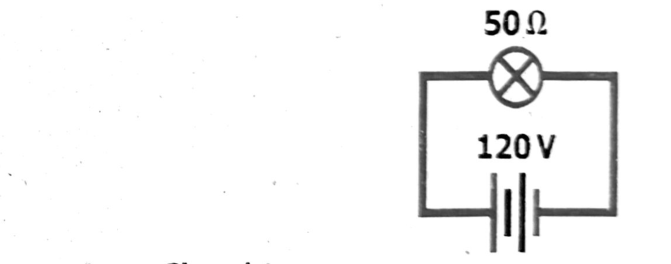
Given data:
Resistance = R = 50 Ω; Voltage = V = 12 V; Time = t = 5 h
Required:
- Power = P = ?
- Current = I = ?
- Energy = E = ?
Calculation:
Power = P = V2/R = (120)2/50 = 14400/50 = 228 W
Current = I = V/R = 120 V/50 Ω = 2.4 A
Energy = E = P × t = 228 W × 5 h = 1440 Wh
Ans. 288 W, 2.4 A, 1440 Wh
So, the results are:
- Power consumed: 288 W
- Current flowing through: 2.4 A
- Electrical energy consumed (in 5 hours): 1440 Wh
(Ans. 10.75 Ω)
Answer
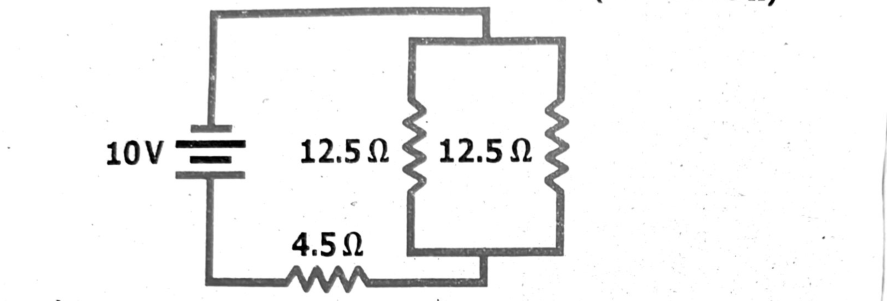
Given data:
Resistance in the circuit:
R1 = 12.5 Ω; R2 = 4.5 Ω; R3 = 12.5 Ω
Required:
Total Resistance = Rtotal = ?
Calculation:
R1 = 12.5 Ω and R3 = 12.5 Ω are in parallel.
R2 = 4.5 Ω is in series with the parallel combination of R1 and R3.
Now for parallel combination,
$$\frac{1}{R_{13}}=\frac{1}{R_1}+\frac{1}{R_3}=\frac{1}{12.5}+\frac{1}{12.5}=0.08+0.08=0.16$$
$$R_{13}=\frac{1}{0.16}=6.25\ \Omega$$
Now, calculating the total resistance Rtotal.
R13 = 6.25 Ω and R2 = 4.5 Ω are in series.
$$R_{\text{total}}=R_{13}+R_2=6.25+4.5=10.75\ \Omega$$
Therefore, the total resistance of the circuit is 10.75 Ω.