
Waves are disturbances that transfer energy through a medium (such as water, air, or solid materials) without the particles of the medium moving permanently. They can be mechanical (e.g., sound waves, water waves) or electromagnetic (e.g., light, radio waves). Waves typically have properties like amplitude, frequency, wavelength, and speed.
Waves transfer energy from one place to another without transferring matter. This is because waves are disturbances that cause particles within a medium to oscillate, but the particles themselves do not move along with the wave. Consider a wave traveling through water; while the wave moves across the surface, the water molecules only bob up and down, not being carried along with the wave.
Explanation:
- Waves as Disturbances:
Waves are essentially disturbances that propagate through a medium or even through space (as in the case of electromagnetic waves). These disturbances cause particles within the medium to oscillate or vibrate.
- Oscillations, Not Movement:
The particles in the medium do not travel with the wave; they oscillate around a fixed point. For example, in a water wave, water molecules bob up and down as the wave passes by, but they don't move along with the wave's direction. Similarly, sound waves cause air molecules to vibrate back and forth, but the air itself is not carried by the sound wave.
- Energy Transfer:
The key point is that the wave’s energy is transferred through the medium by these oscillations, not by moving matter from one place to another. The energy travels along the wave, but the particles in the medium only oscillate around their equilibrium positions.
- Examples:
- Water waves:
A floating object on water will bob up and down as a wave passes underneath, demonstrating that the wave is transferring energy without carrying the object.
- Water waves:
Stadium wave:
In a stadium wave, people move up and down in their seats, but the wave itself travels horizontally around the stadium, demonstrating that the wave is transferring energy without transferring people.
Sound waves:
When you hear someone speak, the sound waves cause your eardrums to vibrate, which then transmits the energy to your brain. The air molecules themselves don't travel from the speaker to your ear; they just vibrate.
Conclusion:
Waves transfer energy by creating disturbances that cause particles in a medium to oscillate. These oscillations transfer the wave's energy without moving the particles themselves along with the wave.
Wave motion describes the transfer of energy through a medium without the actual transport of matter. This is demonstrated by shaking a rope or a spring, or by observing water waves in a ripple tank. When a rope or spring is shaken, the vibrations create a wave that travels along the medium, while the water in a ripple tank shows how energy travels through the water surface without the water moving horizontally.
Vibrations in Ropes and Springs:
Transverse Waves:
Shaking a rope up and down creates a transverse wave. The rope's movement (vibration) is perpendicular to the direction the wave travels.
Longitudinal Waves:
Shaking a spring back and forth along its length creates a longitudinal wave. The spring's movement (vibration) is parallel to the direction the wave travels.
Energy Transfer:
In both cases, the wave carries energy from the source to another point along the rope or spring, but the medium (rope or spring) itself does not move in the direction of the wave.
Water Waves:
Ripple Tank:
A ripple tank is a shallow tank of water where waves can be easily observed.
Demonstration:
A vibrating paddle in the water creates waves. These waves travel across the water's surface, and objects floating on the water bob up and down as the waves pass by. This demonstrates that the water's movement is vertical (up and down), not horizontal (moving away from the paddle).
Energy Transfer:
The waves transport energy, but the water itself stays in place, returning to its original position after the wave passes.
When you drop a stone into a pond, it creates waves on the water's surface that spread outwards, if you place a cork a little distance away from where the stone fell, the cork will start to bob up and down as the waves reach it. This happens because the cork is getting energy from the waves. This activity demonstrates that water waves, like other types of waves, transfer energy from one place to another without actually moving the water itself.
SCIENCE TIDBITS
A human eardrum can oscillate back and forth up to 20,000 times in one second.
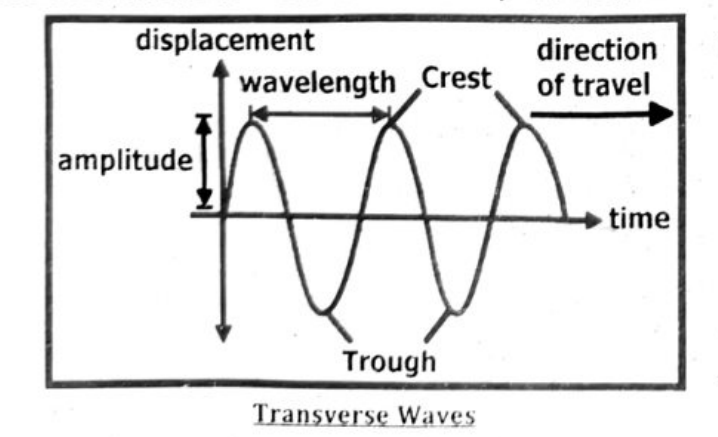
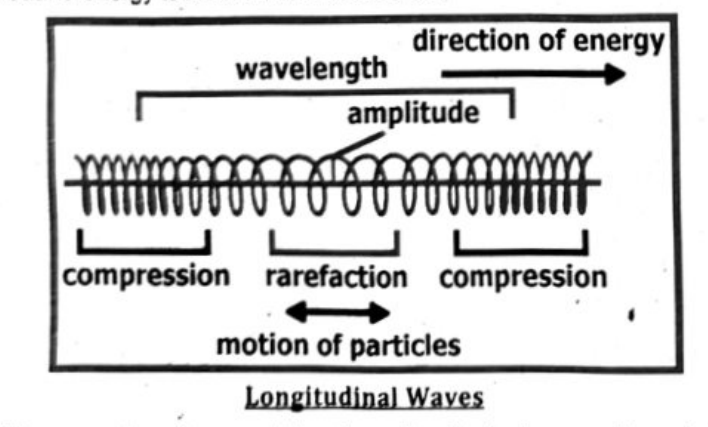
A wave's key features include its crests and troughs, wavelength, amplitude, frequency, time period, and wave speed. Additionally, longitudinal waves are characterized by compressions and rarefactions.
Wave Features Explained
- Wavefront: An imaginary plane that connects all points on a wave that are in the same phase (e.g., all crests).
- Wavelength ($\lambda$): The distance between two successive identical points on a wave, such as two crests or two troughs.
- Frequency ($f$): The number of wave cycles that pass a point in one second, measured in Hertz (Hz).
- Time Period ($T$): The time it takes for one complete wave cycle to pass by a point. The frequency and time period are reciprocals of each other ($f = 1/T$).
- Crest (Peak): The highest point of a wave.
- Trough: The lowest point of a wave.
- Compression: In longitudinal waves (like sound), a region where the particles of the medium are squeezed together, representing a peak.
- Rarefaction: In longitudinal waves, a region where the particles of the medium are spread apart, representing a trough.
- Amplitude ($A$): The maximum displacement of a point on the wave from its rest position (or the midline).
- Wave Speed ($V$): The speed at which a wave travels, calculated as wave speed = frequency × wavelength ($V = f\lambda$).
Definitions
- Frequency: The number of cycles completed by an oscillating body in one second is called frequency ($f$). It is measured in cycles per second (cps) or hertz (Hz).
- Wavelength ($\lambda$): Wavelength is the distance between two identical points on consecutive waves (e.g., from crest to crest or trough to trough), usually measured in meters.
- Amplitude ($x_0$): The maximum displacement form mean on either side is called amplitude ($x_0$). As amplitude is also a displacement that’s why is measured in meters.
We receive sun light (electromagnetic wave) but not the sound (mechanical wave) of fusion reactions occurring at the surface of earth. It is because there is vacuum in between earth and sun. Light waves can travel in vacuum but sound waves cannot.
Wave equation
The relation between the velocity, frequency and wavelength of the wave is known as wave equation.
The velocity of wave which is defined by: Velocity = distance / time
Therefore, $v = \frac{d}{t}$ (i)
$v = \frac{\lambda}{T}$ $\Rightarrow$ $v = \lambda \times \frac{1}{T}$ (ii)
But time period $T$ is reciprocal of the frequency $f$, i.e., $T=\frac{1}{f} \Rightarrow f=\frac{1}{T}$.
Therefore Equation (ii) becomes: $v=f\lambda$ (iii)
Equation (iii) is called the wave equation.
TRANSVERSE WAVES:
The type of waves in which the disturbance occur perpendicular to the direction of motion of the waves are termed as transverse waves. This means the vibrations are at right angles to the wave's motion. Transverse waves are common in nature and can be observed in various forms. Waves produced in a string when its one end is fixed to a support and the other end is moved up and down is an example of transverse waves.
Examples:
Electromagnetic Radiation:
Electromagnetic waves, such as light, X-rays, and radio waves, are examples of transverse waves. These waves do not require a medium.
Waves on the Surface of Water:
Waves on the surface of water are another example of transverse waves. The water particles move up and down (vibration), while the wave energy travels horizontally across the surface. For instance, when a stone is thrown into a pond, ripples spread outwards from the point of impact, showing the transverse motion of the water particles.
Seismic S-Waves (Secondary Waves):
Seismic S-waves, produced during earthquakes, are transverse waves that move through the Earth. In these waves, the ground vibrates side-to-side or up-and-down, while the wave energy travels horizontally. Unlike P-waves, S-waves cannot travel through liquids, as they require the shear strength of a solid medium for their vibrations. These waves are critical in understanding the Earth's interior and locating earthquake epicenters.
No, mechanical waves cannot pass through a vacuum (empty space) because they require a medium (like air, water, or solid substances) to travel through. In a vacuum, there are no particles to transmit the wave, so mechanical waves, such as sound or water waves, cannot propagate.
In contrast, electromagnetic waves, like light and radio waves, can travel through a vacuum. They don't require a physical medium to propagate because they are disturbances in electric and magnetic fields.
Earthquake produces waves through the crust of the Earth in the form of seismic waves. By studying such waves, the geophysicists learn about the internal structure of the Earth and information about the occurrence of future Earth activity to travel. The electric and magnetic fields vibrate at right angles to each other and to the direction of energy transfer. For example, sunlight travels through space as an electromagnetic wave, bringing energy from the Sun to Earth.
Earthquakes generate seismic waves as energy is released when fault lines suddenly move and slip along fault lines. This movement of the fault lines releases stored-up elastic strain energy, which radiates outwards in all directions as seismic waves. These waves travel through the Earth's crust and cause the ground to shake.
LONGITUDINAL WAVES:
Type of waves in which the disturbance occur parallel to the line of travel of the wave are termed as longitudinal waves. This means that the vibrations and the energy transfer occur along the same line. A longitudinal wave can be generated with a Slinky, as shown in Figure. When one end is pushed forward along its length (i.e., longitudinally) and then pulled back to its starting point, as in part a, a region where the coils are compressed together is sent traveling to the right.
Parts of the wave having higher density and pressure are called compressions and parts having smaller density and pressure are called rarefactions.
Examples:
Sound Waves:
Sound waves are a classic example of longitudinal waves. When we speak, the air particles near our vocal cords compress and expand, creating regions of compression (where particles are close together) and rarefaction (where particles are spread apart). These compressions and rarefactions move through the air, carrying sound energy to the listener. For instance,
When we clap, the sound travels as longitudinal waves through the air to reach someone nearby.
Seismic P-Waves (Primary Waves):
Seismic P-waves, generated during earthquakes, are another example of longitudinal waves. These waves cause particles in the Earth to vibrate back and forth in the same direction as the wave's movement. P-waves are the fastest type of seismic wave and can travel through solids and liquids. These characteristic helps scientists study the Earth's structure and detect earthquakes. For example, the time difference between the arrival of P-waves and slower S-waves at a seismic station helps determine the location of the earthquake's epicenter.
Transverse waves travel slower than longitudinal waves in solids primarily because longitudinal waves travel parallel to their direction of propagation, while transverse waves oscillate perpendicular to their direction of propagation. This perpendicular vibration in transverse waves creates a resistance that slows down their travel, whereas longitudinal waves experience less resistance due to their parallel movement.
OR (Second Answer)
Longitudinal waves move faster through solids than through gases or liquids. Transverse waves move through solids at a speed of less than half of the speed of longitudinal waves. It is because the restoring force exerted during this up and down motion of particles of the medium is less than the restoring force exerted by a back and forth motion of particles of the medium in case of longitudinal waves.
Waves can undergo reflection, refraction, and diffraction. Reflection occurs when a wave bounces off an obstacle, refraction when it bends as it changes medium, and diffraction when it bends around obstacles or through openings.
REFLECTION:
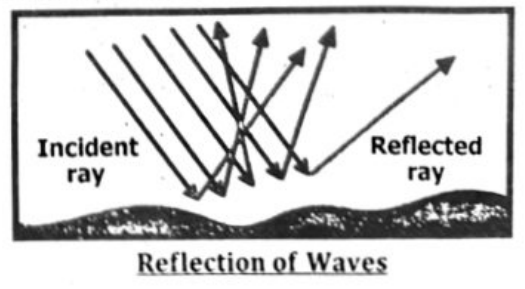
The change in direction of a wave front at an interface between two different media or rigid barrier so that the wave front returns into the medium from which it is originated is called reflection.
When a wave front strikes a straight rigid barrier or irregular surface, it is reflected back along its original path.
REFRACTION:
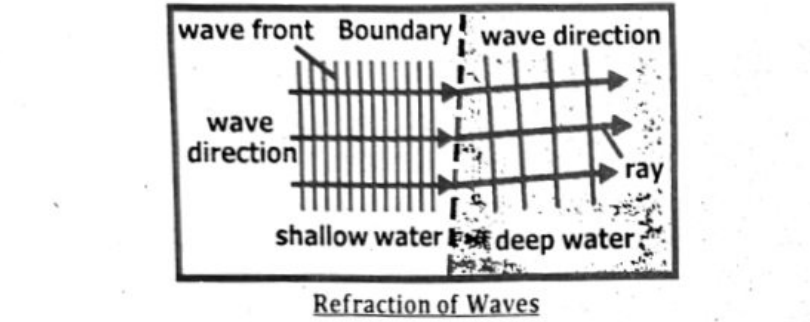
When waves travel from one medium into another its speed changes and in some cases divert from its original path, the phenomenon is called refraction. When a water wave enters a medium in which it moves more slowly, its wavelength decreases as well.
The phenomenon of refraction can be demonstrated in the ripple tank by using a boundary between shallow and deep water. A thick plastic sheet is placed in the tray at some angle to the wave front. When water waves travel from shallow to deep water, its wavelength and hence speed changes along with direction of waves as shown in figure.
DIFFRACTION:
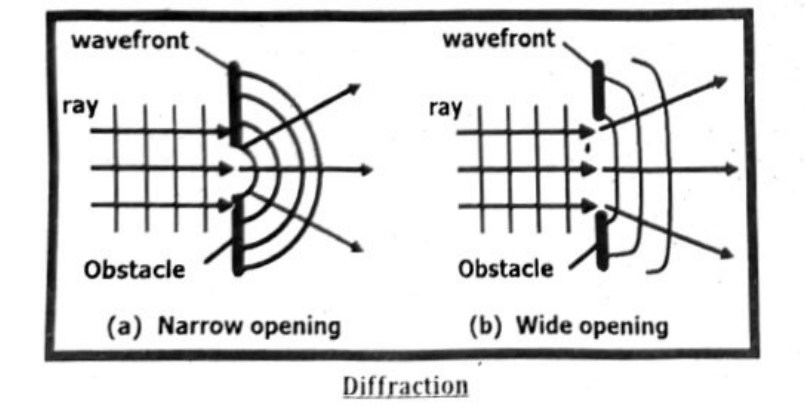
The bending of waves around corners of an obstacle is called diffraction. When waves pass through an aperture or opening it spreads out due to diffraction.
The extent of diffraction depends on the size of the obstacle or opening compared to the wavelength of the wave. The smaller the obstacle or opening relative to the wavelength, the more pronounced the diffraction.
For example, sound waves diffract around objects, allowing you to hear someone even if they are behind a wall.
It is, however, to be noted that wavelength (or speed) of the wave is not affected by diffraction, if the separation is large between obstacles compared to the wavelength, it can be seen that central part of the wave is not affected, only part of the wave at the edges diffracts as shown in the figure (b).
Ripple tank:
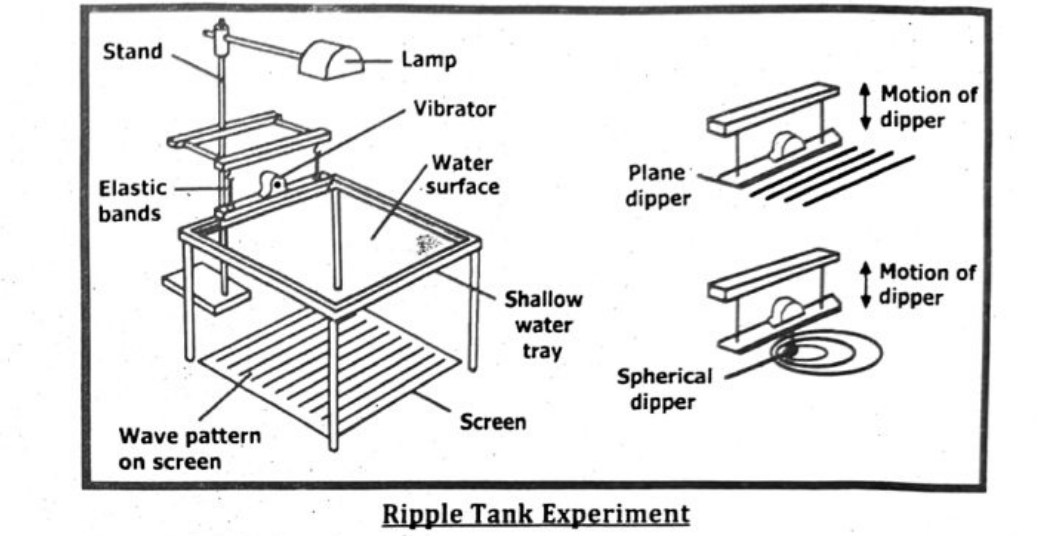
The basic properties of waves like reflection, refraction and diffraction can be described with the help of a ripple tank by using water waves. Ripple tank is also used to calculate frequency, wavelength and speed of waves on water’s surface. It also analyzes the characteristics of waves like transverse and longitudinal behavior.
Basic Construction and working:
A ripple tank consists of shallow tray of water with a transparent base, usually illuminated from above, so that light shines through the water. The ripples on the water show up as shadows (bright and dark lines) on the screen underneath the tank. The ripples are created by a small electric motor (vibrator). The motor has an off-center weight attached. When the motor is turned-on, it makes the strip vibrate and thus create ripples on the surface of water. Straight waves can be set up by using a straight dipper while circular waves can be formed by using a spherical dipper.
In order to get consistent plane waves, the motor assembly is lowered until it just touches the surface of water and the motor is then turned on. You should be able to see straight waves being created which travel across the surface of the tank, often called plane waves.
By lighting the wave fronts being created, clear peaks and troughs can be seen on the screen as shown in figure. The imaginary surface representing corresponding points (crests and troughs) of a wave that vibrate in unison is called a wave front. It may be plane or spherical depending upon the dipper used.
Wavelength directly affects the extent of diffraction at an edge. Waves with longer wavelengths diffract more significantly than waves with shorter wavelengths. When a wave encounters an edge, it spreads out, and this spreading, or diffraction, is more pronounced for longer wavelengths.
Explanation:
Wavelength and Diffraction:
The amount of diffraction depends on the relative sizes of the wavelength and the obstacle or gap it's encountering. When the wavelength is larger compared to the obstacle, the diffraction effect is more noticeable.
Example:
Consider sound waves passing through a doorway. The longer wavelengths of low-frequency sounds diffract more than the shorter wavelengths of high-frequency sounds, allowing us to hear the sound even when we're behind the door.
Edge Diffraction:
When a wave encounters an edge, it spreads out into the region behind the obstacle, a phenomenon also known as edge diffraction. The extent of this spreading, or diffraction, is influenced by the wavelength of the wave. Longer wavelengths lead to a greater degree of diffraction.
Diffraction and Interference:
Diffraction is a result of wave interference. When a wave encounters an edge, it's effectively divided into many smaller wavelets, and these wavelets interfere with each other, creating a diffraction pattern. The pattern's characteristics, such as the angle of diffraction, are related to the wavelength of the wave.
TSUNAMIS:
A tsunami is a series of large ocean waves created by underwater disturbances. These waves travel quickly across the ocean and can reach great heights when they approach the shore, causing massive flooding and damage to coastal areas.
TSUNAMI GENERATION:
Tsunamis are most commonly caused by underwater earthquakes, especially those that happen at tectonic plate boundaries where one plate is pushed beneath another. This sudden movement of the ocean floor displaces a large amount of water, resulting in powerful waves that travel across the ocean. Tsunamis can also be triggered by underwater volcanic eruptions, as the explosion displaces water and creates waves that spread outward. Additionally, landslides occurring under the ocean can displace water and generate tsunamis.
The movement of sediment and rock on the seafloor causes water displacement, leading to the formation of tsunamis. Although rare, large meteorites impacting the ocean can also cause massive waves due to the significant displacement of water.
CHARACTERISTICS OF TSUNAMIS:
Tsunami waves move quickly across the ocean after the initial disturbance, often traveling at speeds of 500 – 800 km/h (310 – 500 mph). In deep waters, the waves are not very high, making them hard to spot. However, as they near the coast, their speed slows down while their height increases significantly as the wave energy gets compressed. When tsunamis hit land, they can cause massive destruction with their towering height and powerful energy, flooding coastal regions, demolishing structures, and resulting in substantial loss of life and property.
OR (Second Answer)
Tsunamis have the following key characteristics:
Large Wavelength:
Tsunamis have very long wavelengths, often hundreds of kilometers long.
Fast Speed:
In deep water, they can travel at speeds up to 500-800 km/h (310-500 mph).
Small Amplitude in Deep Water:
Tsunami waves often appear as small, barely noticeable ripples in deep water.
Large Amplitude Near Shore:
As tsunamis approach shallow coastal areas, their wave height increases dramatically, often reaching several meters or more.
Multiple Waves:
Tsunamis typically consist of a series of waves, with the first wave not always being the largest.
Caused by Underwater Displacements:
They are usually triggered by underwater earthquakes, volcanic eruptions, or landslides.
Destructive Power:
When they hit the shore, tsunamis can cause massive flooding and destruction due to their large energy and wave height.
Wavelength and Diffraction:
The wavelength is the distance between consecutive crests (or troughs) of a wave.
Shorter Wavelengths:
Waves with shorter wavelengths diffract less. If the wavelength is much smaller than the size of the gap, the waves will primarily travel straight through with minimal spreading.
Longer Wavelengths:
Waves with longer wavelengths diffract more. This means that if the wavelength is large compared to the size of the gap, the waves will spread out significantly after passing through the gap.
UV light, which has a shorter wavelength, diffracts less than IR light, which has a longer wavelength.
Gap Size and Diffraction:
The size of the opening through which the waves pass.
Narrow Gaps:
When the gap size is comparable to or smaller than the wavelength of the wave, significant diffraction occurs. The waves spread out widely on the other side of the gap.
Wide Gaps:
When the gap size is much larger than the wavelength, diffraction is minimal. The waves pass through the gap with only slight spreading, and most of the wave energy remains in the original direction of propagation.
For example sound waves have relatively large wavelength that is why they can diffract around obstacles and through openings, allowing you to hear sounds even when you can’t see the source. Whereas light wave has much shorter wavelength, visible light has a wavelength range from about 400 nm to 700 nm.
When light passes through a slit or an aperture that is much larger than its wavelength, there is minimal diffraction, and the light beam remains well-defined. However, if the slit is on the order of the light’s wavelength (as in a diffraction grating), significant diffraction and interference patterns can be observed.
Examples:
GIVEN:
Frequency $f = 5\,\text{Hz}$
REQUIRED:
Time Period $T = ?$
SOLUTION:
Using frequency-time relation, we have: $T=\frac{1}{f}$
Putting values: $T=\frac{1}{5\,\text{Hz}}$
Therefore, $T=0.2\,\text{s}$ [ANSWER]
So, the pendulum will oscillate with a period of 0.2 s.
An athlete in the gym moves one end of a rope up and down, whose other end is fastened with a wall, with a speed of 2.5 m s$^{-1}$. It produces oscillations whose wavelength is 0.5 m. Calculate the frequency of waves generated in the rope.
GIVEN:
Wavelength $\lambda = 0.5\,\text{m}$
Wave speed $V = 0.5\,\text{m s}^{-1}$
REQUIRED:
Frequency $f = ?$
SOLUTION:
By universal wave equation: $v=f\lambda$ or $f=\frac{v}{\lambda}$
Putting values: $f=\frac{0.25\,\text{m s}^{-1}}{0.5\,\text{m}}$
Therefore, $f=5\,\text{Hz}$ [ANSWER]
The rope therefore oscillates at 5 times per second.
GIVEN:
Lowest frequency $f_1 = 20\,\text{Hz}$
Highest frequency $f_2 = 20{,}000\,\text{Hz}$
Speed of sound $v = 343\,\text{m s}^{-1}$
REQUIRED:
Low wavelength $\lambda_1 = ?$
High wavelength $\lambda_2 = ?$
SOLUTION:
By universal wave equation: $v=f\lambda$ or $f=\frac{v}{\lambda}$
For the lowest frequency sound, the above equation becomes: $\lambda_1=\frac{v}{f_1}$
Putting values: $\lambda_1=\frac{343\,\text{m s}^{-1}}{20\,\text{Hz}}$
Therefore, $\lambda_1=17.15\,\text{m}$ [ANSWER]
Similarly, for the highest frequency sound: $\lambda_2=\frac{v}{f_2}$
Putting values: $\lambda_2=\frac{343\,\text{m s}^{-1}}{20{,}000\,\text{Hz}}$
Therefore, $\lambda_2=0.017\,\text{m}$ [ANSWER]
Summary
- Wave is the energy transfer mechanism without the transport of material media.
- Mechanical Waves are the waves that require medium for their propagation.
- Electromagnetic waves are the waves that do not require any media for their propagation.
- Transverse waves are the waves in which particles of the medium vibrate / oscillate perpendicular to the direction of motion of waves.
- Longitudinal waves are the waves in which particles of the medium vibrate / oscillate parallel to the direction of motion of waves.
- Seismic waves are caused by the sudden movement of materials within the Earth, such as slip along a fault during an earthquake.
- Reflection is the throwing back by a body or surface of light, heat, or sound without absorbing it.
- Refraction is the change in direction of a wave passing from one medium to another caused by its change in speed.
- Diffraction is the bending of waves around the edges of an obstacle.
- Tsunamis are a series of enormous ocean waves caused by earthquakes, underwater landslides, volcanic eruptions or asteroids.