
Constructed Response Questions:
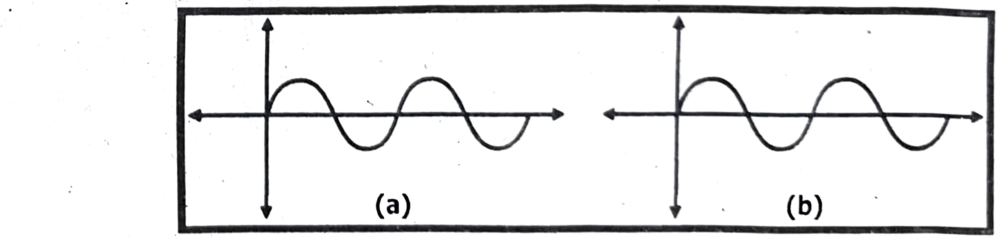
(a) In the graph below represent crest, trough and origin.
(b) Also in similar graph drawn again show displacement, amplitude and wavelength.
Ans:
(a) Labeling Crest, Trough, and Origin:
- Crest: The highest point on the wave.
- Trough: The lowest point on the wave.
- Origin: The point where the wave starts (where displacement = 0 at the beginning of the cycle).
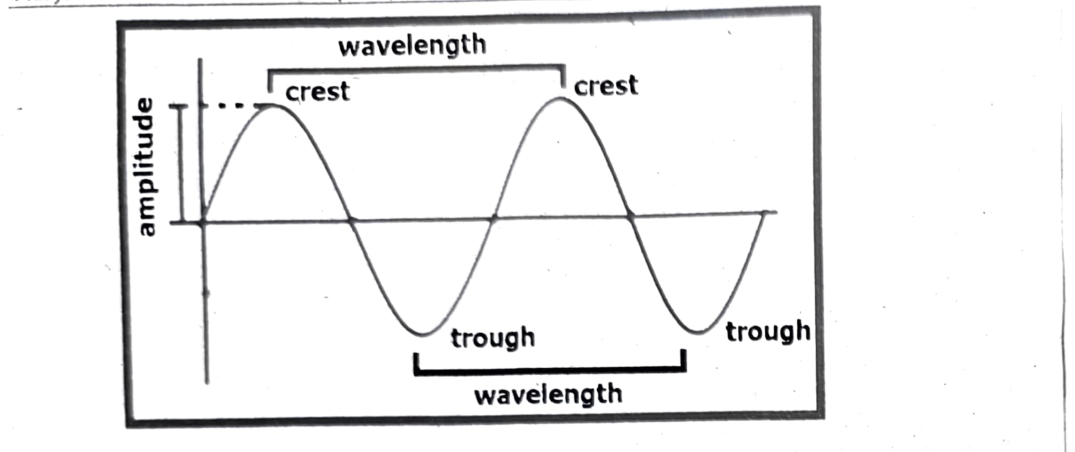
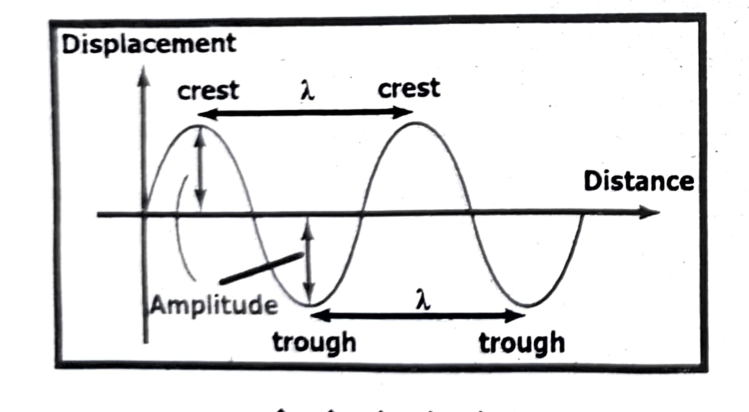
(b) Showing Displacement, Amplitude, and Wavelength:
- Displacement: The vertical distance of a point on the wave from the origin or equilibrium position. Displacement varies for each point on the wave.
- Amplitude: The maximum displacement of the wave from the origin. It’s the distance from the origin to the crest or from the origin to the trough.
- Wavelength: The distance between two consecutive crests (or two consecutive troughs) on the wave. It represents one complete cycle of the wave.
Short Questions:
Ans: If the time period of the electrical vibrator in a ripple tank is decreased, the frequency of the waves will increase, and the speed of the waves will remain constant, as long as the medium (water depth) does not change.
Relationship between Frequency and Time Period:
The frequency (f) and time period (T) of a wave are inversely related. The relationship is given by:
$$f = \frac{1}{T}$$
This means if the time period (T) decreases, the frequency (f) increases. The wave speed is also related to frequency and wavelength by the equation:
$$v = f\lambda$$
If the time period of the electrical vibrator decreases, the frequency increases. If we assume the depth of the water in the ripple tank remains constant, the wave speed will remain constant.
Ans: When water waves in a ripple tank move from deep to shallow water, the speed and wavelength decrease, while the frequency and time period remain the same.
Explanation:
- Speed:
Water waves travel faster in deep water than in shallow water. As the water gets shallower, the speed of the waves decreases.
- Wavelength:
Wavelength is the distance between two consecutive crests or troughs of a wave. Since speed decreases and frequency remains the same, the wavelength also decreases as waves move from deep to shallow water.
- Frequency:
The number of waves passing a point per second (the frequency) is determined by the source of the wave and remains constant as it travels through different depths.
Time Period:
Time period is the reciprocal of frequency (the time it takes for one complete wave cycle). Since frequency doesn't change, the time period also remains constant.
In essence, as water waves move from deep to shallow water, they slow down and their wavelength gets shorter, but the number of waves passing by in a given time and the time it takes for one complete wave remain the same.
OR (Second Answer)
When water waves enter from deep water to shallow water regions in a ripple tank, several changes occur in their properties. As the waves move into shallower water, the wavelength decreases because the wave’s speed slows down. This happens because water waves travel slower in shallow water compared to deep water. The frequency of the waves remains unchanged because it is determined by the source of the waves.
However, since the speed of the waves decreases in shallow water, and the frequency is constant, the wavelength must shorten to maintain the relationship between speed, frequency, and wavelength (V = f × λ). Additionally, the time period (the time taken for one complete wave cycle) remains constant since it is also determined by the frequency, which hasn’t changed. In summary, as the waves enter shallow water, their speed decreases, wavelength shortens, and frequency and time period remain the same.
Ans: The reason we don't hear sound from nuclear fusion on the Sun is because sound waves require a medium (like air or water) to travel through. Space between the Sun and the Earth is a vacuum, meaning it's mostly empty. Without a medium, sound waves can’t propagate, so we can’t hear the explosions. However, heat and light (electromagnetic radiation) can travel through the vacuum of space, which is why we feel the Sun’s warmth and see its light.
OR (Second Answer)
We don't hear sound from the Sun's nuclear fusion explosions because sound needs a medium (like air, water, or solids) to travel through, and space is a vacuum. In the vacuum of space, there are no molecules to transmit sound waves. While the Sun’s fusion reactions generate massive amounts of energy, including heat and light, these are in the form of electromagnetic waves (like light and radiation), which can travel through the vacuum of space. Therefore, although we receive heat and light from the Sun, no sound reaches Earth due to the lack of a medium for the sound waves to propagate through.
Ans: Water waves refract, or change direction, when transitioning between shallow and deep water because their speed changes as they encounter different depths. This change in speed is analogous to how light refracts when passing from one medium to another, like air to glass, due to variations in light's speed.
Here’s a more detailed explanation:
Water Waves and Refraction:
Speed Change: Water waves travel faster in deeper water and slower in shallower water.
Wavelength Change: As water waves slow down in shallower water, their wavelength also decreases. The frequency, however, remains constant.
Direction Change: The change in speed and wavelength causes the wave’s direction to change, bending towards the normal (a line perpendicular to the boundary) when moving from deep to shallow water.
Light Refraction:
Speed Change: Similar to water waves, light travels at different speeds in different mediums (e.g., air, water, glass).
Wavelength Change: The frequency of light remains constant, but the wavelength changes when light travels from one medium to another.
Direction Change: Light rays also bend when they transition between different mediums, following the same principle as water waves: bending towards the normal when entering a denser medium (e.g., air to glass).
The Relationship:
Both water waves and light experience refraction because of changes in speed and wavelength when they travel across a boundary between different media. This change in speed is the fundamental factor causing the bending of the waves or rays.
OR (Second Answer)
Water waves refract at the boundary between shallow and deep water due to a change in their speed. In deeper water, waves travel faster, but as they enter shallow water, their speed decreases because the wave motion is influenced by the ocean floor. This change in speed causes the waves to bend as they cross from one region to another. This behavior is similar to the refraction of light, where light changes direction when it moves from one medium (like air) into another (like water) with a different speed. The bending of both light and water waves occurs because of this change in speed at the boundary between two different mediums.
Ans: Waves can be classified into two main types based on their need for a medium: mechanical waves require a medium to propagate, while electromagnetic waves do not. Electromagnetic waves, like light and radio waves, can travel through a vacuum because they are generated by the oscillating electric and magnetic fields, and these fields can propagate even without a material medium.
Elaboration:
Mechanical Waves:
These waves require a physical medium (solid, liquid, or gas) to travel. They transfer energy through the vibrations of the medium’s particles. Examples include sound waves, water waves, and seismic waves.
Electromagnetic Waves:
These waves can propagate through a vacuum, meaning they don’t need a material medium. They are generated by the acceleration of electric charges, which creates oscillating electric and magnetic fields. These fields are self-propagating, meaning a change in the electric field induces a change in the magnetic field, and vice versa. This continuous interaction allows the wave to travel even without a physical medium.
Why electromagnetic waves don’t need a medium:
The core reason lies in the nature of electromagnetic waves themselves. They are essentially disturbances in the electric and magnetic fields, which exist in space, even when there is no matter present. These fields are coupled, and one changes in response to the other, allowing the wave to propagate through the vacuum. The speed of light, which is the speed of all electromagnetic waves in a vacuum, is a fundamental constant determined by the properties of these fields.
Ans: Maximum diffraction of waves occurs when the size of the aperture or obstacle is of the same order of magnitude as the wavelength of the incident wave. For very small aperture sizes, the vast majority of the wave is blocked. For large apertures the wave passes by or through the obstacle without any significant diffraction.
Conditions for Maximum Diffraction:
Aperture / Obstacle Size ≈ Wavelength:
The most significant diffraction occurs when the width of the aperture (or the size of the obstacle) is approximately equal to the wavelength of the wave (λ). In this case, the waves spread out significantly after passing through the aperture or around the obstacle.
Aperture / Obstacle Size < Wavelength:
If the aperture is much smaller than the wavelength (λ), the waves will spread out almost as if the aperture were a point source. The diffraction is very pronounced in this case.
Aperture / Obstacle Size > Wavelength:
If the aperture is much larger than the wavelength (λ), the waves will pass through the aperture with very little bending. The diffraction is minimal in this case, and the wave behaves more like a ray traveling in a straight line.
Distinguishing Reflection and Refraction:
Reflection is the bouncing back of a wave at a boundary, changing direction but not typically the speed or medium. Refraction, on the other hand, involves a change in both direction and speed (and often medium) as a wave passes from one medium to another. A ripple tank experiment can demonstrate both, and changes in medium (like depth in the tank) affect refraction more than reflection.
Reflection:
Direction:
Waves change direction at the boundary, reflecting back into the original medium. The angle of incidence (the angle at which the wave hits the boundary) equals the angle of reflection.
Speed:
Typically, the wave speed remains the same during reflection. The medium is not changed during reflection.
Example in a Ripple Tank:
A barrier placed in the ripple tank will cause waves to bounce back, changing direction.
Refraction:
Direction:
Waves bend (refract) as they pass from one medium to another (e.g., from deep water to shallow water in a ripple tank). The amount of bending depends on the difference in speed in the two media.
Speed:
Waves change speed when they enter a different medium. For example, they slow down and bend toward the normal (the imaginary line perpendicular to the surface) when entering shallower water.
Example in a Ripple Tank:
If a section of the ripple tank is shallower, the waves will slow down and bend as they pass into that area, demonstrating refraction.
Experiment with a Ripple Tank:
Set up:
Place a barrier (for reflection) and a region of shallow water (for refraction) in a ripple tank.
Generate waves:
Use a vibrator to create waves.
Observe reflection:
Observe the waves bouncing off the barrier, changing direction but staying in the water.
Observe refraction: Observe the waves bending as they enter the shallow area, changing both direction and speed.
Evaluate the effect of medium changes: Note how the speed and direction of the refracted waves change as the depth of the water changes.
OR (Second Answer)
Reflection vs. Refraction:
Reflection: Waves bounce off a surface, changing direction but maintaining speed.
Refraction: Waves change direction and speed when passing into a different medium.
Experiment Design (Ripple Tank):
Materials:
Ripple tank, water, acrylic sheet, different liquids (e.g., oil and water), wave generator.
Procedure:
Reflection: Generate waves and use the acrylic sheet to reflect them. Measure angles of incidence and reflection.
Refraction: Create waves in water, introduce oil to one side, and observe how waves bend. Measure angles and observe speed changes.
Evaluation:
Reflection keeps wave speed constant; refraction shows speed changes and bending at medium boundaries.
Long Questions:
Ans: Waves transfer energy by causing particles within a medium to oscillate or vibrate, effectively transferring momentum and kinetic energy without physically moving the particles themselves along the wave's direction. This principle applies across different media like ropes, water, and air, although the specific nature of the oscillation varies.
Explanation:
Ropes:
When a pulse is sent down a rope, the rope’s segments move up and down, or side to side, transferring energy from one segment to the next. The rope’s particles don’t move along the wave’s direction; they oscillate around their equilibrium position.
Water:
In water waves, the water particles move in a circular path as the wave passes, but they don’t travel with the wave. They are displaced by the wave, but they return to their original position, transferring energy as they do so.
Air:
In sound waves, air particles oscillate back and forth, creating regions of high and low pressure. This compression and rarefaction of air particles transfer energy through the air, causing vibrations in a sound source and in our eardrums.
In essence, waves act like a chain reaction, transferring energy from one oscillating particle to the next, without the particles themselves being transported along with the wave’s motion.
Ans: A wave’s key characteristics are wavelength, frequency, and amplitude. Wavelength is the distance between two identical points on a wave, frequency is the number of waves passing a point per second, and amplitude is the wave’s height or maximum displacement. These characteristics are interconnected and directly influence the wave’s energy and behavior.
Elaboration:
Wavelength:
The distance between two successive crests (or troughs) of a wave. It’s a measure of the wave’s spatial extent.
Frequency:
The number of wave cycles (or crests / troughs) that pass a specific point in one second. It’s measured in Hertz (Hz).
Amplitude:
The maximum displacement of a wave from its rest position. It’s a measure of the wave’s intensity or strength.
Relationship between frequency and wavelength:
For a given wave speed (which depends on the medium), wavelength and frequency are inversely proportional. Higher frequency means shorter wavelength, and vice versa.
Relationship between amplitude and energy:
A wave's energy is directly related to the square of its amplitude. A larger amplitude indicates a more energetic wave.
Impact on wave behavior:
Intensity / Loudness / Brightness:
Amplitude determines the wave’s intensity. For sound waves, this is perceived as loudness; for light waves, it’s brightness.
Pitch / Color:
Frequency determines the wave’s pitch (for sound) and color (for light).
Wave Interaction:
Wavelength affects how a wave interacts with obstacles and boundaries. Shorter wavelengths are more easily diffracted (bent around corners).
Wave speed:
While frequency and amplitude don’t change wave speed, the speed of a wave is determined by the properties of the medium it’s traveling through.
In essence, these characteristics work together to define the nature of a wave, from its intensity and frequency to its energy and how it interacts with its surroundings.
Ans: The $V = f\lambda$ equation describes the relationship between wave speed ($V$), frequency ($f$), and wavelength ($\lambda$). It states that wave speed is equal to the product of frequency and wavelength.
In a given medium, if the speed of the wave is constant, then frequency and wavelength are inversely proportional; a higher frequency means a shorter wavelength, and vice versa.
Scenario:
Let’s imagine a sound wave traveling in air, with a certain frequency and wavelength.
Impact of changing one variable:
If we increase the frequency of the sound wave, the wavelength will decrease proportionally to maintain the same wave speed in air. Conversely, if we decrease the frequency, the wavelength will increase.
Example:
If we double the frequency of the sound wave, the wavelength will be halved, and the speed of the sound wave will remain the same.
In summary, for a given medium, the wave speed is a constant. If the frequency changes, the wavelength will adjust inversely to maintain that constant speed.
Ans:
Compare and Contrast transverse and longitudinal waves:
| Feature | Transverse Waves | Longitudinal Waves |
|---|---|---|
| Definition | Waves in which the particle displacement is perpendicular to the direction of wave propagation. | Waves in which the particle displacement is parallel to the direction of wave propagation. |
| Direction of Motion | The particles move up and down or side to side. | The particles move forward and backward (compression and rarefaction). |
| Waveform | Creates crests and troughs. | Creates compressions and rarefactions. |
| Medium | Can travel through solids, liquids, or gases, but often most common in solids and surfaces of liquids. | Can travel through solids, liquids, or gases (e.g., sound waves in air). |
| Energy Transfer | Energy moves perpendicular to the wave. | Energy moves parallel to the wave. |
| Speed of Propagation | Often faster in solids due to the rigidity of the medium. | Speed depends on the medium’s compressibility. Generally slower than transverse in gases. |
| Example in Nature | Ocean waves- Light traveling through space | Sound traveling through air- Seismic waves traveling through Earth |
| Distinction Importance | Helps understand how energy and disturbances propagate, especially in optical, seismic, and oceanography studies. | Important for understanding sound transmission, seismic activity, and acoustic waves. |
| Examples | Light waves- Water waves- Radio waves | Sound waves- Seismic P-waves (Primary waves) |
OR (Second Answer)
Transverse and longitudinal waves differ in the direction of particle displacement relative to the wave’s propagation. Transverse waves, like ripples on a pond or vibrations on a guitar string, involve particles moving perpendicular to the wave’s direction, while longitudinal waves, like sound, involve particles moving parallel to the wave’s direction. This distinction is crucial because it affects how waves interact with different materials and how they transmit energy.
(i) Transverse Waves:
Particle Displacement:
The particles of the medium move perpendicular (at right angles) to the direction of the wave’s motion.
Examples:
- Ripples on a pond
- Vibrations in a guitar string
- Electromagnetic waves (light, radio waves)
Key Features:
- Crests (high points) and troughs (low points)
- Wavelength (distance between crests or troughs)
Polarization:
- Transverse waves can be polarized, meaning the direction of their oscillations can be aligned or restricted in a specific plane.
- Polarization is a property of transverse waves where the direction of oscillation can be oriented in one direction.
(ii) Longitudinal Waves:
Particle Displacement:
The particles of the medium move parallel to the direction of the wave’s motion.
Examples:
- Sound waves
- Pressure waves (e.g., in an earthquake)
- Ultrasound waves
Key Features:
- Compressions (areas where particles are close together) and rarefactions (areas where particles are spread out)
- Wavelength (distance between compressions or rarefactions)
Polarization:
Longitudinal waves cannot be polarized.
Why the Distinction Matters:
Wave Behavior:
The direction of particle displacement affects how a wave interacts with obstacles, reflects off surfaces, and is refracted through different materials.
Energy Transfer:
The way energy is transferred by transverse and longitudinal waves differs, which can influence how they are detected and used in various applications.
Medium Requirements:
Transverse waves, particularly electromagnetic waves, can travel through a vacuum, while longitudinal waves, like sound, require a medium (e.g., air, water) to propagate.
Applications:
Understanding the difference between transverse and longitudinal waves is crucial in various fields, including acoustics (sound), seismology (earthquakes), and optics (light).
Ans: Waves exhibit three key behaviors: reflection (bouncing off a barrier), refraction (bending when entering a different medium), and diffraction (bending around an obstacle). A real-world scenario illustrating these is a sound wave from a distant radio station: reflection occurs as the wave bounces off the ionosphere, refraction bends the wave as it passes through the atmosphere’s varying densities, and diffraction allows the wave to spread out and still reach distant receivers even when buildings or hills obstruct the direct path.
(i) Reflection:
Definition:
Waves change direction when they encounter a boundary and bounce back into the original medium.
Example:
An echo is a sound wave reflected off a wall or cliff, illustrating reflection.
Law of Reflection:
The angle of incidence (angle at which the wave approaches the boundary) equals the angle of reflection (angle at which the wave bounces off).
(ii) Refraction:
Definition:
Waves change direction as they transition from one medium to another due to a change in speed.
Example:
Light bending as it enters water from air, making a straw appear bent, is a refraction phenomenon.
Factors Affecting Refraction:
The speed of light (or other wave) changes as it moves through different mediums (like air, water, or glass), causing it to bend.
(iii) Diffraction:
Definition:
Waves bend or spread out as they encounter an obstacle or pass through an opening.
Example:
Sound waves can be heard around a corner, even if an obstacle blocks the direct path, demonstrating diffraction.
Factors Affecting Diffraction:
Diffraction is more pronounced when the wavelength of the wave is larger than the obstacle or opening.
Ans: The extent of diffraction, or the spreading of a wave, is significantly influenced by both the wavelength of the wave and the size of the opening or obstacle it encounters. Larger wavelengths, relative to the opening, result in greater diffraction. Conversely, smaller wavelengths and larger openings lead to less pronounced diffraction effects. This principle is utilized in various technologies like X-ray diffraction for material analysis and certain optical applications.
Elaboration:
Wavelength and Diffraction:
Larger Wavelengths, Greater Diffraction:
Longer wavelengths (like those associated with sound or microwaves) diffract more readily. This is why you can hear around a corner but not see someone.
Smaller Wavelengths, Less Diffraction:
Light waves, with their much shorter wavelengths, diffract less significantly.
Size of Opening / Obstacle:
Small Openings, More Diffraction:
When the size of an opening or obstacle is comparable to or smaller than the wavelength, diffraction becomes more prominent.
Large Openings, Less Diffraction:
If the opening is significantly larger than the wavelength, diffraction is less noticeable.
Diffraction Angle:
The angle of diffraction ($\theta$) is related to the wavelength ($\lambda$) and the size of the aperture ($d$) by the following approximate formula for single-slit diffraction:
$$\sin(\theta)=\frac{\lambda}{d}$$
This formula shows that the angle of diffraction is directly proportional to the wavelength.
Factors Determining Diffraction:
- Wavelength ($\lambda$): The intrinsic property of the wave that dictates its length.
- Size of the Aperture / Obstacle ($d$): The physical dimensions of the opening or object the wave encounters.
- The Ratio $\lambda/d$: The crucial parameter that determines the extent of diffraction; a larger $\lambda/d$ ratio leads to more diffraction.
Technology Applications:
- X-ray Diffraction: Used to study the structure of materials, where X-rays, with their short wavelengths, are diffracted by the atomic arrangement within a crystal.
- Optical Diffraction: Diffraction is used in various optical instruments and technologies, such as diffraction gratings for separating light into its spectral components.
- Medical Imaging: Diffraction plays a role in the formation of images in some medical imaging techniques, such as ultrasound and MRI.
Examples:
- Sound Diffraction: Sound waves diffract more readily than light waves, which is why we can hear around a corner but not see through it.
- Light Diffraction: Diffraction occurs when light passes through a narrow slit or around the edge of an object, creating a pattern of bright and dark bands.
Ans: Formation of Tsunamis due to Underwater Earthquakes:
Tsunamis, giant ocean waves, are primarily generated by underwater earthquakes, where sudden displacement of the ocean floor causes large volumes of water to be displaced. As these waves travel from deep to shallow water, they slow down but increase in height, potentially causing significant damage upon reaching coastal areas.
Formation and Movement:
Trigger:
Underwater earthquakes, particularly those with a magnitude of 7.0 or higher, can trigger tsunamis when the earth's tectonic plates shift vertically, displacing large amounts of water.
Wave Generation:
The sudden rise or fall of the ocean floor launches rolling waves, which are the foundation of a tsunami.
Deep Ocean Behavior:
In deep water, tsunamis travel at high speeds (up to 500 miles per hour) and may have relatively small heights (a foot or so).
Shallow Water Transformation:
As tsunamis enter shallower water near coastlines, they slow down due to the increasing friction with the seabed.
Wave Height Increase:
The slowing of the waves causes the energy to compress, resulting in a significant increase in wave height, sometimes reaching tens of meters.
Coastal Impact:
Tsunamis approaching coastlines can appear as a series of powerful and rapid tides rather than a single giant wave. The initial shock is often followed by other waves within minutes or hours.
Potential Impacts:
Flooding:
Tsunami waves can inundate coastal areas, causing widespread flooding and damage to infrastructure and property.
Debris Impact:
The waves can carry large amounts of debris, which can further damage structures and pose hazards to people.
Structural Damage:
Tsunami forces can cause severe damage to buildings, bridges, and other infrastructure, potentially leading to collapse.
Human Casualties:
The combination of powerful waves, debris, and flooding can result in significant loss of life.
In summary, Tsunamis are powerful waves generated by underwater earthquakes and other events. They change significantly as they move from deep to shallow water, slowing down and increasing in height. These changes lead to potentially devastating coastal impacts, including flooding, debris damage, structural damage, and human casualties.
Relationship Between Amplitude and Energy of a Wave:
The energy a wave carries is directly related to its amplitude. Higher amplitude waves carry more energy than lower amplitude waves. This relationship is often expressed mathematically as energy ($E$) being proportional to the square of the amplitude ($A$).
$$E \propto A^2$$
For example, a loud sound (high amplitude) has more energy than a quiet sound (low amplitude), and a bright light (high amplitude) has more energy than a dim light (low amplitude).
Mathematical Reasoning:
- The energy of a wave is related to the work done to create the disturbance. This work is proportional to the displacement or amplitude of the wave.
- Specifically, the energy of a mechanical wave (like a sound or water wave) is related to the square of the amplitude: $E \propto A^2$.
- For electromagnetic waves (like light), the intensity, which is related to the energy carried per unit area, is also proportional to the square of the amplitude.
Real-World Examples:
Sound:
A loud sound wave (high amplitude) requires more energy to produce than a quiet sound wave (low amplitude). A speaker needs more power to produce a louder sound.
Light:
A bright light source (high amplitude light wave) emits more energy than a dim light source (low amplitude light wave). A powerful laser beam (high amplitude) can cut through materials, while a low-intensity light source may not.
Water Waves:
A large, crashing wave (high amplitude) carries more energy and can cause more damage than a small, gentle wave (low amplitude). The height of the wave directly relates to the energy it can exert.
Seismic Waves:
Earthquakes produce seismic waves. A higher amplitude wave will be a stronger earthquake, with more energy released.
Lasers:
High-powered lasers emit light waves with very high amplitudes. These lasers can cut through materials or be used in medical procedures because they carry a significant amount of energy.
In summary, the amplitude of a wave is a direct measure of the energy it carries. The energy is proportional to the square of the amplitude, meaning even small increases in amplitude can result in significant increases in energy. This principle applies to all types of waves and has important implications in various fields, from acoustics to optics.
Ans: Primary (P) and secondary (S) seismic waves are distinct types of waves generated by earthquakes, differing in their speed, propagation mechanism, and ability to travel through different mediums. P-waves are faster, longitudinal waves that can travel through solids and liquids, while S-waves are slower, transverse waves that can only travel through solids. These differences in wave behavior provide crucial information about the Earth’s internal structure, including the presence and nature of its liquid outer core.
P-Waves (Primary Waves):
- Speed: P-waves are the fastest seismic waves, traveling at approximately 7 km/s at the Earth’s surface.
- Type: They are longitudinal waves, meaning the particles vibrate in the same direction as the wave’s travel.
- Propagation: P-waves can travel through solids, liquids, and gases.
- Travel: They can pass through the Earth’s mantle and core.
S-Waves (Secondary Waves):
- Speed: S-waves are slower than P-waves, traveling at about 4 km/s.
- Type: They are transverse waves, meaning the particles vibrate perpendicular to the wave’s direction.
- Propagation: S-waves can only travel through solids.
- Travel: They cannot travel through the Earth’s liquid outer core, creating a shadow zone on the opposite side of the Earth from the earthquake.
Insights into Earth’s Internal Structure:
Discovery of the liquid outer core:
The existence of an S-wave shadow zone, where S-waves are not detected beyond a certain distance from the earthquake, is a key indicator of the liquid outer core. S-waves cannot pass through liquids, so their absence in this zone confirms the liquid state of the outer core.
Structure of the inner core:
Refraction and reflection of P-waves at the interface between the mantle and the outer core, and again at the interface between the outer and inner core, provide information about the inner core’s structure. The size and position of the shadow zones also suggest the presence of a solid inner core.
Earth’s layers:
The varying speeds of P-waves and S-waves through different layers of the Earth allow scientists to infer the composition and density of each layer. For example, P-wave speed increases with depth due to increased pressure and density.
Epicenter location:
The difference in travel times between P-waves and S-waves can be used to determine the distance from the earthquake’s epicenter to the seismograph. By analyzing the arrival times of P-waves and S-waves at multiple locations, geologists can pinpoint the epicenter of the earthquake.
In summary, P-waves and S-waves are invaluable tools for studying the Earth’s internal structure. By analyzing their travel times, paths, and behavior as they pass through the Earth, scientists can infer the properties of the different layers and gain insights into the dynamic processes that shape our planet.
Practical Applications of Wave Phenomena in Technology:
Wave reflection, refraction, and diffraction have significant practical applications in technology. Reflection is used in sonar and radar to determine distance and object location. Refraction is utilized in optics, like in lenses for magnification and vision correction. Diffraction finds applications in telecommunications, antenna design, and spectroscopy.
Reflection:
Radar (Radio Detection and Ranging):
Application: Radar systems use radio waves to detect objects such as aircraft, ships, and weather patterns. The radar emits radio waves, which are reflected by the target object.
Example: Air traffic control, weather forecasting, and military surveillance.
Significance: By analyzing the reflected waves (time delay and frequency shift), the distance, speed, and direction of the object can be determined.
Sonar (Sound Navigation and Ranging):
Application: Sonar uses sound waves to detect underwater objects. It is similar to radar but uses sound waves instead of radio waves.
Example: Submarine detection, mapping the ocean floor, and locating schools of fish.
Significance: Sonar is crucial for underwater navigation, exploration, and resource management.
Optical Fibers:
Application: Optical fibers use total internal reflection to transmit light signals over long distances.
Example: Telecommunications, internet services, and medical imaging.
Significance: Total internal reflection allows light to travel through the fiber with minimal loss of signal, enabling high-speed data transmission.
Refraction:
Lenses:
Application: Lenses use refraction to focus light and form images.
Example: Eyeglasses, cameras, microscopes, and telescopes.
Significance: Lenses are essential for vision correction, photography, scientific research, and astronomy.
Prisms:
Application: Prisms use refraction to disperse white light into its constituent colors (spectrum).
Example: Spectrometers, decorative lighting, and optical instruments.
Significance: Prisms are used in spectroscopy to analyze the composition of light sources and in various optical devices.
Atmospheric Refraction:
Application: Atmospheric refraction causes the bending of light as it passes through the Earth’s atmosphere.
Example: The apparent flattening of the Sun at sunset and mirages.
Significance: While sometimes a nuisance in astronomical observations, understanding atmospheric refraction is crucial for accurate positioning and navigation.
Diffraction:
Holography:
Application: Holography uses diffraction to record and reconstruct three-dimensional images.
Example: Security holograms on credit cards and banknotes, holographic displays, and scientific imaging.
Significance: Holography provides a unique way to store and display information in three dimensions.
Diffraction Gratings:
- Application: Diffraction gratings are used to separate light into its component wavelengths.
- Example: Spectrometers, DVD players, and optical filters.
- Significance: Diffraction gratings are essential for analyzing light spectra and for various optical applications.
X-ray Diffraction:
- Application: X-ray diffraction is used to determine the atomic and molecular structure of crystals.
- Example: Material science, drug discovery, and structural biology.
- Significance: X-ray diffraction is a powerful tool for understanding the arrangement of atoms in materials, which is crucial for designing new materials and drugs.
Radio Wave Diffraction:
- Application: Radio waves can diffract around obstacles, allowing them to propagate beyond the line of sight.
- Example: Radio communication in urban areas, where buildings can block the direct path between transmitter and receiver.
- Significance: Diffraction enables radio communication in environments where direct line of sight is not possible.