
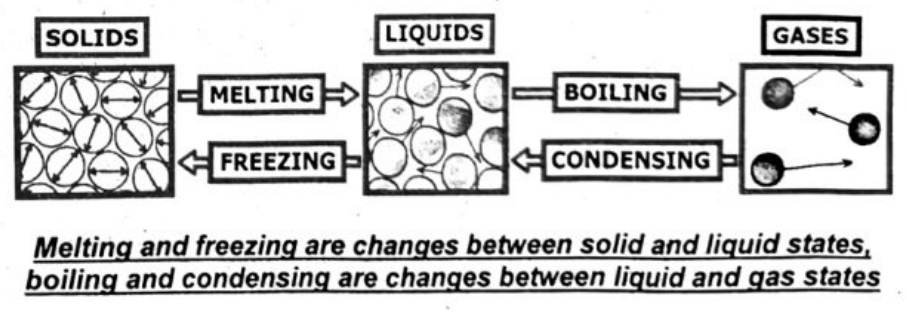
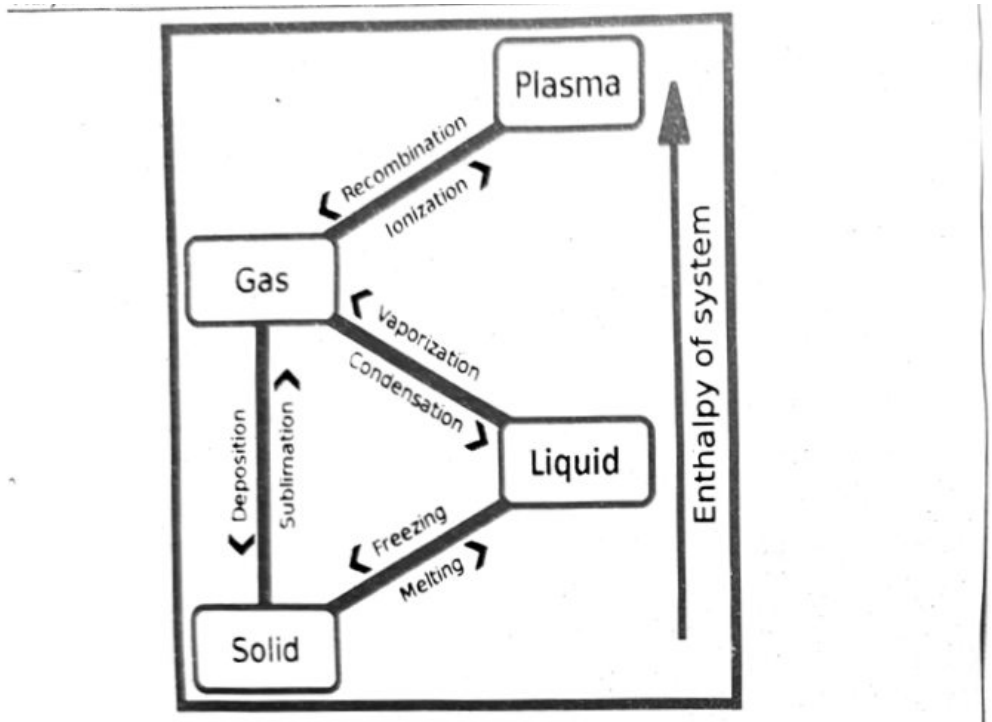
The terms for changes in state between solids, liquids, and gases are: Melting (solid to liquid), Freezing (liquid to solid), Boiling or Evaporation (liquid to gas), Condensation (gas to liquid), Sublimation (solid to gas), and Deposition (gas to solid).
The change in state of ice (solid) into water (liquid) and then into water vapours (gas) with increase in its temperature. Attractive forces among particles of matter usually decrease with increase in temperature.
- Melting: The process where a solid transforms into a liquid.
- Freezing: The process where a liquid transforms into a solid.
- Boiling / Evaporation: The process where a liquid transforms into a gas.
- Condensation: The process where a gas transforms into a liquid.
- Sublimation: The process where a solid directly transforms into a gas without becoming a liquid first.
- Deposition: The process where a gas directly transforms into a solid without becoming a liquid first.
Melting and freezing are changes between solid and liquid states, boiling and condensing are changes between liquid and gas states.
Thermal expansion, the tendency of matter to expand when heated, is explained by the kinetic theory through the increased movement and separation of atoms and molecules. When heat is added, particles gain kinetic energy, causing them to vibrate faster and collide more frequently, effectively increasing the average distance between them and thus expanding the material.
Here’s a more detailed explanation.
- Increased Kinetic Energy:
According to the kinetic theory, temperature is a measure of the average kinetic energy of particles within a substance. As temperature increases, the particles gain more kinetic energy, meaning they move faster and vibrate more vigorously. - Vibrations and Separations: In solids, atoms are held in place by intermolecular forces, but when they vibrate more vigorously, they tend to push each other farther apart. This increase in the average distance between particles causes the solid to expand.
- Liquids and Gases: In liquids and gases, the weaker intermolecular forces mean that particles can move around more freely. When heated, the increased kinetic energy causes them to move further apart, again leading to expansion.
- Pressure and Expansion in Gases: In gases, the increased kinetic energy and faster movement of molecules lead to more frequent and forceful collisions with the container walls. This increased pressure can cause the gas to expand if the container walls are flexible or allow the gas to push them outwards.
- Thermal Expansion Coefficients: The amount of expansion a material undergoes for a given temperature change is quantified by its thermal expansion coefficient. Different materials have different coefficients, meaning they expand or contract differently when exposed to the same temperature change.
Difference in relative expansion for solid liquid and gas:
Gases exhibit the greatest relative expansion when heated, followed by liquids, and solids expand the least. This difference is primarily due to the varying distances between particles and the strength of intermolecular forces in each state of matter.
Detailed Explanation:
- Solids: In solids, particles are tightly packed and held in place by strong intermolecular forces, limiting their movement and resulting in a relatively small expansion when heated.
- Liquids: Liquids have weaker intermolecular forces than solids, allowing particles to move more freely. This greater mobility leads to a larger expansion when heated compared to solids.
- Gases: Gases have the weakest intermolecular forces, and their particles are far apart, moving randomly and at high speeds. When heated, gas particles gain kinetic energy, causing them to move even faster and farther apart, resulting in a significant increase in volume and expansion.
In essence, the weaker the intermolecular forces, the greater the relative expansion of the substance when heated.
Linear Thermal Expansion of Solids:
It is change in length of a solid on heating. Change in one dimension of a solid object on heating is called linear thermal expansion in solids.
Factors:
Linear thermal expansion of solids depends upon three factors:
- Increase in temperature of the rod:
When a solid rod is heated, its atoms gain kinetic energy and vibrate with greater amplitude about their mean position. This increased vibrations causes the atoms to move slightly further apart resulting in an increase in the length of the rod. If we continue to increase the temperature, their kinetic energy and amplitude of vibration will further increase. This will further increase the length of the rod. Therefore, thermal expansion in length of the rod is directly proportional to the increase in temperature of the rod. - Original length of the rod:
On heating the rod the increase in length of the rod is directly proportional to the original length of the rod. This is because longer rod has more atoms, each atom contribute to overall thermal expansion. So, a longer rod will expand more than a shorter rod when heated to the same temperature. - Nature of material of the rod:
Different materials expand differently on heating. Thermal expansion depends on the atomic structure and the strength of attractive force between its atoms. For example, aluminum rod expands more than steel rod of same length for same rise in temperature.
Consider a metal rod of original length $L_0$, at initial temperature $T_0$, as shown in figure.
This rod is heated to final temperature $T$ and its final length becomes $L$. Increase in length of the rod is $\Delta L$ ($\Delta L = L - L_0$) for increase in temperature $\Delta T$ ($\Delta T = T - T_0$).
We know that change in length is directly proportional to original length $L_0$ and change in temperature $\Delta T$.
Mathematically,
$$\Delta L \propto L_0 \qquad \text{(i)}$$
$$\Delta L \propto \Delta T \qquad \text{(ii)}$$
Joining equation (i) and (ii),
$$\Delta L = \alpha L_0 \Delta T \qquad \text{(iii)}$$
From equation (iii), we have:
$$\alpha = \frac{\Delta L}{L_0\Delta T}$$
or
$$\alpha = \frac{\Delta L/L_0}{\Delta T} = \frac{\text{Change in length} / \text{Original length}}{\text{Change in temperature}}$$
$$\alpha = \frac{\text{Fractional change in length}}{\text{Change in temperature}}$$
Coefficient of linear expansion ($\alpha$):
The coefficient of linear expansion is defined as the fractional change in length per kelvin change in temperature. It tells how much length of the rod will change with respect to its original length when its temperature rises by 1 kelvin. SI unit of coefficient of linear thermal expansion is $\mathrm{K}^{-1}$.
Volumetric Thermal Expansion of Solids:
It is change in volume of a solid on heating. Chang in three dimensions of a solid object on heating is called volumetric thermal expansion in solids.
Factors:
Volumetric thermal expansion of solids also depends upon three factors:
- Increase in temperature of the object:
When a three-dimensional object (like a cube shaped object) is heated, kinetic energy of its particles increases, their vibrations become more vigorous and they spread out further apart. As a result, particles of the object occupy more volume, its atoms push each other and increase the volume of the object. Therefore, thermal expansion in volume of is directly proportional to the increase in its temperature. - Original volume of the object:
For the similar reason that we discussed in the case of linear thermal expansion, increase in volume of the solid object is directly proportional to its original volume. - Nature of material of the object:
Different materials expand differently on heating. Therefore, increase in volume of an object will be different for different materials on heating.
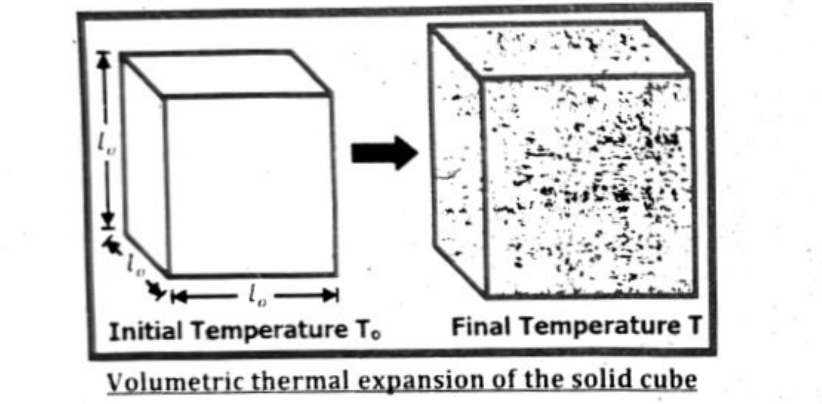
Let original volume of solid cube is ‘$V_0$’ at temperature ‘$T_0$’ as shown in figure. Its final volume becomes ‘$V$’ when its final temperature becomes ‘$T$’ ($T = T_0 + \Delta T$). Let increase in its volume is ‘$\Delta V$’ ($\Delta V = V - V_0$) for increase in temperature $\Delta T$ ($\Delta T = T - T_0$).
We know that change in volume is directly proportional to original volume ‘$V_0$’ and change in temperature ‘$\Delta T$’.
Mathematically,
$$\Delta V \propto V_0 \qquad \text{(i)}$$
$$\Delta V \propto \Delta T \qquad \text{(ii)}$$
Joining equation (i) and (ii),
$$\Delta V \propto V_0\Delta T \qquad \text{(iii)}$$
$$\Delta V = \beta V_0\Delta T \qquad \text{(iv)}$$
Where ‘$\beta$’ is the constant of proportionality and it is called coefficient of volume expansion.
From equation (iv), we have:
$$\beta = \frac{\Delta V}{V_0\Delta T} \qquad \text{(v)}$$
or
$$\beta = \frac{\Delta V/V_0}{\Delta T} = \frac{\text{Change in length} / \text{Original length}}{\text{Change in temperature}}$$
$$\beta = \frac{\text{Fractional change in length}}{\text{Change in temperature}}$$
Coefficient of volumetric thermal expansion ($\beta$):
The coefficient of volumetric thermal expansion of solids is defined as the fractional change in volume per Kelvin change in temperature. It tells how much volume of the solid object will change with respect to its original volume when its temperature rises by 1 kelvin. Its value is different for different materials. SI unit of $\beta$ is $\mathrm{K}^{-1}$.
Thermal expansion, the tendency of matter to change in volume in response to temperature changes, has both practical applications and potential consequences in real life. It's used in things like thermometers, thermostats, and bridges, and it can also cause problems like buckling tracks or overflowing gas tanks.
Applications:
- Thermometers: Thermometers rely on the expansion of liquids (like mercury or alcohol) to measure temperature.
- Thermostats: Bimetallic strips, where two metals with different expansion rates are bonded, bend when heated, activating temperature controls in ovens, irons, and air conditioners.
- Tight-fitting parts: Heating one part can temporarily expand it so it can be fitted onto another.
- Expansion joints: Found in bridges and railway tracks, these joints allow materials to expand and contract without buckling or cracking.
- Hot air balloons: Heated air expands and becomes less dense, creating lift.
- Bimetallic strips in thermostats: These strips bend due to the differing expansion rates of the metals.
- Overhead cables: Slightly sagging power lines allow for expansion in hot weather and contraction in cold weather, preventing breakage.
- Fixing a metal rim on a wooden wheel: Heating the metal rim before fitting it on the wheel allows it to expand.
Consequences:
- Railroad tracks and bridges buckling: Without expansion joints, metal structures can buckle due to expansion in hot weather.
- Car radiator coolant overflowing: Engine coolant expands more than the metal tank, potentially causing overflow.
- Power lines sagging: Expansion in hot weather causes power lines to sag.
- Gasoline overflowing: Gasoline in a tank expands more than the tank itself, potentially causing overflow.
- Cracks in roads: Expansion and contraction of road surfaces can lead to cracks.
- Glass cracking: Sudden temperature changes can cause glass to crack due to uneven expansion and contraction.
Melting, solidification, boiling, and condensation are phase transitions where energy is transferred to or from a substance without a change in its temperature. This occurs because the energy is used to overcome intermolecular forces, causing the substance to change from one state to another.
Melting and Solidification:
- Melting: Energy is absorbed by a solid as it transitions to a liquid state, breaking the bonds between molecules without a change in temperature. This is an example of the latent heat of fusion.
- Solidification (Freezing): When a liquid cools, energy is released as it transitions to a solid state, forming bonds between molecules without a change in temperature. This is an example of the latent heat of fusion.
Boiling and Condensation:
- Boiling: Energy is absorbed by a liquid as it transitions to a gas state, overcoming intermolecular forces and causing molecules to separate without a change in temperature. This is an example of the latent heat of vaporization.
- Condensation: When a gas cools, energy is released as it transitions back to a liquid state, forming bonds between molecules without a change in temperature. This is an example of the latent heat of vaporization.
In summary: During these phase changes, the energy is used to change the state of matter, not to raise or lower the temperature. The temperature remains constant during these transitions until all of the substance has changed phase.
Changes Between Solid and Gases:
The change of a solid directly into a gas without becoming a liquid is called sublimation, and the reverse process, a gas directly becoming a solid, is called deposition. These are distinct phase transitions, unlike melting (solid to liquid) or boiling (liquid to gas), where an intermediate liquid phase is involved.
Sublimation:
In sublimation, a solid transforms directly into a gas. This process requires a specific set of conditions, such as a decrease in pressure or a sufficiently transition directly to the gaseous state without becoming liquid first.
- Dry ice (solid CO2) is solid at extremely low temperature (−78.5°C). When it is exposed to room temperature and pressure, its molecules overcome all the attractive forces and convert directly into gas without going into the liquid phase.
Deposition:
- Deposition is the reverse of sublimation. A gas transforms directly into a solid. This process typically occurs when a gas is cooled to a temperature where the gas molecules lose enough kinetic energy to form a solid structure without going through a liquid phase.
- Formation of frost is an example of deposition. Snowflakes form from water vapor in the atmosphere through deposition.
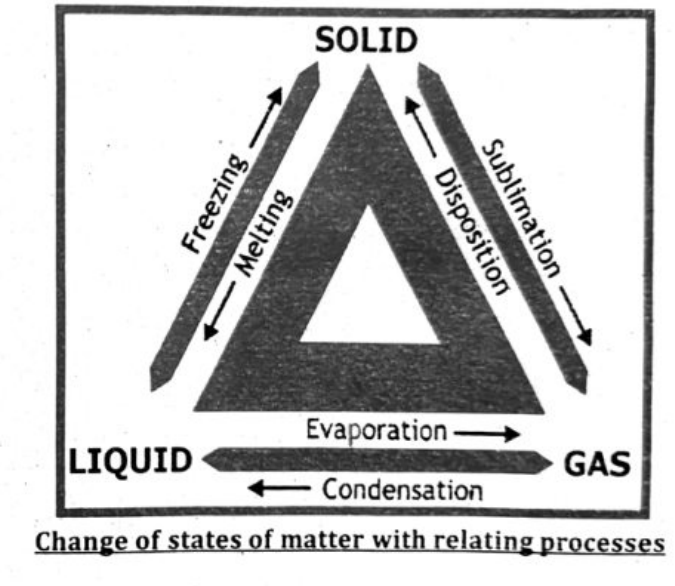
A food preservation technique relies on deposition and sublimation to remove moisture from food or other materials. The product is frozen or frosted using deposition and then it is and placed in a vacuum chamber with very low pressure. The water in the frozen or frosted material sublimates directly into the vacuum, leaving the dehydrated product behind. These cold surfaces, condenses directly into ice crystals forming the frost.
At standard atmospheric pressure, water melts (ice turns to liquid) at 0°C (32°F) and boils (liquid turns to steam) at 100°C (212°F). These are the fixed points used in the Celsius temperature scale.
The boiling point of water decreases at higher altitudes because atmospheric pressure is lower. At lower pressure, water molecules require less energy to escape the liquid phase and enter the gas phase, which results in water boiling at temperatures lower than 100°C. This is why food takes longer to cook at higher elevations.
Water freezes at 0°C and boils at 100°C because these are the temperatures at which water’s solid, liquid, and gaseous phases are in equilibrium under standard atmospheric pressure (1 atmosphere). Pressure plays a crucial role in determining these points: at higher pressure, the boiling point increases, and at lower pressure, it decreases.
Thermal expansion in solids refers to the tendency of solids to increase in volume (and therefore dimensions like length, area, or volume) when heated. This happens because the particles in a solid, which are tightly packed and vibrate, gain kinetic energy with increasing temperature, causing them to vibrate more vigorously. This increased vibration pushes the particles further apart, leading to expansion.
Here’s a more detailed explanation:
Molecular Level:
At a molecular level, the atoms or molecules in a solid are held together by forces of attraction. When a solid is heated, these particles gain kinetic energy, which translates to more vigorous vibrations.
- Vibrations and Spacing:
The more the particles vibrate, the more they tend to push apart, creating more space between them. This increased spacing between particles leads to a macroscopic expansion of the solid. - Types of Expansion:
Solids can expand in length (linear expansion), area (area expansion), or volume (volume expansion) depending on their shape and how they are constrained. - Relative Expansion:
Compared to liquids and gases, solids generally have a smaller coefficient of thermal expansion, meaning they expand less for a given temperature change. This is because their particles are tightly packed and have less freedom to move.
In essence, thermal expansion in solids is a consequence of the increased kinetic energy of particles and the resulting increase in their spacing when heated.
Thermal expansion of a liquid refers to the increase in volume of a liquid when its temperature is raised. This occurs because the molecules in a liquid gain kinetic energy as the temperature increases, causing them to move faster and farther apart, thus expanding the liquid’s volume.
Here’s a more detailed explanation:
- Temperature and Kinetic Energy:
When a liquid is heated, the temperature increases, which means the average kinetic energy of the liquid’s molecules increases. - Increased Molecular Movement:
With more kinetic energy, the molecules move faster and farther apart from each other. - Expansion of Volume:
This increased separation between molecules results in the liquid occupying a larger volume, i.e., the liquid expands. - No Fixed Shape:
Unlike solids, liquids don’t have a fixed shape, so the expansion is observed as an increase in the liquid’s level within a container. - Coefficient of Volume Expansion:
The amount a liquid expands per unit change in temperature is quantified by its coefficient of volume expansion, denoted as $\beta$. This coefficient is a measure of how much a liquid expands for every degree Celsius (or Kelvin) increase in temperature. - Cubical Expansion:
Since liquids don’t have a fixed shape, they expand in all three dimensions (length, width, and depth), making it a cubical or volume expansion.
Real expansion of the liquid = Apparent expansion of the liquid + Expansion of the flask
Gas pressure arises from the constant collisions of gas particles with the walls of their container. The pressure is directly proportional to the number of collisions and the force of each collision. Changes in pressure occur when the number of particles, their speed, or the container’s volume changes.
Here’s a more detailed explanation:
Gas Pressure:
- Collisions:
Gas particles are in constant, random motion, colliding with each other and the walls of their container. - Force:
Each collision exerts a force on the walls. - Pressure Definition:
Pressure is the total force exerted by these collisions per unit area of the container walls. - Kinetic Energy:
The faster gas particles move (higher temperature), the more kinetic energy they have, leading to more frequent and forceful collisions.
Factors Affecting Gas Pressure:
- Temperature:
Increasing temperature increases the average kinetic energy of the particles, resulting in more frequent and forceful collisions, thus increasing pressure. - Number of Particles:
Adding more gas particles to a container will increase the number of collisions with the walls, thereby raising pressure. - Volume:
Reducing the volume of a container forces the gas particles into a smaller space, leading to more frequent collisions and increased pressure.
Key Concepts:
- Kinetic Molecular Theory:
This theory explains the behavior of gases based on the motion of their particles. - Boyle’s Law:
At constant temperature, the pressure of a gas is inversely proportional to its volume ($P \propto 1/V$). - Gay-Lussac’s Law:
At constant volume, the pressure of a gas is directly proportional to its absolute temperature ($P \propto T$).
Pressure exerted by gas particles:
The molecules of a gas are in a state of continuous random motion in a container. They collide with one another and also with the walls of the container. Pressure is the measure of force exerted by the gas particles on unit area of the walls of the container perpendicularly.
Pressure = (Force exerted by particle due to collision) / (Area of the walls of container), or $P=\frac{F}{A}$.
Pressure of a gas in a container change with change in temperature, volume and amount of substance (number of particles).
- Effect of temperature:
If the temperature of the gas increases, the particles move faster. Faster particles collide with the walls with greater force and more frequently. This increases the pressure of the gas in the container. Pressure of the gas will decrease if its temperature decreases. So, the pressure of a gas inside a container is directly proportional to its temperature provided the volume remains constant. - Effect of volume:
Pressure of a gas is inversely proportional to its volume if its temperature is kept constant (Boyle’s law). If the volume of the container is reduced while keeping the number of particles constant, particles have less space to move around. This increases the number of collisions of its particles with the walls, which results in increase in pressure. Conversely, if the volume is increased, particles have more space and collide with the walls less frequently, which decreases the pressure. - Effect of amount of gas (number of particles):
By increasing the number of particles of the gas in a fixed volume increases the number of collisions of gas molecules with the walls of the container and hence, it increases the pressure of the gas in the container. By decreasing the number of particles of the gas in the container, its pressure will decrease.
MINI LAB
Consider an inflated balloon filled with gas. When heated, the gas particles inside the balloon move faster and hit the balloon’s inner walls more forcefully. This causes the balloon to expand. If you cool the balloon in air or in cold water, the particles move slow down, hit the walls less forcefully, and the balloon may shrink.
DIFFERENCE BETWEEN EVAPORATION AND BOILING:
| Properties | Evaporation | Boiling |
|---|---|---|
| Occurs | at the surface of liquid | Throughout the liquid |
| Temperature | at any temperature | only at boiling point of liquid |
| Energy Source | Uses surrounding energy | uses continuous external heat source |
| Rate /speed | Generally slower and depends on many factors | Fast process (after reaching boiling point) |
| Process Completion Time | It takes longer to be completed | It is quick process than evaporation |
| Effect of pressure | Less effected by external pressure | Highly effected by external pressure |
| Formation of Bubble | No bubble formation | Bubbles are formed throughout the liquid and rise from the surface |
| Dependence on surface area | Depends on surface area | Does not depend on surface area |
| Effect on temperature of surrounding | Causes cooling in surrounding | Increases temperature of surrounding |
Evaporation, in terms of particles, is the process where liquid particles at the surface gain enough kinetic energy to break free and become a gas. This happens because individual liquid particles near the surface absorb energy, overcoming the attractive forces holding them in the liquid phase. As these energetic particles escape, the remaining liquid cools down as the average kinetic energy of the liquid is reduced.
Here's a more detailed explanation:
- Kinetic Energy: Particles in a liquid are constantly moving and have kinetic energy.
- Temperature and Energy: The temperature of the liquid is directly related to the average kinetic energy of its particles. Warmer liquids have particles with more kinetic energy.
- Surface Particles: At the surface, some particles have enough kinetic energy to overcome the attractive forces holding them within the liquid.
- Breaking Free: These energetic particles break free and transition from the liquid to the gaseous phase, becoming water vapor or another gas depending on the liquid.
- Cooling Effect: As the most energetic particles leave, the average kinetic energy of the remaining liquid decreases, causing the liquid to cool down.
- Equilibrium: Evaporation continues until the rate of particles escaping the liquid equals the rate of particles returning from the gas phase (condensation) in a closed system.
Evaporation is influenced by temperature, humidity, surface area, and air movement. Higher temperatures increase the rate of evaporation as they provide more energy to liquid molecules to escape as vapor. Increasing surface area also speeds up evaporation, as there are more molecules at the surface to evaporate. Conversely, higher humidity slows down evaporation, as the air is already saturated with water vapor. Air movement, like wind, can increase evaporation by carrying away water vapor and replacing it with drier air.
Here's a more detailed explanation:
- Temperature: A higher temperature increases the kinetic energy of liquid molecules, allowing more of them to overcome the intermolecular forces and escape into the gas phase (vapor). This means more molecules are able to evaporate at a given time, leading to a faster rate of evaporation.
- Surface Area: Evaporation is a surface phenomenon, meaning it occurs at the boundary between the liquid and the atmosphere. A larger surface area exposes more molecules to the air, increasing the number of molecules that can evaporate.
- Humidity: Humidity refers to the amount of water vapor in the air. High humidity means the air is already close to saturation with water vapor, making it harder for more water molecules to evaporate. The air is already holding a lot of water, so there is less space for additional water vapor to be absorbed.
- Air Movement: Wind or other air currents can significantly increase the rate of evaporation by carrying away the water vapor that has already evaporated from the liquid surface. This replacement of saturated air with drier air allows for more molecules to evaporate. The wind also helps to increase the overall temperature of the surface, further accelerating the rate of evaporation.
Wet clothes dry more quickly in summer than in winter because the higher temperatures and lower humidity in summer cause water to evaporate faster. Warm air holds more moisture and speeds up the evaporation process, while in winter, the cooler air slows it down, making clothes take longer to dry.
EVAPORATION CAUSES COOLING:
Evaporation causes cooling because the process is endothermic, meaning it absorbs heat from its surroundings to change from a liquid to a gas. Specifically, when liquid molecules evaporate, the most energetic molecules with the highest kinetic energy escape the surface, taking their heat with them. This leaves behind a lower average kinetic energy of the remaining liquid molecules, which results in a temperature decrease, hence the cooling effect.
- Energy Absorption:
For a liquid to evaporate, its molecules need to absorb enough energy (heat) to overcome the intermolecular forces holding them together in the liquid state. - Kinetic Energy and Temperature:
The temperature of a substance is directly related to the average kinetic energy of its molecules. High kinetic energy means high temperature, and vice versa. - Evaporation and Kinetic Energy:
During evaporation, the most energetic molecules leave the liquid surface, carrying away their energy. This reduces the average kinetic energy of the remaining liquid molecules. - Cooling Effect:
Since temperature is directly proportional to average kinetic energy, the decrease in average kinetic energy results in a lower temperature, leading to the cooling effect. - Example:
Think about sweating. When sweat evaporates from your skin, it absorbs heat from your body, causing your skin to cool down.
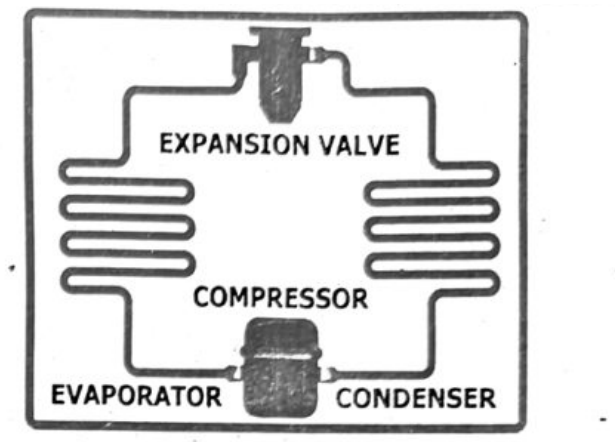
Evaporation cooling in refrigeration relies on the natural principle that when a liquid evaporates, it absorbs heat from its surroundings, thus lowering the temperature. Modern refrigerators and air conditioners utilize this principle without harmful CFCs by employing different types of refrigerants like HFCs and hydrocarbons. The process involves a closed cycle where a refrigerant evaporates, absorbing heat from the environment, and then is condensed and recycled.
Here’s a more detailed explanation:
- Evaporation:
- A low-pressure, low-temperature refrigerant is introduced into the evaporator (the part of the system that removes heat).
- The refrigerant evaporates, absorbing heat from the surrounding environment, such as the food inside the refrigerator.
- This evaporation cools the area inside the refrigerator or air conditioner.
- Compression:
- The refrigerant, now a gas, is compressed by a compressor, increasing its pressure and temperature.
- Condensation:
- The high-pressure, high-temperature refrigerant is then passed through a condenser (usually located outside the appliance).
- The condenser releases the heat absorbed during the evaporation process into the surrounding air.
- As the refrigerant releases heat, it condenses back into a liquid state.
- Expansion:
- The liquid refrigerant is then expanded through a valve, reducing its pressure and temperature, and the cycle starts over again.
Alternative Refrigerants:
- HCFCs (Hydrochlorofluorocarbons):
These were previously used as alternatives to CFCs but also have some environmental impact. HCFCs are being phased out, and newer technologies are being developed. - HFCs (Hydrofluorocarbons):
These are commonly used in modern refrigeration systems. HFCs are generally considered to be less damaging to the ozone layer than CFCs but still have a global warming potential. - Hydrocarbons:
These are natural refrigerants like propane, isobutane, and others. Hydrocarbons have a very low global warming potential and are becoming increasingly popular in refrigeration and air conditioning systems.
Refrigeration relies on the evaporation of a refrigerant to absorb heat. Modern systems use alternatives to CFCs, such as HFCs and hydrocarbons, to minimize environmental impact while maintaining the cooling process.
APPLICATIONS OF EVAPORATION:
(a) Refrigeration using evaporation (without CFCs):
Cooling is produced in the fridge / refrigerators by evaporation of refrigerant (a liquefied gas), which absorbs heat and creates a cooling effect. Freons, or chloro fluoro carbons (CFCs), were the type off found in perfume bottles, refrigerant gas used in fridge. However, since it was found that CFCs are depleting the ozone in the upper atmosphere which increases the amount of UV rays from the sun. All living things are harmed by ultra violet radiation. Therefore, CFCs use has been prohibited. CFCs are replaced by the environment friendly substances like water, ammonia and hydrocarbons (propane, butane) etc. There refrigerator contains a coil (called evaporation coil) filled with refrigerant at low pressure. When the warm air inside the fridge comes into contact with the evaporator coil, there refrigerant absorbs heat and changes from liquid to gas, which cools the inside of the fridge. This gas is then compressed, releasing heat outside, and is condensed back into a liquid by the condenser. This cycle continues to maintain a cool temperature inside the fridge.
(b) Food preservation:
Many food items are preserved by removing the water content through evaporation. This concentrates the flavours and prevents spoilage. Examples include dried fruits, jerky (dried meat).
(c) Production of salt:
Sea water is stored in large pools. As the water evaporates, the salt is left behind.
(d) Air conditioning:
Air conditioners use evaporation to cool air. They work by passing warm air over a coil that is filled with a cool liquid. As the liquid evaporates, it takes heat from the air, cooling it down.
(e) Fever control:
When someone has a high fever, they apply a wet cloth to their forehead. The reason behind this is that heat from the head is removed when the water evaporates. As a result, the patient’s brain temperature stays within acceptable bounds and no brain injury occurs.
Latent Heat:
It is defined as “It is the amount of heat energy absorbed or lost by a substance during its phase change without change in its temperature”.
- Consider you are boiling a pot of water. The temperature of the water increases gradually as you turn up the heat. But then, something interesting happens. The water reaches 100°C.
- Even when you apply more heat, the temperature does not change! The answer lies in a concept called latent heat. It is the hidden heat absorbed or released by a substance during a phase change (like melting, freezing (solidification), boiling or condensation) without a change in temperature.
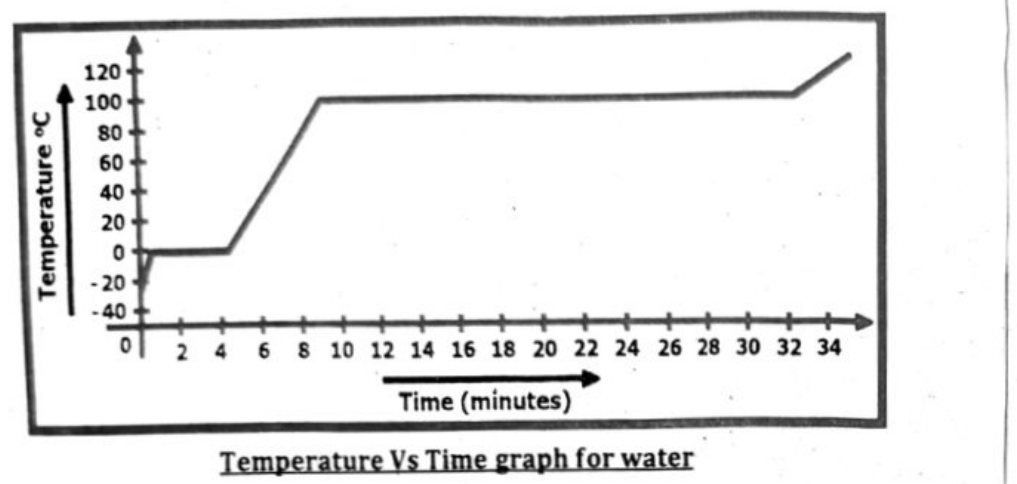
Consider a heating curve for water:
- The initial slope represents the solid phase heating up.
- The flat line at 0°C represents the latent heat of fusion as ice melts.
- The next slope represents the liquid water heating up.
- The flat line at 100°C represents the latent heat of vaporization as water boils.
- The final slope represents the gas phase heating up.
- From A to B: Heat is given to ice at −20°C. Its temperature rises and but it is still ice at 0°C.
- From B to C: Now heat given to ice is not increasing its temperature. This heat is being used to change its states from ice (solid) to water (liquid) at its melting point 0°C. This amount of heat is called latent heat of fusion ($L_f$). This process continues till all the ice is converted into water.
- From C to D: In this portion, added heat again increases the temperature of the water uniformly till it reaches its boiling point.
- From D to E: In this portion, added heat again is not used to increase the temperature of water. It is used to change the state of water (liquid) into vapours (gas) at its boiling point 100°C. Heat added at this stage to water is called latent heat of vaporization ($L_v$).
- From E to F: After complete change of water into vapours at its melting point, added heat increases the temperature of the vapours (steam).
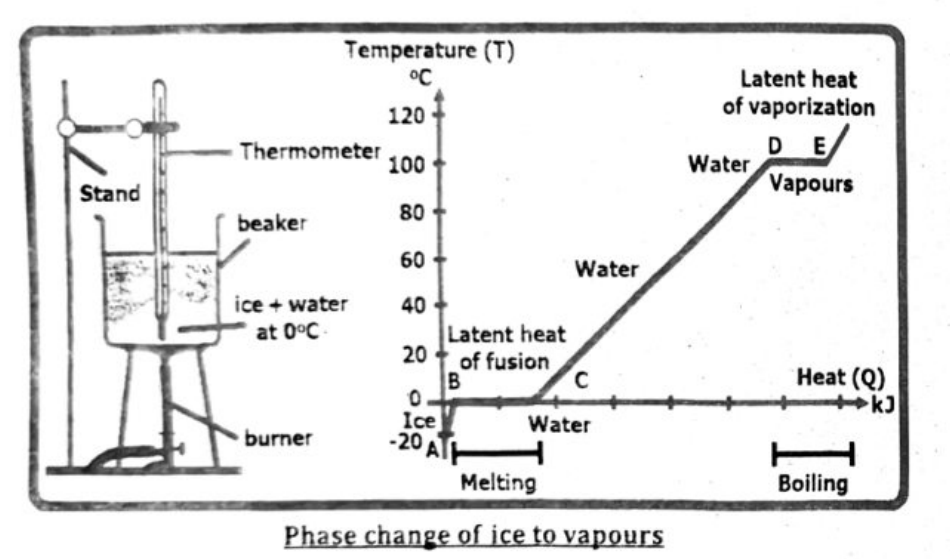
But when added heat is used to change the state of a substance, it does not change its temperature. Here, heat is used to weaken the attractive forces between its particles instead of increasing their average kinetic energy. This happens at the meting point and boiling point of the substance.
LATENT HEAT OF FUSION:
The amount of heat energy required to convert a given mass of a substance from the solid state to the liquid state without change in its temperature is called its latent heat of fusion. During freezing, liquids release the same amount of heat to change state to solids.
If $\Delta Q$ is the amount of heat energy needed to melt mass $m$ of a solid to liquid (or freeze liquid to solid), then mathematically:
$$\Delta Q = mL_f$$
Where $L_f$ is the specific latent heat of fusion of a substance. It is defined as the amount of heat energy required to convert unit mass (one kilogram) of the solid at its melting point to liquid (or liquid into solid) without any change in temperature. This is called its specific latent heat of fusion ($L_f$) of the solid.
$$L_f = \frac{\Delta Q}{m}$$
The SI unit of specific latent heat of fusion is joule per kilogram, expressed as $\mathrm{J\ kg^{-1}}$. Different substances have different specific latent heats of fusion. The latent heat of fusion of ice is $3.33 \times 10^5\ \mathrm{J\ kg^{-1}}$.
| Material | Melting Point (°C) | Latent Heat of fusion (J/kg) | Boiling Point | Latent Heat of Vaporisation (J/kg) |
|---|---|---|---|---|
| Helium | −269.65 | $5.23 \times 10^3$ | −269 | $2.09 \times 10^4$ |
| Oxygen | −218.79 | $1.38 \times 10^4$ | −183 | $2.13 \times 10^5$ |
| Water | 0 | $3.33 \times 10^5$ | 100 | $2.26 \times 10^6$ |
| Mercury | −39 | $1.13 \times 10^4$ | 357 | $2.93 \times 10^5$ |
| Sulphur | 119 | $3.81 \times 10^4$ | 445 | $3.26 \times 10^5$ |
| Lead | 327 | $2.45 \times 10^4$ | 1750 | $8.70 \times 10^5$ |
| Aluminum | 660 | $3.97 \times 10^5$ | 2450 | $1.14 \times 10^7$ |
| Copper | 1083 | $1.34 \times 10^5$ | 1187 | $5.06 \times 10^6$ |
| Silver | 961 | $8.82 \times 10^4$ | 2193 | $2.33 \times 10^5$ |
| Gold | 1063 | $6.44 \times 10^4$ | 2660 | $1.58 \times 10^6$ |
LATENT HEAT OF VAPORISATION:
The amount of heat energy required to convert a given mass of a substance from the liquid state to the gaseous state without any change in its temperature is called its latent heat of vaporisation. During condensation, the same amount of heat is released by the gases to change their state to liquids.
If $\Delta Q$ is the amount of heat energy needed to vaporize mass $m$ of a liquid to gas (or condense gas to liquid), then mathematically:
$$\Delta Q = mL_v$$
Where $L_v$ is the latent heat of vaporization of a substance. It is defined as the amount of heat energy required to convert unit mass (one kilogram) of the liquid at its melting point to gas (or gas into liquid) without any change in temperature. This is called its specific latent heat of vaporization of the solid.
$$L_v = \frac{\Delta Q}{m}$$
The SI unit of specific latent heat of vaporisation is joule per kilogram ($\mathrm{J\ kg^{-1}}$). Different substances have different specific latent heats of vaporisation. The latent heat of vaporisation of water is $2.26 \times 10^6\ \mathrm{J\ kg^{-1}}$.
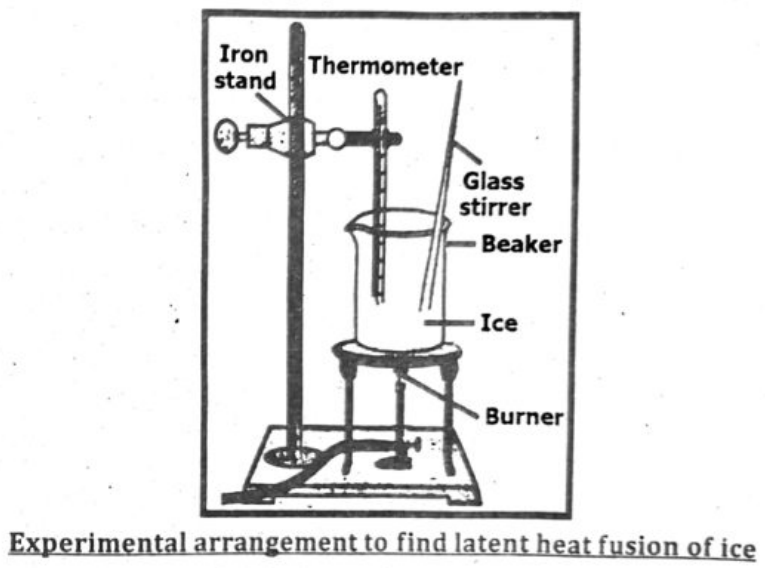
EXPERIMENT TO FIND LATENT HEAT OF FUSION OF ICE:
The experiment to determine the latent heat of fusion of ice provides a practical and accurate method to measure the amount of heat required to change a substance from a solid (ice) to a liquid (water) at its melting point. This is crucial for understanding phase transitions and the energy involved in these processes. The experiment also helps in validating theoretical concepts related to heat transfer and energy balance, which are fundamental to thermodynamics.
- Place a beaker over a stand as shown in figure.
- Add small pieces of ice to the beaker.
- To find out the ice’s temperature, hang a thermometer inside the beaker.
- Set a burner below the beaker.
- Start calculating the time by stopwatch.
- The ice will begin to melt.
- Now, it will have mixture of ice and water but its temperature will not rise above 0°C until all the ice melts.
- Note the time which the ice takes to melt completely into water at 0°C.
- When all the ice converts to water, its temperature will begin to rise. Continue heating the water at 0°C in the beaker. Its temperature will begin to increase.
- Note the time which the water in the beaker takes to reach its boiling point at 100°C from 0°C.
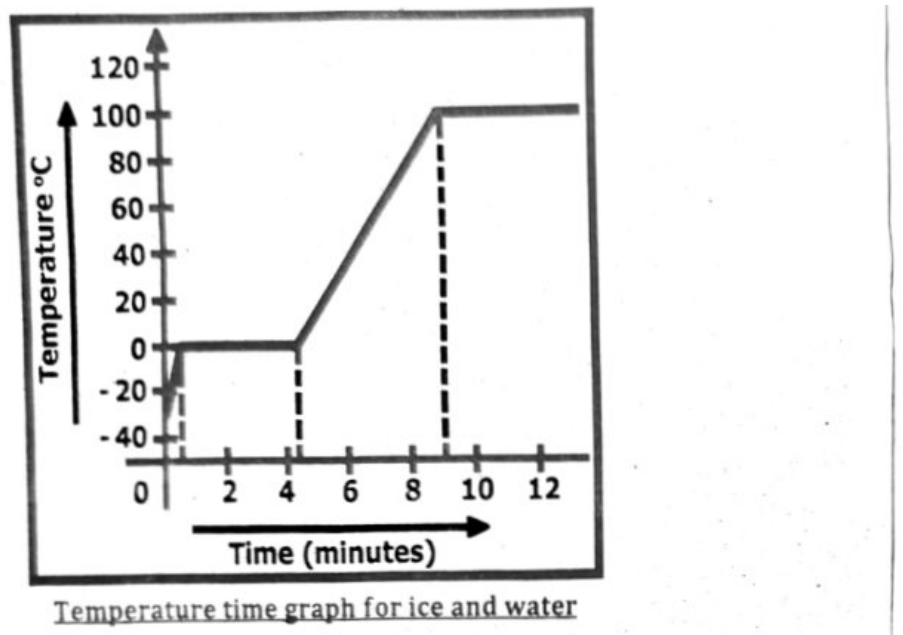
- Draw a temperature-time graph such as shown in figure.
Experimental arrangement to find latent heat of fusion of ice
Calculations to find the latent heat of fusion of ice:
Let’s do some calculations to find the latent heat of fusion of ice from the graph data as follows: Let, mass of ice = $m$.
Finding the time from the graph:
- Time taken by ice to melt completely at 0°C (time for fusion) = $t_F = t_2 - t_1 = 3.7$ minutes.
- Time taken by water for its temperature rise from 0°C to 100°C = $t_R = t_3 - t_2 = 4.6$ minutes.
Specific heat of water = $c = 4200\ \mathrm{J\ kg^{-1}\ K^{-1}}$.
Increase in the temperature of water from 0°C to 100°C = $\Delta T = 100°C = 100\ \mathrm{K}$.
Heat required by water to raise its temperature from 0°C to 100°C is given by:
$$\Delta Q = mc\Delta T$$
Putting values:
$$\Delta Q = m(4200\ \mathrm{J\ kg^{-1}\ K^{-1}})(100\ \mathrm{K})$$
$$\Delta Q = m(4.2 \times 10^5\ \mathrm{J\ kg^{-1}})$$
This is the heat absorbed by water to raise its temperature from 0°C to 100°C. This heat is absorbed by the water in time $t_R$ (4.6 minutes). Heat is absorbed at uniform rate.
Temperature time graph for ice and water
So, rate of absorption of heat (heat absorbed by the water in unit time) is given by:
$$\text{Rate of absorption of heat} = \frac{\Delta Q}{t_R}$$
Rate of absorption of heat is the same during fusion process time $t_F$ and raising temperature time $t_R$. Hence, heat absorbed by the water in time $t_F$ during fusion process is:
Total heat absorbed during fusion of ice = Rate of absorption of heat × Total time of fusion
$$\Rightarrow\quad \Delta Q_F = \frac{\Delta Q}{t_R} \times t_F = \Delta Q \times \frac{t_F}{t_R} \qquad (i)$$
As:
$$\Delta Q_F = m \times L_f \qquad (ii)$$
Comparing equations (i) and (ii):
$$m \times L_f = \Delta Q \times \frac{t_F}{t_R}$$
Putting values in above equation and simplifying it:
$$\Rightarrow\quad m \times L_f = m \times (4.2 \times 10^5\ \mathrm{J\ kg^{-1}}) \times \frac{3.7\ \mathrm{min}}{4.6\ \mathrm{min}}$$
Therefore, $L_f = 3.9 \times 10^5\ \mathrm{J\ kg^{-1}}$.
The latent heat of fusion of ice found by the above experiment is $3.37 \times 10^5\ \mathrm{J\ kg^{-1}}$ while its actual value is $3.36 \times 10^5\ \mathrm{J\ kg^{-1}}$.
The experiment also reinforces the understanding of the fundamental principles of thermodynamics, such as the first law of thermodynamics.
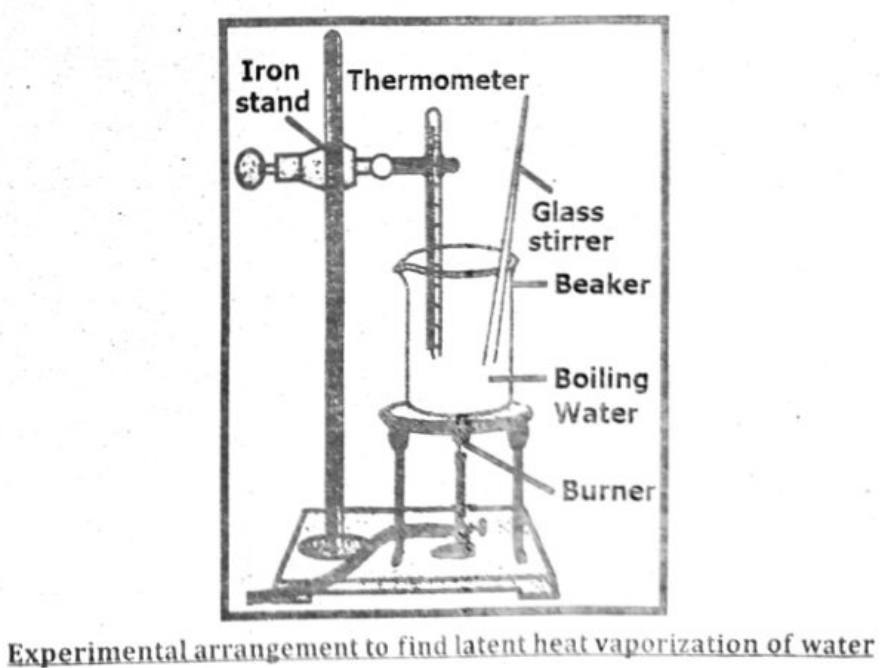
EXPERIMENT TO FIND LATENT HEAT OF VAPORISATION OF WATER
To find latent heat of vaporisation of water, we keep on heating a beaker containing boiling water as shown in figure. Continue heating water till all the water changes into steam. Note the time taken by water to change completely into steam at its boiling point 100°C. Extend the temperature-time graph such as shown in figure. Let’s calculate the latent heat of fusion of ice from the data as follows:
Time taken by water at 100°C to change it into steam (time of vaporization) = $t_v=t_4-t_3=24.4\ \mathrm{min}$.
In experiment to find latent heat of fusion $L_f$, we have calculated the rate of absorption of heat by water.
Rate of absorption of heat by water $=\frac{\Delta Q}{t_R}$.
Total heat absorbed during vaporization of water = Rate of absorption of heat × total time of vaporization:
$$\Delta Q_v=\frac{\Delta Q}{t_R}\times t_v=\Delta Q\times\frac{t_v}{t_R}\qquad (i)$$
As: $$\Delta Q_v=m\times L_v\qquad (ii)$$
Comparing equations (i) and (ii): $$m\times L_v=\Delta Q\times\frac{t_v}{t_R}$$
Putting values in above equation and simplifying it:
$$m\times L_v=m\times(4.2\times10^5\ \mathrm{J\ kg^{-1}})\times\frac{24.4\ \mathrm{min}}{4.6\ \mathrm{min}}$$
Therefore, $L_v=2.23\times10^6\ \mathrm{J\ kg^{-1}}$.
The latent heat of vaporization of water found by the above experiment is $2.23\times10^6\ \mathrm{J\ kg^{-1}}$ while its actual value is $2.26\times10^6\ \mathrm{J\ kg^{-1}}$.
Certain materials, when cooled to temperatures very near absolute zero, exhibit the phenomenon of superconductivity, where they display zero electrical resistance. This means that electric current can flow through them without any energy loss. Superconductivity is a quantum mechanical effect.
SUPERCONDUCTIVITY:
Superconductors are those material through which current flows without resistance.
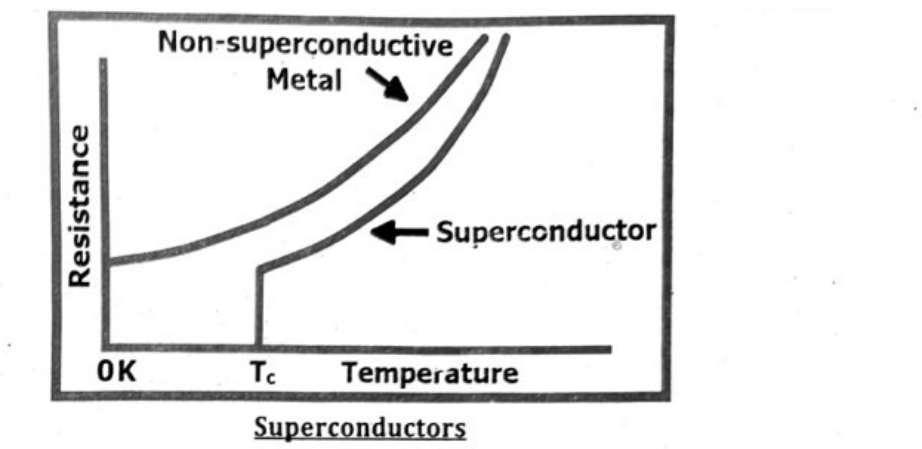
Superconductors
When we connect a wire or a device like a bulb with the cell, current flows through it. Current flow means free electrons in the wire move through gaps between the atoms of the conductor. But they collide with the atoms of the conductor. This causes a hindrance to their flow which is called resistance of the conductor and, if we relate it with the material, then it is called specific resistance or resistivity of the material of the conductor. Atoms of the conductor are in vibrational motion. With decrease in temperature, their amplitude of vibration decreases. This increases the size of the gap between the atoms. Due to this, collisions of flowing electrons with the atoms of the conductor decrease and hence, resistivity of the material also decreases.
If we keep on decreasing the temperature, then at a certain temperature (critical temperature) the resistivity of the material becomes zero and then the material is called a superconductor.
The general graph relating superconductor and normal metal is shown in the figure. Superconductivity was discovered by Dutch physicist Heike Kamerlingh Onnes in 1911. While studying the properties of materials at very low temperatures, he observed that electrical resistance of mercury becomes zero when cooled to about 4.2 Kelvin (−268.95°C). He got Nobel Prize in Physics in 1913.
| Substances | Critical temperature |
|---|---|
| Mercury (Sb) | 4.2 K |
| Aluminum (Al) | 1.18 K |
| Tin (Sn) | 3.72 K |
| Lead (Pb) | 7.2 K |
| Yttrium Barium Copper Oxide (YBCO) | 92 K |
| Bismuth Strontium Calcium Copper Oxide (BSCCO) | 108 K |
Superconductors are used in magnetic levitation (Maglev) trains as shown in the figure, small but powerful electric motors, fast computer chips, and potentially more efficient power transmission lines. Researchers continue to explore ways to achieve superconductivity at higher temperatures, which would make it more practical for everyday use.
Critical Temperature:
The temperature at which and below which the resistance and resistivity of a substance become zero is called the critical temperature or superconducting transition temperature.
Effect of the temperature on distance between particle of matter.
Solids:
In solids, particles are close to each other, and they have a high density. There is a strong attractive force between particles, which keeps them closely packed. Particles in solids can only vibrate about their mean position. When a solid absorbs heat, the vibrational kinetic energy and amplitude of the vibration of its particles increase. These particles push each other away and increase the gap between them. This is how solids expand upon heating.
Liquids:
A liquid has intermediate density (smaller than a solid and higher than a gas). The attractive force between its particles is stronger than that of gases but weaker than that of solids. Due to it, the distance between particles in liquid is greater than that in solids. Liquid particles keep changing their position. Liquid particles flow. When a liquid is heated, attractive force between particles decreases and particles start moving.
Gases:
In gases, there is negligibly weak attractive force between gas particles. Due to weak attractive force, distance between particles is larger as compared to the size of the particles. Particles are in constant random motion and they constantly collide with each other and with the walls of the container. Due to collisions of gas particles with container, they exert pressure. Gases are less dense than liquids and gases. When gases are heated, kinetic energy of gas molecules increases. They move faster and expand quickly. The change in distances between the particles of different states of matter is due to change in their temperature.
Examples:
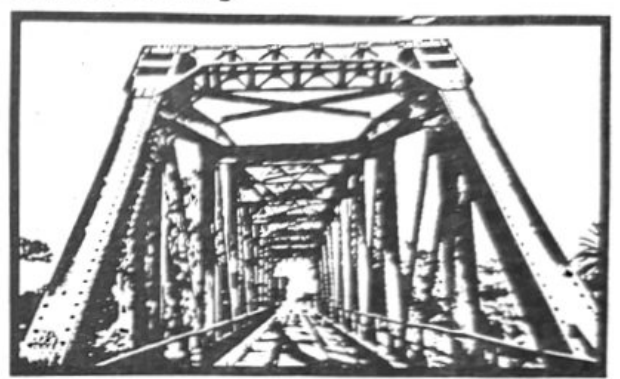
GIVEN:
- Original length, $L_0 = 1.5\ \mathrm{km} = 1500\ \mathrm{m}$
- Coefficient of linear thermal expansion, $\alpha = 12 \times 10^{-6}\ \mathrm{K^{-1}}$
- Change in temperature, $\Delta T = 15^\circ\mathrm{C} = 15\ \mathrm{K}$
REQUIRED:
Change in length, $\Delta L = ?$
SOLUTION:
Increase in length of the bridge is calculated by the formula:
$$\Delta L = \alpha L_0 \Delta T$$
Putting values:
$$\Delta L = (12 \times 10^{-6}\ \mathrm{K^{-1}})(1500\ \mathrm{m})(15\ \mathrm{K})$$
Therefore, $\Delta L = 0.27\ \mathrm{m}$.
So, the increase in the length of the bridge is 0.27 m.
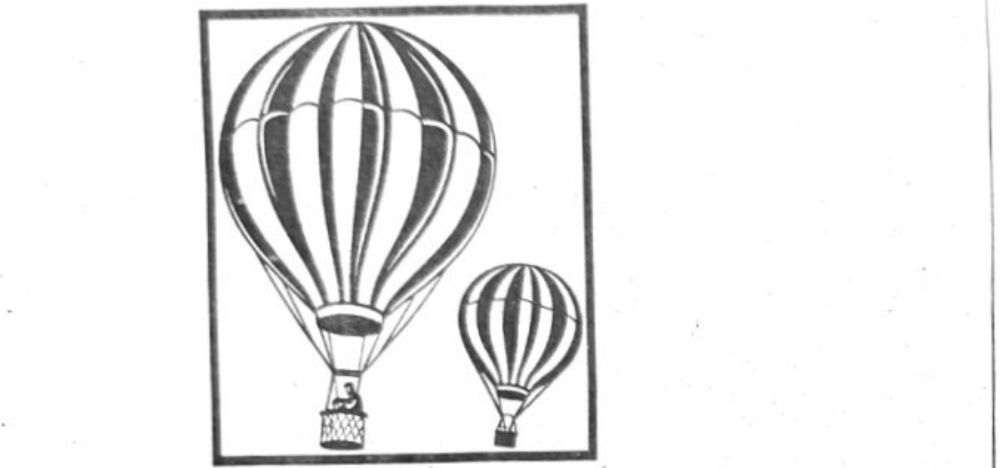
GIVEN:
- Original volume, $V_0 = 500\ \mathrm{m^3}$
- Coefficient of volume thermal expansion, $\beta = 3.5 \times 10^{-5}\ \mathrm{K^{-1}}$
- Change in temperature, $\Delta T = 80^\circ\mathrm{C} - 20^\circ\mathrm{C} = 60^\circ\mathrm{C} = 60\ \mathrm{K}$
REQUIRED:
Change in volume, $\Delta V = ?$
SOLUTION:
Increase in volume of the balloon is calculated by the formula:
$$\Delta V = \beta V_0 \Delta T$$
Putting values:
$$\Delta V = (3.5 \times 10^{-5}\ \mathrm{K^{-1}})(500\ \mathrm{m^3})(60\ \mathrm{K})$$
Therefore, $\Delta V = 1.05\ \mathrm{m^3}$.
After raising the temperature by filling the balloon with air at 80°C, the increase in volume of the hot air balloon is 1.05 m³.
GIVEN:
Original volume, $V_0 = 250\ \mathrm{ml} = 250 \times 10^{-6}\ \mathrm{m^3}$
Coefficient of real expansion, $\gamma_r = 500 \times 10^{-6}\ \mathrm{K^{-1}}$.
Change in temperature, $\Delta T = 70^\circ\mathrm{C} - 20^\circ\mathrm{C} = 50^\circ\mathrm{C} = 50\ \mathrm{K}$.
REQUIRED:
Change in volume, $\Delta V = ?$
SOLUTION:
Increase in volume of the glycerine is calculated by the formula:
$$\Delta V = \gamma_r V_0 \Delta T$$
Putting values: $\Delta V = (500 \times 10^{-6}\ \mathrm{K^{-1}})(250 \times 10^{-6}\ \mathrm{m^3})(50\ \mathrm{K})$
Therefore, $\Delta V = 6.25 \times 10^{-6}\ \mathrm{m^3} = 6.25\ \mathrm{ml}$. [ANSWER]
Increase in the volume of glycerine is 6.25 ml when its temperature rises by 50°C.
GIVEN:
- Mass of ice-cream, $m = 0.5\ \mathrm{kg}$
- Initial temperature, $T_0 = 20^\circ\mathrm{C}$
- Final temperature (melting point), $T = -10^\circ\mathrm{C}$
- Specific heat capacity of ice, $c = 2.1 \times 10^3\ \mathrm{J/kg^\circ C}$
- Latent heat of fusion, $L_f = 3.347 \times 10^5\ \mathrm{J/kg}$
REQUIRED:
Heat for melting ice-cream, $\Delta Q = ?$
SOLUTION:
Change in temperature is given by:
$$\Delta Q = T - T_0 = -10^\circ\mathrm{C} - (-20^\circ\mathrm{C}) = 10^\circ\mathrm{C}$$
First, we will provide heat to increase the temperature of the ice-cream from 20°C to 10°C (melting point).
$$\Delta Q_1 = mc\Delta T$$
Putting values: $\Delta Q_1 = (2.1 \times 10^3\ \mathrm{J\ kg^{-1}\ ^\circ C^{-1}})(0.5\ \mathrm{kg})(10^\circ\mathrm{C})$
Hence, $\Delta Q_1 = 1.05 \times 10^4\ \mathrm{J}$.
Now we will find heat required for melting ice-cream at its melting point:
$$\Delta Q_2 = mL_f$$
Putting values: $\Delta Q_2 = (0.5\ \mathrm{kg})(3.347 \times 10^5\ \mathrm{J\ kg^{-1}}) = 16.735 \times 10^4\ \mathrm{J}$
Total heat required will be: $\Delta Q = \Delta Q_1 + \Delta Q_2$
Putting values: $\Delta Q = 1.05 \times 10^4\ \mathrm{J\ kg^{-1}} + 16.735 \times 10^4\ \mathrm{J\ kg^{-1}}$
Therefore, $\Delta Q = 17.785 \times 10^4\ \mathrm{J\ kg^{-1}} = 177.85\ \mathrm{kJ}$. [ANSWER]
So, a total of 177.85 kJ of heat will be required to melt an ice-cream of 0.5 kg at −20°C.
Summary
- Freezing is the phenomenon in which liquid changes into solid.
- Melting is the phenomenon in which solid changes into liquid.
- Vaporization is the phenomenon in which a liquid is converted into gas (vapours) upon boiling.
- Evaporation is phenomenon of conversion liquid into vapours at any temperature.
- Condensation is a phenomenon in which gases (vapours) change into liquids.
- Sublimation is a phenomenon in which solids change directly into gases.
- Deposition is a phenomenon in which gas changes directly to solid.
- Thermal expansion means “increase in size of matter on heating”.
- Linear thermal expansion of solids is increase in length of substance on heating.
- Volume thermal expansion of solids is increase in volume of substance on heating.
- Coefficient of linear thermal expansion is the fractional change in length per kelvin change in temperature.
- Coefficient of volume thermal expansion is the fractional change in volume per Kelvin change in temperature.
- Real volume expansion is thermal expansion in volume of liquid when it is heated directly.
- Apparent volume expansion is thermal expansion of volume of liquid in a container without considering the expansion of its container.
- Bimetallic Strips consists of two thin strips of different metals joined together which bend on heating.
- Humidity is content of water in air.
- Refrigerant is a material used to produce cooling in refrigerator that absorb an releases heat by cycling between liquid and gaseous state.
- Latent Heat is the amount of heat energy absorbed or lost by a substance during its phase change without change in its temperature.
- Latent Heat of Fusion is the amount of heat energy required to convert a given mass of a substance from the solid state to the liquid state without change in its temperature is called its latent heat of fusion.
- Latent Heat of Vaporization is the amount of heat energy required to convert a given mass of a substance from the liquid state to the gaseous state without any change in its temperature is called its latent heat of vaporization.
- Pressure is Force on unit area on an object perpendicularly.
- Pressure of Gas is the measure of force exerted by the gas particles on unit area of the walls of the container perpendicularly.
- Superconductor are those material through which current flows without resistance.
- Critical temperature is the temperature at which and below which the resistance and resistivity of substance become zero is called the critical temperature.