
Constructed Response Questions:
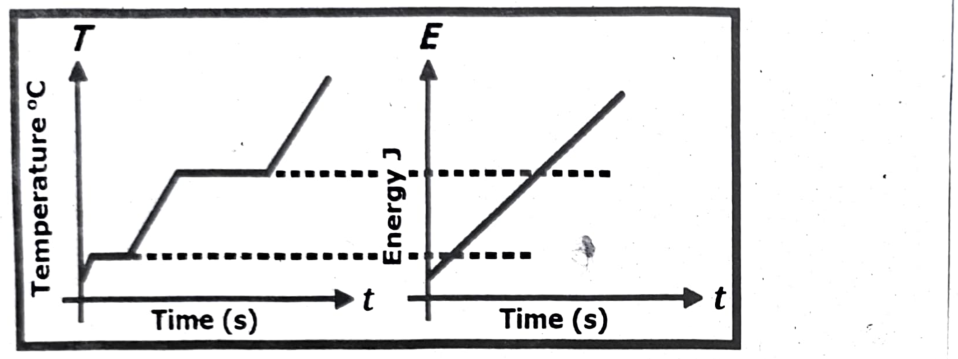
(T)-time (t) graph shows that change of temperature of ice and water during different stages.
There are two horizontal parts of this graph, where temperature is not changing but energy is being supplied to substance at constant rate. Explain why does temperature not change at these two stages?
Explain why the temperature and energy trends are not same for the same time intervals.
a. Explanation for Constant Temperature Stages:
The two horizontal parts of the temperature-time graph represent phase transitions. During these stages, the energy supplied is used to overcome the intermolecular forces holding the substance in its current phase, rather than increasing the kinetic energy of the molecules.
First Horizontal Stage (Melting): The energy is used to break the bonds holding the ice in a solid structure, converting it to liquid water. All the energy goes into breaking the solid bonds, so the temperature remains constant at 0°C until all the ice has melted.
Second Horizontal Stage (Boiling): Once all the water is heated to 100°C, the energy supplied is used to break the bonds holding the water in a liquid state, converting it to steam (gaseous state). The temperature remains constant at 100°C until all the water has evaporated.
b. Explanation for Different Temperature and Energy Trends:
The temperature and energy trends differ because the energy supplied to the substance is used in different ways depending on the phase:
During a Phase Change (Horizontal Stages): The energy is used to change the state of the substance (solid to liquid, or liquid to gas) without increasing the kinetic energy of the molecules and hence no change in temperature.
During Temperature Increase (Sloped Stages): The energy is used to increase the kinetic energy of the molecules, which results in a rise in temperature. The amount of temperature increase depends on the specific heat capacity of the substance in that phase (ice, water, or steam).
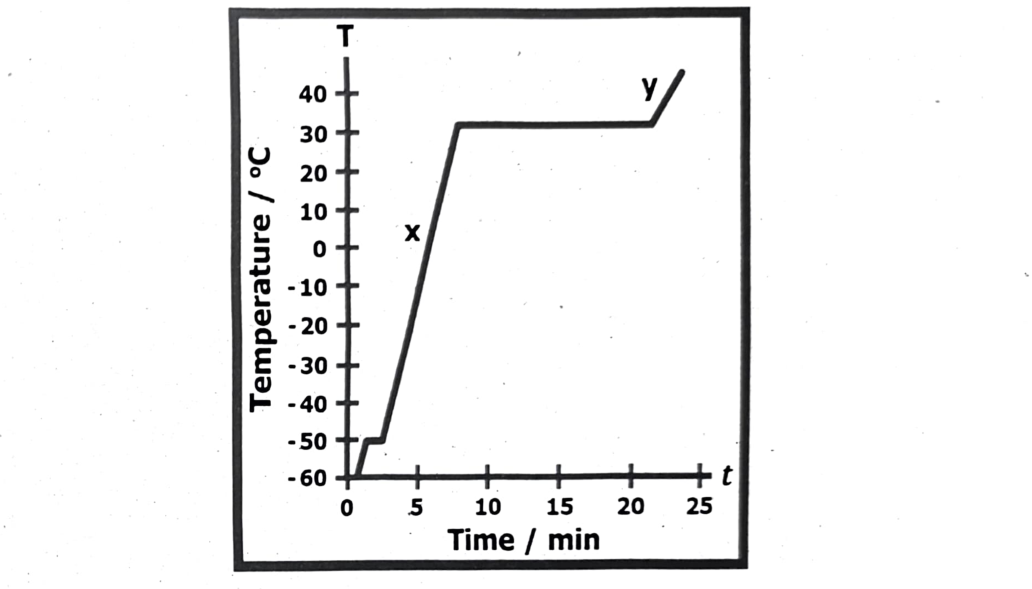
Given:
Mass of substance = m = 100 g = 0.1 kg
Heater power = P = 250 W
Graph of temperature vs. time
a. Melting and Boiling Points:
Melting Point: From the graph, the temperature remains constant during melting at 0°C.
Boiling Point: From the graph, the temperature remains constant during boiling at 30°C.
b. Time to Melt and Vaporize:
Time to Melt: The melting process occurs between approximately t = 2 minutes and t = 7 minutes. Therefore, the time to melt is 7 − 2 = 5 minutes = 300 seconds.
Time to Vaporize: The vaporization process occurs between approximately t = 12 minutes and t = 22 minutes. Therefore, the time to vaporize is 22 − 12 = 10 minutes = 600 seconds.
c. Temperature Increase in Liquid Phase:
The liquid phase is represented by the section of the graph where the temperature is increasing between the melting and boiling points. From the graph, this occurs between 0°C and 30°C.
Therefore, the temperature increase in the liquid phase is:
$$30^\circ\mathrm{C} - 0^\circ\mathrm{C} = 30^\circ\mathrm{C}$$
d. Latent Heat of Vaporization:
The energy supplied during vaporization is given by:
$$Q = P \cdot t$$
Where P is the power and t is the time.
The time for vaporization is 600 s, so the energy supplied is:
$$Q = 250\ \mathrm{W} \times 600\ \mathrm{s} = 150{,}000\ \mathrm{J}$$
The latent heat of vaporization, $L_v$, is the energy per unit mass:
$$L_v = \frac{Q}{m} = \frac{150{,}000\ \mathrm{J}}{0.1\ \mathrm{kg}} = 1{,}500{,}000\ \mathrm{J/kg} = 1.5 \times 10^6\ \mathrm{J/kg}$$
Short Questions:
Dew forms on leaves and grass in the spring morning due to a process called condensation. When temperatures drop overnight, the air near the ground cools, and the water vapor in the air condenses onto the cooler surfaces of leaves and grass, forming dew drops. In summary, dew forms because the air near the ground cools overnight, reducing its ability to hold moisture. This causes water vapor to condense into liquid droplets on cool surfaces like leaves and grass.
OR (Second Answer)
Dew drops form on leaves and grass in the early morning due to condensation. During the night, the ground and plants cool down as the temperature drops. As the air cools, it can hold less moisture, and when the air temperature reaches its dew point (the temperature at which air becomes saturated), the moisture in the air condenses into tiny droplets on surfaces like leaves and grass. This is why you often see dew in the early morning, especially in spring when the nights are cooler and the mornings are moist.
Effect of pressure and temperature variation on sublimation and deposition:
Sublimation: Sublimation is the process where a substance transitions directly from a solid to a gas phase without passing through the liquid phase.
Temperature: Higher temperatures favor sublimation. Increasing the temperature provides the molecules with more kinetic energy, making it easier for them to overcome the intermolecular forces holding them in the solid phase and transition directly into the gaseous phase.
Pressure: Lower pressures favor sublimation. Decreasing the pressure reduces the external force pushing the molecules together, making it easier for them to escape from the solid phase into the gaseous phase.
Deposition: Deposition is the reverse process, where a substance transitions directly from a gas to a solid phase without passing through the liquid phase.
Temperature: Lower temperatures favor deposition. Decreasing the temperature reduces the kinetic energy of the molecules in the gaseous phase, making it easier for them to lose energy and condense directly into the solid phase.
Pressure: Higher pressures favor deposition. Increasing the pressure brings the gas molecules closer together, increasing the intermolecular forces between them and making it easier for them to solidify directly.
In summary, sublimation is favored by high temperatures and low pressures, while deposition is favored by low temperatures and high pressures.
OR (Second Answer)
Sublimation and deposition are both phase transitions that are influenced by changes in pressure and temperature. Sublimation, the process where a solid turns directly into a gas, typically occurs at low pressure and higher temperatures. When pressure is reduced or temperature increases, more molecules can gain enough energy to overcome the solid phase and escape directly into the gas phase. On the other hand, deposition, where a gas turns directly into a solid, happens at lower temperatures and higher pressures. In this case, gas molecules lose enough energy to settle into a solid form, bypassing the liquid phase. Therefore, increasing pressure and decreasing temperature favor deposition, while the opposite conditions favor sublimation.
The formation of vapors on the handle and cylinder of a fire extinguisher upon discharge is primarily due to the Joule-Thomson effect, also known as the Joule-Kelvin effect.
Explanation:
High Pressure Inside:
Fire extinguishers contain a compressed gas or liquefied gas under high pressure (e.g., carbon dioxide, nitrogen, or a chemical propellant).
Rapid Expansion:
When the fire extinguisher is discharged, the compressed gas rapidly expands as it exits through the nozzle. This expansion is an adiabatic process (occurs without heat exchange with the surroundings).
Joule-Thomson Effect:
For real gases (as opposed to ideal gases), rapid expansion causes a change in temperature. Most gases experience a cooling effect during expansion, known as the Joule-Thomson effect.
Cooling of the Cylinder:
As the gas expands and cools, it draws heat from the cylinder and the handle of the fire extinguisher. This can cause the temperature of the cylinder and handle to drop significantly.
Condensation of Atmospheric Moisture:
If the temperature of the cylinder and handle drops below the dew point of the surrounding air, water vapor in the air will condense on these surfaces, forming visible “vapors” (which are actually tiny water droplets).
OR (Second Answer)
When a fire extinguisher is discharged, the gas inside the cylinder rapidly expands as it is released under pressure. This expansion causes the gas to cool down significantly, which lowers its temperature. As the gas cools, it can cause moisture in the surrounding air to condense, forming visible vapors or droplets on the handle and cylinder. This phenomenon is similar to how water vapor forms on a cold glass on a humid day. The cooling effect is due to the Joule-Thomson effect, where the rapid expansion of a gas leads to a decrease in temperature.
Sweating cools the body during exercise through a process called evaporative cooling. When sweat glands release sweat onto the skin, the water in the sweat evaporates, absorbing heat from the body in the process, which then cools the skin and underlying tissues. This process helps maintain a stable internal body temperature, preventing overheating, especially during strenuous physical activity.
Draw a temperature-time graph illustrating the changes in temperature of metal X as it is heated.
Now, examine a different metal, Y, which has a higher latent heat of fusion compared to metal X. Both metals have identical melting points and heat capacities. The heating procedure for metal Y is conducted under the same energy supply rate as metal X. Describe how the temperature-time graph for metal Y will differ from that of metal X, considering the implications of its greater latent heat of fusion.
Answer:
The graph will show a linear increase in temperature from 100°C to 250°C.
There will be a plateau at 250°C as the metal melts.
After melting, the temperature will increase linearly again until it reaches 400°C.
The graph for metal Y will have the same initial linear increase from 100°C to 250°C.
The plateau at 250°C will be longer for metal Y due to its higher latent heat of fusion.
The final linear increase from 250°C to 400°C will have the same slope as metal X.
Therefore, the temperature-time graph for metal Y will have a longer plateau at the melting point compared to metal X.
OR (Second Answer)
a. Temperature-Time Graph for Metal X:
A description of how the temperature-time graph for metal X would look:
Initial Heating (100°C to 250°C):
The graph starts with a linear increase in temperature from 100°C to 250°C. The slope of this line depends on the specific heat capacity of the solid metal X and the rate at which the heater supplies energy.
Melting (250°C):
At 250°C, the temperature remains constant as the metal melts. This is represented by a horizontal line on the graph. The length of this horizontal line depends on the latent heat of fusion of metal X and the rate at which energy is supplied.
Heating of Liquid (250°C to 400°C):
Once all the metal has melted, the temperature again increases linearly from 250°C to 400°C. The slope of this line depends on the specific heat capacity of the liquid metal X and the rate at which the heater supplies energy.
b. Comparison of Temperature-Time Graphs for Metals X and Y:
Metals X and Y have the same melting points and heat capacities, but metal Y has a higher latent heat of fusion. This means that the temperature-time graphs will differ primarily in the melting phase:
Initial Heating:
The initial heating phase (from 100°C to 250°C) will be identical for both metals since they have the same heat capacities and are heated at the same rate.
(ii) Melting:
The melting phase (at 250°C) will be longer for metal Y than for metal X. This is because metal Y requires more energy to completely melt due to its higher latent heat of fusion. Therefore, the horizontal line representing the melting phase will be longer for metal Y.
(iii) Heating of Liquid:
The heating of the liquid phase (from 250°C to 400°C) will again be identical for both metals since they have the same heat capacities in the liquid state and are heated at the same rate.
In summary:
The graph for metal Y will have a longer horizontal line at the melting point (250°C) compared to metal X, indicating the greater amount of energy required to melt metal Y.
The rest of the graph (initial heating and heating of the liquid) will be the same for both metals, assuming identical heating rates and heat capacities.
During a long drive on a hot day, the pressure in a car tire will generally increase. This is primarily due to the expansion of air molecules inside the tyre as they heat up, following the principles of thermodynamics.
Initial State: When a car tire is initially inflated, it has a certain pressure and temperature.
Driving Increases Temperature: During a long drive, the tire undergoes flexing and friction with the road surface. This generates heat, which increases the temperature of the air inside the tire.
Constant Volume: The volume of the tire remains approximately constant because it is a closed container with relatively rigid walls.
Pressure Increase: Since the volume $V$ and the number of moles $n$ are approximately constant, the pressure $P$ is directly proportional to the temperature $T$. Therefore, as the temperature of the air inside the tire increases, the pressure inside the tire also increases.
OR (Second Answer)
During a long drive on a hot day, the pressure in a car tire increases due to the temperature rise. As the car moves, the friction between the tires and the road causes the tires to heat up. According to Gay-Lussac’s Law, when the temperature of a gas (in this case, the air inside the tire) increases, its pressure also increases, provided the volume remains constant. As the air inside the tire heats up, the molecules move faster, causing them to collide with the tire walls more frequently and forcefully, which increases the pressure. This is why tire pressure is typically higher after a long drive compared to when the car is stationary, especially on a hot day. It’s important to monitor tire pressure regularly, as over-inflated tires can lead to reduced traction, uneven wear, or even a blowout.
Understanding thermal expansion helps prevent sidewalk cracks during hot weather by allowing for planned expansion and contraction in the concrete. By incorporating expansion joints, the sidewalk can move with temperature changes, reducing stress and preventing uncontrolled cracking. Proper planning for thermal expansion helps maintain the integrity of the sidewalk, preventing cracks and ensuring its durability even during extreme temperature fluctuations.
A high-powered heat lamp would be more effective for melting snow trapped underneath a car compared to a pot of hot water because it can deliver concentrated heat over a larger area, melting the snow faster.
Explanation:
Heat lamp efficiency:
A high-powered heat lamp generates a focused beam of infrared radiation, which directly melts snow on contact. This concentrated heat can quickly penetrate the snowpack and reach the trapped areas.
Pot of hot water limitations:
While hot water can melt snow, its heat transfer is less efficient due to its surface area limitations. The snow needs to be in direct contact with the pot to melt, which takes longer than using a heat lamp. Additionally, the water might cool down quickly in cold outdoor conditions.
Evaporation of water from a plant’s leaves, known as transpiration, creates a “suction” or negative pressure that pulls water and dissolved nutrients upward through the plant from the roots to the leaves. This process, along with the properties of water like cohesion and adhesion, drives the continuous flow of water throughout the plant.
Adding ice to a drink cools it down more effectively than adding cold water because ice absorbs more heat during its phase change (melting). Specifically, when ice melts at 0°C, it absorbs the “latent heat of fusion” from the drink, which is a significant amount of energy, effectively drawing more heat away and cooling the drink more.
Maintaining the extremely low temperatures needed for superconductivity presents significant challenges due to the high energy costs and complexity of refrigeration systems. Superconductivity is a phenomenon that typically
occurs at temperatures close to absolute zero. Maintaining such low temperatures is not only technically challenging but also energy-intensive and expensive.Maintaining such low temperatures requires complex and costly cooling systems, such as liquid helium or liquid nitrogen cryostats
The need for expensive cooling limits the widespread adoption of superconducting technologies in many fields
Long Questions:
Definition of Latent Heat:
Latent heat is the amount of heat energy absorbed or released by a substance during a phase change without any change in its temperature. This heat is used to break or form the intermolecular bonds, rather than increasing the kinetic energy of the molecules and causing a temperature change.
Differentiating between Latent Heat and Specific Latent Heat of Fusion:
Latent heat:
This refers to the total amount of heat energy absorbed or released during a phase change, and it depends on the mass of the substance.
$Q = mL$
Specific latent heat of fusion:
This is the amount of heat energy required to change the state (from solid to liquid, or vice versa) of one unit mass (e.g., one kilogram or one gram) of a substance without any change in temperature.
The formula for latent heat can be rearranged to solve for the specific latent heat of fusion:
$L_f = \frac{Q}{m}$
Difference between latent heat and specific latent heat of vaporization:
| Property | Latent Heat of Vaporization | Specific Latent Heat of Vaporization |
|---|---|---|
| Definition | The total amount of heat energy required to convert a given amount of liquid into vapor at a constant temperature & pressure. | The amount of heat required to convert 1 kg of a liquid into vapor at a constant temperature and pressure. |
| Unit | Joules (J) or Kilojoules (kJ) | Joules per kilogram (J/kg) |
| Depends on Mass | Yes, it depends on the amount of substance being vaporized. | No, it is a property per unit mass (for 1 kg of the substance). |
| Example | 2260 J for converting 1 kg of water into steam at 100°C. | 2260 J/kg for water’s latent heat of vaporization. |
Formulas and Units:
Latent Heat of Vaporization (Q):
$Q = mL_v$
Where:
Q is the latent heat of vaporization (in joules or calories)
m is the mass of the substance (in kg or g)
$L_v$ is the specific latent heat of vaporization (in J/kg or cal/g)
Units: Joules (J) or calories (cal)
Specific Latent Heat of Vaporization ($L_v$):
The formula for latent heat can be rearranged to solve for the specific latent heat of vaporization:
$L_v = \frac{Q}{m}$
Where:
$L_v$ is the specific latent heat of vaporization (in J/kg or cal/g)
Q is the latent heat of vaporization (in joules or calories)
m is the mass of the substance (in kg or g)
Units: Joules per kilogram (J/kg) or calories per gram (cal/g)
Evaporation:
Evaporation is the process by which liquid changes into vapours (gas) at any temperature. This occurs at the surface of the liquid.
DIFFERENCE BETWEEN EVAPORATION AND BOILING:
| Properties | Evaporation | Boiling |
|---|---|---|
| Occurs | at the surface of liquid | Throughout the liquid |
| Temperature | at any temperature | only at boiling point of liquid |
| Energy Source | Uses surrounding energy | uses continuous external heat source |
| Rate/speed | Generally slower and depends on many factors | Fast process (after reaching boiling point) |
| Process Completion Time | It takes longer to be completed | It is quick process than evaporation |
| Effect of pressure | Less effected by external pressure | Highly effected by external pressure |
| Formation of Bubble | No bubble formation | Bubbles are formed throughout the liquid and rise from the surface |
| Dependence on surface area | Depends on surface area | Does not depend on surface area |
| Effect on temperature of surrounding | Causes cooling in surrounding | Increases temperature of surrounding |
FACTORS AFFECTING RATE OF EVAPORATION:
The rate of evaporation indicates how quickly molecules at the surface of a liquid escape and become a gas. Higher rate of evaporation means the liquid will evaporate faster. Rate of evaporation depends upon different factors, such as:
Temperature:
Rate of evaporation is directly proportional to temperature. Higher temperature of the liquid increases kinetic energy of its molecules and increase the rate of evaporation. Water in sunshine (high temperature area) evaporates faster than water in shade (low temperature area).
Surface Area:
A larger surface area allows more molecules to escape, speeding up evaporation. Larger is the surface area of a liquid, greater number of molecules has the chance to escape from its surface. It is why wet clothes are stretched out to dry quickly.
Humidity:
Dry air is less humid air (It has low value of moisture in it). It has ability to store more moisture. Therefore, lower humidity levels increase the rate of evaporation as dry air can allow more water vapours to be absorbed. You now understand that room air coolers function most efficiently in the dry air months of June and less efficiently in the humid months of August.
Wind Speed
Increased wind speed blows away the moist air near the surface, which speeds up the rate of evaporation. It is why wet clothes dry quickly in windy day than on a calm day.
Linear thermal expansion refers to the increase in length of a solid when heated, while volume thermal expansion refers to the increase in volume. Both types of expansion are influenced by the change in temperature, the material’s coefficient of thermal expansion, and the original dimensions of the object.
Linear Thermal Expansion:
Definition:
The increase in the length of a solid object when heated.
Factors:
Temperature Change: The larger the increase in temperature, the greater the expansion.
Original Length: A longer object will expand more than a shorter object for the same temperature change.
Material: Different materials expand at different rates, with a material’s specific coefficient of linear expansion ($\alpha$) dictating how much it expands for a given temperature change.
Formula:
$$\Delta L = \alpha L_0 \Delta T$$
Where $\Delta L$ is the change in length, $\alpha$ is the coefficient of linear expansion, $L_0$ is the original length, and $\Delta T$ is the change in temperature.
Volume Thermal Expansion:
Definition:
The increase in volume of a solid object when heated, which results from the expansion of all three dimensions.
Factors:
Temperature Change: Similar to linear expansion, a larger temperature increase leads to greater volume expansion.
Original Volume: A larger volume will experience a greater change in volume for the same temperature change.
Material: Different materials have different coefficients of volumetric expansion ($\beta$), impacting how much they expand in volume.
Formula:
$$\Delta V = \beta V_0 \Delta T$$
Where $\Delta V$ is the change in volume, $\beta$ is the coefficient of volumetric expansion, $V_0$ is the original volume, and $\Delta T$ is the change in temperature.
Uses of Thermal Expansion in Daily Life:
Thermal expansion, the tendency of matter to change in volume in response to temperature changes, has numerous practical applications in our daily lives. Examples include the use of bimetallic strips in thermostats, the expansion joints in bridges and roadways, and the operation of mercury thermometers.
Specific examples:
Thermostats:
Bimetallic strips, made of two different metals with different coefficients of thermal expansion, bend in response to temperature changes, triggering switches to control heat.
Bridges and Roads:
Expansion joints are designed to allow for the expansion and contraction of materials like concrete and steel as temperatures fluctuate, preventing buckling and stress.
Mercury Thermometers:
The thermal expansion of mercury in a glass tube allows for temperature measurement, as the mercury rises with increasing temperature.
Power Lines:
Overhead power lines sag in summer due to thermal expansion and snap tighter in winter due to thermal contraction.
Jar Lids:
Running hot water on a tight jar lid can help loosen it by causing the metal to expand slightly, making it easier to unscrew.
Engine Coolants:
The expansion and contraction of engine coolants in a car’s radiator help regulate engine temperature.
THERMAL EXPANSION IN LIQUIDS:
Thermal expansion of liquids refers to the phenomenon where the volume of a liquid changes in response to a change in temperature. When a liquid is heated, its particles (atoms or molecules) gain kinetic energy and move more vigorously. This increased movement leads to greater average separation between the particles, resulting in an increase in volume.
There are two types of thermal volume expansion for liquid.
Real volume expansion
Apparent volume expansion
Types of Expansion:
Real Expansion:
This refers to the actual increase in the volume of the liquid when heated. It considers the expansion of both the liquid and the container holding the liquid.
$$\gamma_r = \beta = \frac{\Delta V}{V_0\Delta T} \qquad (i)$$
Apparent Expansion:
This is the observed increase in the volume of the liquid without accounting for the expansion of the container. It is always less than the real expansion.
$$\gamma_a = \frac{\Delta V_{\text{apparent}}}{V_0\Delta T} \qquad (ii)$$
Experiment:
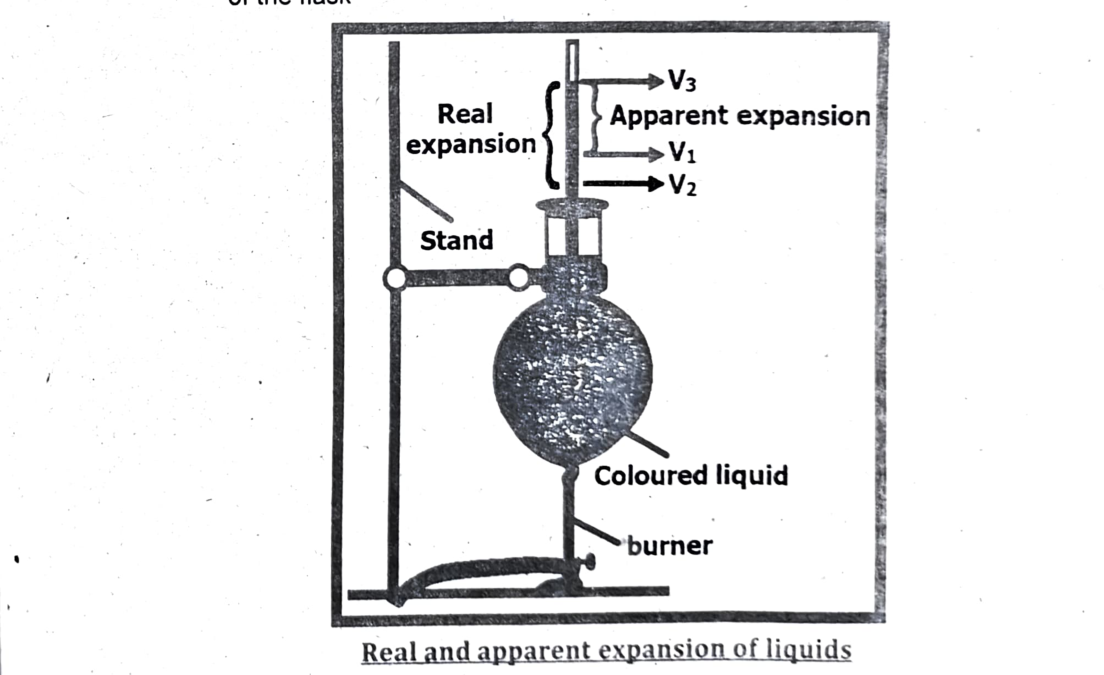
The increase in volume of liquid from ‘V1’ to ‘V2’ is called the apparent expansion in the volume of the liquid. But actually heat is transferred to liquid when it is at level ‘V2’. Therefore, rise in the level of liquid from ‘V2’ to ‘V3’ is called real expansion of liquid. Actual expansion of the liquid is greater than its apparent expansion. While, fall level of liquid from ‘V1’ to ‘V2’ represents expansion in glass flask.
Hence,
Real expansion of the liquid = Apparent expansion of the liquid + Expansion of the flask
Or, $$V_2V_3 = V_1V_3 + V_1V_2 \qquad (iii)$$
The Coefficient of real rate of volume expansion (γr) is always greater than the apparent rate of volume expansion (γa) by an amount equal to the rate of volume expansion of the container (γg).
Thus: $$\gamma_r = \gamma_a + \gamma_g \qquad (iv)$$
It should be noted that different liquids have different coefficients of volume expansion.
Relationship between Real and Apparent Expansion:
The real expansion is the sum of the apparent expansion and the expansion of the container:
$$\gamma_{\text{real}} = \gamma_{\text{apparent}} + \gamma_{\text{container}}$$
Where, $\gamma_{\text{container}}$ is the coefficient of volume expansion of the container.
Bimetallic Strips in Temperature Control Devices (Thermostats):
Bimetallic strips are commonly used in temperature control devices like thermostats because they utilize the principle of thermal expansion. These strips consist of two bonded metals with different expansion rates. As the temperature changes, the strip bends due to the unequal expansion or contraction of the two metals, and this bending movement can be used to activate a switch or measure temperature.
Principle of Thermal Expansion:
Thermal expansion is the tendency of matter to change in size (length, area, or volume) in response to temperature changes. Generally, solids expand when heated and contract when cooled.
How Bimetallic Strips Work:
Two Metals, Different Expansion:
A bimetallic strip is made by bonding two different metal strips together. These metals have different coefficients of linear expansion, meaning they expand and contract at different rates for the same temperature change.
Bending with Temperature Change:
When the temperature changes, the metal with the higher coefficient of linear expansion expands or contracts more than the metal with the lower coefficient. This differential expansion or contraction causes the strip to bend.
Practical Utilization:
Thermostats: In thermostats, the bending of the bimetallic strip is used to activate a switch. When the temperature reaches a certain point, the strip bends enough to make or break an electrical connection, turning a heating or cooling device on or off.
Thermometers: In thermometers, the bending of the bimetallic strip is used to move a pointer on a scale, indicating the temperature. The strip is often wound into a spiral or helical shape to maximize sensitivity to temperature changes.
Examples:
Refrigerator Thermostat: A refrigerator thermostat uses a bimetallic strip to control the compressor. When the temperature drops below a set point, the strip bends, making a contact and turning the compressor on. When the temperature rises to the set point, the strip bends in the opposite direction, breaking the contact and turning the compressor off.
Automobile Thermostat: Automobile thermostats use bimetallic strips to regulate engine temperature. When the engine cools down, the strip bends, opening a valve to allow coolant to flow through the engine. As the engine warms up, the strip straightens, closing the valve and preventing coolant flow.
In essence, the different expansion rates of the two metals in a bimetallic strip are used to create a mechanical movement in response to temperature changes, which can then be harnessed for temperature control or measurement.
Superconductivity:
Superconductivity is a phenomenon observed in certain materials at very low temperatures, characterized by exactly zero electrical resistance and the expulsion of magnetic fields (the Meissner effect). This means that an electric current can flow through a superconducting material indefinitely without losing any energy.
Explanation of the Phenomenon:
Critical Temperature ($T_c$):
Superconductivity occurs below a specific critical temperature ($T_c$), which varies for different materials. Above this temperature, the material behaves as a normal conductor, exhibiting electrical resistance.
Cooper Pairs:
The microscopic theory of superconductivity, known as the BCS theory (Bardeen-Cooper-Schrieffer theory), explains that near absolute zero, electrons in a superconductor form Cooper pairs. These pairs are formed due to a slight attraction between electrons mediated by lattice vibrations (phonons).
Energy Gap:
The formation of Cooper pairs creates an energy gap around the Fermi level. This energy gap means that a minimum amount of energy is required to break apart a Cooper pair and excite an electron.
Zero Resistance:
When a voltage is applied, the Cooper pairs move through the lattice without scattering, as long as their energy is less than the energy gap. This absence of scattering results in zero electrical resistance.
Meissner Effect:
Superconductors expel magnetic fields from their interior when they are cooled below their critical temperature in a magnetic field.
This expulsion is called the Meissner effect. It occurs because the superconductor generates surface currents that create a magnetic field equal and opposite to the external field, canceling the field inside the material.
Scope in the Future World:
Superconductivity has the potential to revolutionize many areas of technology:
Energy Transmission:
- Application: Lossless power transmission over long distances.
- Impact: Significant reduction in energy waste, more efficient power grids.
High-Speed Transportation:
- Application: Magnetic levitation (Maglev) trains.
- Impact: Faster, smoother, and more energy-efficient transportation.
Medical Imaging:
- Application: Superconducting magnets in MRI (Magnetic Resonance imaging) machines.
- Impact: Higher resolution images, improved diagnostics.
Quantum Computing:
- Application: Superconducting qubits in quantum computers.
- Impact: Faster & more powerful computers for solving complex problems.
Electronics:
- Application: Superconducting electronics for high-speed, low-power devices.
- Impact: Faster and more efficient electronic devices.
Fusion Reactors:
- Application: Strong superconducting magnets for plasma confinement in fusion reactors.
- Impact: Potential for clean and sustainable energy.
Scientific Instruments:
- Application: Highly sensitive detectors and sensors.
- Impact: Improved capabilities for scientific research and exploration.
Challenges:
Low Critical Temperatures:
Most superconductors require extremely low temperatures (close to absolute zero) to operate, which is expensive to maintain.
Material Development:
Research is ongoing to discover and develop materials that exhibit superconductivity at higher temperatures (ideally room temperature).
Manufacturing:
Fabrication and integration of superconducting materials into devices can be complex and costly.