
Constructed Response Questions:
Frequency values to classify:
| 0 Hz | 10 Hz | 20 Hz | 1000 Hz | 3500 Hz | 13,000 Hz | 20,000 Hz | 40,000 Hz | 55,000 Hz | 80,000 Hz |
|---|---|---|---|---|---|---|---|---|---|
Ans:
| Frequency (Hz) | Region |
|---|---|
| 0 Hz | Infrasound |
| 10 Hz | Infrasound |
| 20 Hz | Audible |
| 1000 Hz | Audible |
| 3500 Hz | Audible |
| 13,000 Hz | Audible |
| 20,000 Hz | Audible |
| 40,000 Hz | Ultrasound |
| 55,000 Hz | Ultrasound |
| 80,000 Hz | Ultrasound |
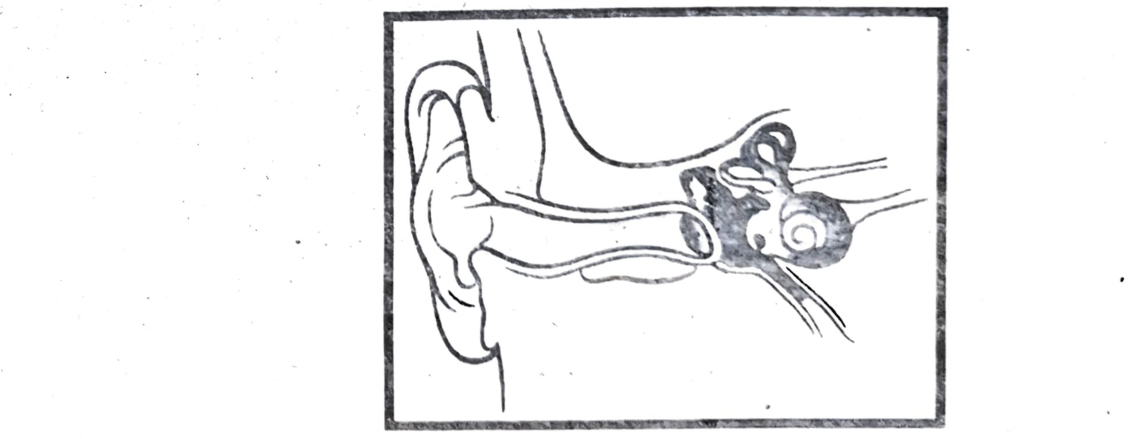
Ans:
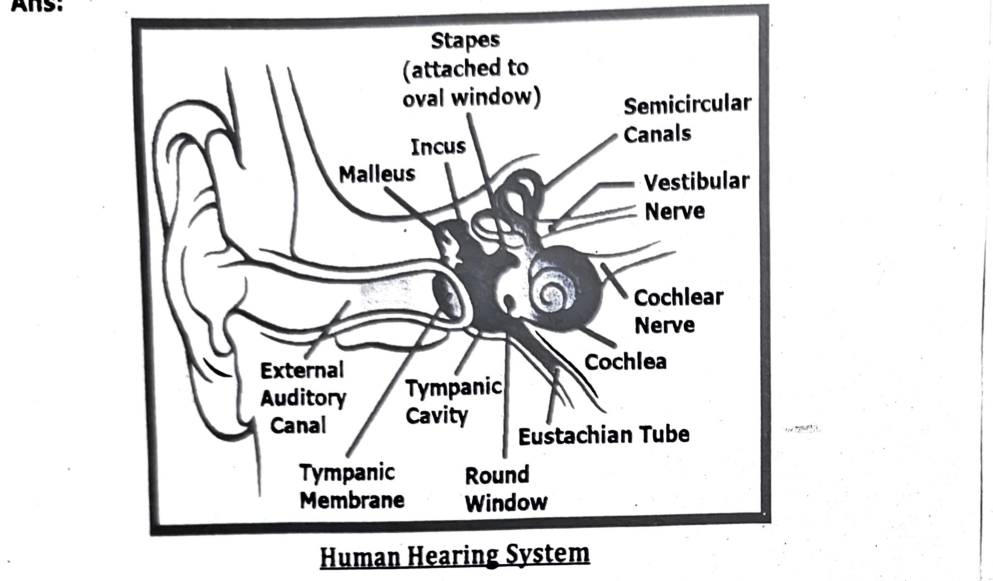
Labels shown in the completed diagram:
- External Auditory Canal
- Tympanic Membrane
- Tympanic Cavity
- Malleus
- Incus
- Stapes (attached to oval window)
- Semicircular Canals
- Vestibular Nerve
- Cochlear Nerve
- Cochlea
- Eustachian Tube
- Round Window
Short Questions:
Sound waves travel from the outer ear to the brain in a multi-step process involving mechanical and electrical signal conversions. Sound waves enter the ear, vibrate the eardrum and ossicles in the middle ear, which in turn transfer these vibrations to the fluid-filled cochlea in the inner ear. Hair cells within the cochlea convert these vibrations into electrical signals that are transmitted via the auditory nerve to the brain, where they are processed and interpreted as sound.
Common sources of harmful noise include transportation (vehicles, aircraft, trains), construction, industrial machinery, and loud entertainment venues. Exposure to excessive noise can lead to hearing loss, cardiovascular problems, sleep disturbances, and psychological stress, among other health issues.
OR (Second Answer)
Common Sources of Harmful Noise
- Industrial Noise: Factories, construction sites, machinery.
- Transportation Noise: Traffic (cars, trucks, motorcycles), airplanes, trains.
- Recreational Noise: Concerts, sporting events, loud music through headphones, nightclubs, power tools, lawnmowers.
- Household Noise: Appliances (vacuum cleaners, blenders), loud televisions or stereos.
- Occupational Noise: Certain workplaces (e.g., airports, construction, manufacturing) expose workers to high noise levels.
Impact on Human Health
- Hearing Loss: Prolonged exposure to loud noise can cause noise-induced hearing loss (NIHL), which can be temporary or permanent.
- Tinnitus: Ringing, buzzing, or hissing in the ears, often caused by noise exposure.
- Cardiovascular Problems: Noise can increase blood pressure, heart rate, and the risk of heart disease.
- Sleep Disturbances: Noise can disrupt sleep patterns, leading to fatigue, irritability, and reduced cognitive function.
- Stress and Mental Health: Noise can contribute to stress, anxiety, and depression.
- Cognitive Impairment: Noise can interfere with concentration, memory, and learning, especially in children.
- Communication Difficulties: Noise can make it difficult to understand speech, leading to social isolation and frustration.
- Other Health Effects: Some studies suggest links between noise exposure and other health problems, such as headaches, digestive issues, and immune system dysfunction.
Animals, like elephants and whales, utilize infrasound (very low-frequency sound waves) for long-distance communication, while humans primarily rely on audible sound and other methods like visual cues and language. Infrasound travels efficiently through various mediums, including air and even the ground, allowing animals to communicate over vast distances, even miles apart. Humans, on the other hand, have limited infrasound detection capabilities and primarily use audible sound, which is more effective for localized communication.
Animal Infrasound Communication
Long-distance communication
Infrasound’s long wavelengths allow it to travel great distances, making it ideal for animals to maintain social bonds, find mates, or warn of danger across large areas.
Examples
Elephants use infrasound to communicate with each other across vast distances, even miles apart, while whales also utilize infrasound for long-range communication.
Limited directionality
Infrasound is difficult to localize, meaning it's hard to determine the exact source of the sound, which can be an advantage in some situations.
Not easily absorbed
Infrasound is less susceptible to being absorbed by obstacles, making it more reliable for long-distance communication.
Human Communication Methods
Audible sound
Humans primarily use audible sound for communication, including speech, which allows for complex language and nuanced expression.
Visual cues
Body language, facial expressions, and gestures play a significant role in human communication.
Language
Human language is unique in its ability to create complex sentences with subjects, verbs, and objects, allowing for the expression of abstract ideas and concepts.
Symbolic communication
Human language is symbolic, meaning words represent objects, ideas, or actions.
Directional hearing
Humans can easily determine the direction of a sound source using the time difference between when the sound reaches each ear.
In summary, while animals like elephants and whales use infrasound for long-distance communication, humans have developed a more complex system of communication using audible sound, visual cues, and language.
Comparison with Human Communication
- Frequency Range: Humans primarily use sound in the audible range (20 Hz to 20 kHz) for communication. We cannot hear infrasound (below 20 Hz) without technological assistance.
- Purpose: Human communication serves a wide range of purposes, including conveying information, expressing emotions, building relationships, and creating art. Animal infrasound communication is often focused on more basic needs like warning, mating, and navigation.
Ultrasonic cleaning offers several advantages, including superior cleaning power, speed, and efficiency compared to manual methods. It can effectively remove contaminants from intricate parts and surfaces that are difficult to reach with traditional cleaning methods. However, it also has limitations, such as potential damage to delicate materials, higher initial costs, and the need for specialized knowledge for optimal operation.
Advantages of Ultrasonic Cleaning:
Superior Cleaning:
Ultrasonic cleaning utilizes cavitation, where high-frequency sound waves create tiny bubbles that implode on surfaces, dislodging and removing contaminants with greater efficiency than manual or mechanical methods.
Speed and Efficiency:
The automated process allows for simultaneous cleaning of multiple items, significantly reducing cleaning time and increasing throughput in manufacturing environments.
Reduced Labor and Consumables:
Ultrasonic cleaning can minimize the need for manual scrubbing and reduce the amount of cleaning solution and other consumables, leading to cost savings.
Reach Difficult Areas:
The cavitation effect enables cleaning of intricate parts, small crevices, and hidden areas that are challenging to access with traditional methods.
Environmental Friendliness:
Ultrasonic cleaning can reduce the use of harsh chemicals and minimize waste, making it a more environmentally responsible option.
Limitations of Ultrasonic Cleaning:
Material Compatibility:
Some materials, particularly very soft metals or delicate components (like certain electronics or ceramics), can be damaged by the cavitation process, potentially causing dents, erosion, or other forms of damage.
Cost:
Ultrasonic cleaning equipment can be expensive to purchase and maintain, making it less suitable for small-scale or infrequent cleaning tasks.
Operating Expertise:
Proper operation of ultrasonic cleaners requires some level of training and expertise to ensure effective and safe cleaning without causing damage.
Potential for Damage:
While generally gentle, ultrasonic cleaning can cause damage to certain materials, especially if the wrong frequency or cleaning solution is used, or if the parts are not properly positioned.
Noise:
The process can generate noise due to the high-frequency sound waves, which may require hearing protection in some environments.
Ans:
Sound travels faster in solids than in liquids and gases primarily because the molecules in solids are packed more closely together and are more tightly bonded. This close proximity and strong bonding allow sound waves, which are disturbances that travel through a medium via molecular vibrations, to be transmitted more quickly from one molecule to the next. In simpler terms, the molecules in solids are better at passing the “vibration” of the sound wave to their neighbors, resulting in a faster speed of sound.
Here's a more detailed explanation:
- Close Proximity and Tight Bonds:
In solids, molecules are very close to each other and are held together by strong intermolecular forces. This means that when one molecule vibrates due to a sound wave, it can easily transfer that vibration to its neighboring molecules. - Faster Transfer of Energy:
Because the molecules are tightly packed and bonded, the transfer of energy from one molecule to the next is much faster in solids compared to liquids and gases. This results in the sound wave propagating through the solid at a higher speed. - Density and Elasticity:
While density plays a role (denser materials can slow down sound), the elasticity (or stiffness) of the material is also crucial. Solids generally have a higher elasticity than liquids or gases. This means they can recover from a deformation (like a vibration) more quickly, further contributing to the faster speed of sound.
In contrast, liquids and gases have greater intermolecular spaces between molecules. While liquids are denser than gases, their molecules are not as tightly bound as in solids, and their elasticity is lower, causing the sound waves to travel slower.
Ans:
A string telephone (two plastic glasses connected by a taut string) provides clearer and more direct communication than shouting through the air because the string acts as a conductor, transmitting sound waves with less dispersion and allowing for longer distances and clearer reception. When shouting, sound waves spread out in all directions, losing energy and clarity, especially over distance.
Here's a more detailed explanation:
- Sound Transmission:
When someone speaks into a plastic glass, the sound waves cause the bottom of the glass to vibrate. - String as a Medium:
These vibrations are then transferred to the string, which acts as a medium for transmitting the sound waves. - Reduced Dispersion:
Unlike shouting where sound waves spread out in all directions, the string focuses the sound waves, minimizing their dispersion and loss of energy. - Enhanced Clarity: Because the sound waves travel more efficiently through the string, the receiver at the other end experiences clearer and louder sound compared to shouting.
- Longer Distance: The string telephone allows for communication over longer distances than shouting because the sound waves are less likely to dissipate.
Ans:
Two sounds of the same loudness can be distinguished by their timbre or quality. Timbre refers to the characteristic that allows the ear to differentiate between sounds with the same pitch and loudness but produced by different sources. For example, a guitar and a violin can produce sounds of the same loudness and pitch, but their timbres allow us to easily distinguish between them.
Elaboration:
Loudness and Amplitude:
Loudness, which is how intense a sound seems, is related to the amplitude of the sound wave. A larger amplitude means a louder sound.
Pitch and Frequency:
Pitch, which is how high or low a sound is, is related to the frequency of the sound wave. A higher frequency means a higher pitch.
Timbre and Waveform:
Timbre is determined by the waveform of the sound. Even if two sounds have the same amplitude and frequency (and thus the same loudness and pitch), their waveforms can be different, leading to a difference in timbre.
Example:
If two musical instruments produce notes at the same frequency and amplitude, the difference in their shapes (waveforms) will allow us to distinguish them based on their timbre.
Ans:
The time difference between seeing a batsman hit a cricket ball and hearing the sound of the impact is due to the difference in the speeds of light and sound. Light travels much faster than sound, so the light from the impact reaches your eyes almost instantaneously, while the sound waves take a noticeable amount of time to travel to your ears. The reason you see the batsman striking the ball before you hear the sound is due to the difference in the speed of light and the speed of sound.
Speed of Light:
Light travels much faster than sound. The speed of light in air is approximately $3.0 \times 10^8$ meters per second (300,000,000 ms−1). This means that the image of the batsman striking the ball reaches your eyes almost instantaneously.
Speed of Sound:
Sound travels much slower than light. The speed of sound in air at room temperature (around 20°C) is approximately 343 meters per second. Therefore, it takes a noticeable amount of time for the sound of the bat hitting the ball to travel from the stadium to your ears.
Time Delay:
The time difference between seeing the event and hearing the sound depends on the distance between you and the event. The greater the distance, the more noticeable the delay will be.
Ans:
A vibrating simple pendulum’s sound is generally inaudible to humans because its frequency of vibration is typically below the range of human hearing, which is between 20 Hz and 20,000 Hz. While a pendulum does vibrate and produce sound waves, those waves are too low in frequency for our ears to detect.
Here’s why:
Audible Frequency Range:
Humans can only hear sounds with frequencies between 20 Hertz (Hz) and 20,000 Hz.
Pendulum Frequency:
The frequency of a simple pendulum’s vibration is determined by its length and the acceleration due to gravity. For most practical pendulum setups, the frequency is significantly less than 20 Hz.
Infrasound:
Sounds with frequencies below 20 Hz are called infrasound, and are not detectable by the human ear.
Energy Transfer:
Even though the pendulum is vibrating, the energy it transfers to the surrounding air is not enough to create sound waves within the audible range.
Ans:
It happens due to diffraction. Diffraction is a phenomenon of bending of a wave on corners, having size of the order of wavelength of the wave. When two people talk, walking around the corner, sound is diffracted by corner and we able to hear it.
Ans:
To minimize echo and reverberation in a large room, focus on adding sound-absorbing materials to surfaces that reflect sound. This includes covering floors with rugs or carpets, adding soft furnishings like curtains and upholstered furniture, and installing acoustic panels on walls and ceilings. Controlling sound radiation by adjusting speaker placement and loudness can also help.
OR (Second Answer)
To reduce echo and reverberation in a large room:
- Use sound-absorbing materials (e.g., carpets, curtains, acoustic panels).
- Install acoustic ceiling tiles to absorb sound.
- Add soft furnishings (e.g., cushions, sofas).
- Cover hard surfaces (e.g., use rugs on floors, soft materials on walls).
- Use partitions to divide the space into smaller sections.
- Ensure irregular room shapes to diffuse sound and avoid parallel surfaces.
Long Questions:
Ans:
Sound waves are produced by vibrating objects that disturb the surrounding medium, usually air, creating areas of compression and rarefaction. These disturbances propagate outward as a wave, carrying sound energy. Essentially, any object that moves back and forth or oscillates can produce sound waves.
Examples of Sound Production:
Speaking:
When a person speaks, air is pushed out of the lungs and forced through the vocal cords in the larynx. The vibration of the vocal cords creates sound waves that travel through the air.
Musical Instruments:
- Guitar: Plucking a guitar string causes it to vibrate, which in turn vibrates the surrounding air, producing sound.
- Drum: Hitting a drum creates vibrations in the drumhead, which disturbs the air and generates sound waves.
Vehicles:
The engines of vehicles produce sound through the vibration of various parts, such as pistons and cylinders.
Appliances:
Many household appliances, like refrigerators or washing machines, produce sound due to the vibration of their internal components.
Clapping:
When hands clap together, the rapid compression of air between them generates sound waves.
Tuning Fork:
Striking a tuning fork causes it to vibrate, producing a distinct tone as the tines move back and forth.
Blowing a Flute:
When air is blown into a flute, it causes the air column inside to vibrate, producing sound.
How Sound Waves Propagate:
When an object vibrates, it pushes against the air molecules near it, creating a region of higher pressure (compression). This compression then pushes on neighboring air molecules, causing them to compress as well. This process continues, with compressions and rarefactions (regions of lower pressure) moving outward from the source, forming a sound wave. The disturbance, or wave, travels through the medium (like air) until it reaches a receiver, such as a human ear.
Ans:
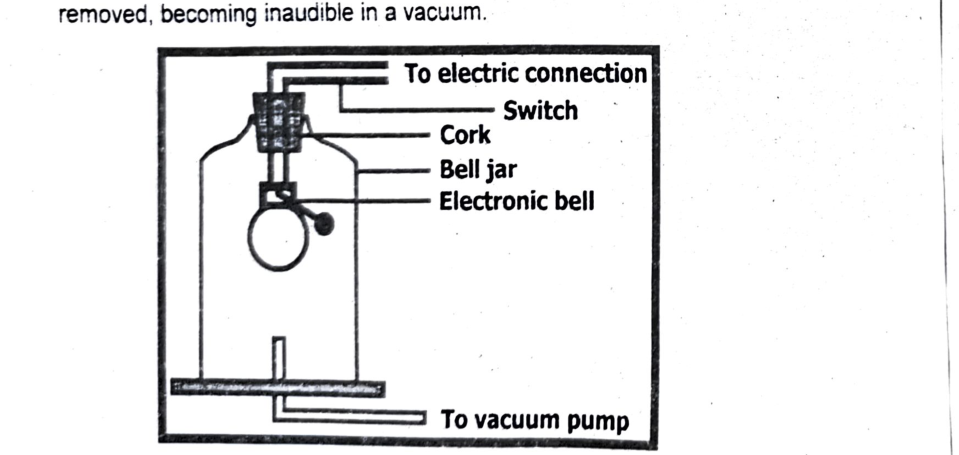
Sound waves are mechanical waves, which means they require a medium (like air, water, or a solid) to travel. They propagate through a medium by causing the particles of that medium to vibrate. These vibrations pass from one particle to the next, transferring energy and creating the wave motion. In a vacuum, there are no particles (no air, no water, nothing). Therefore, there’s nothing to vibrate, and sound waves cannot propagate. A bell jar experiment illustrates this, where a ringing bell’s sound fades as air is removed, becoming inaudible in a vacuum.
Sound as a Mechanical Wave:
Sound waves are disturbances that travel by causing particles in a medium to vibrate.
Vacuum:
A vacuum is a space devoid of matter, meaning there are no particles to vibrate.
No Medium, No Propagation:
Because sound waves require a medium, they cannot travel in a vacuum.
Bell Jar Experiment:
- A bell is placed inside a bell jar connected to a vacuum pump.
- Initially, with air in the jar, the bell’s sound is audible.
- As air is pumped out, the sound gradually fades.
- When a near-perfect vacuum is achieved, the bell’s sound becomes inaudible, even though the bell is still ringing.
- This demonstrates that sound needs a medium to travel and cannot travel through a vacuum.
- This experiment demonstrates that sound requires a medium to travel and cannot propagate through a vacuum.
Ans:
Explanation of the nature of sound waves and how they are propagated:
Nature of Sound Waves:
- Mechanical Waves: Sound waves are mechanical waves, meaning they require a medium to travel through. This medium can be a solid, liquid, or gas.
- Longitudinal Waves: Sound waves are longitudinal waves, which means that the particles of the medium vibrate parallel to the direction of wave propagation. This is different from transverse waves, where the particles vibrate perpendicular to the direction of wave propagation (like light waves).
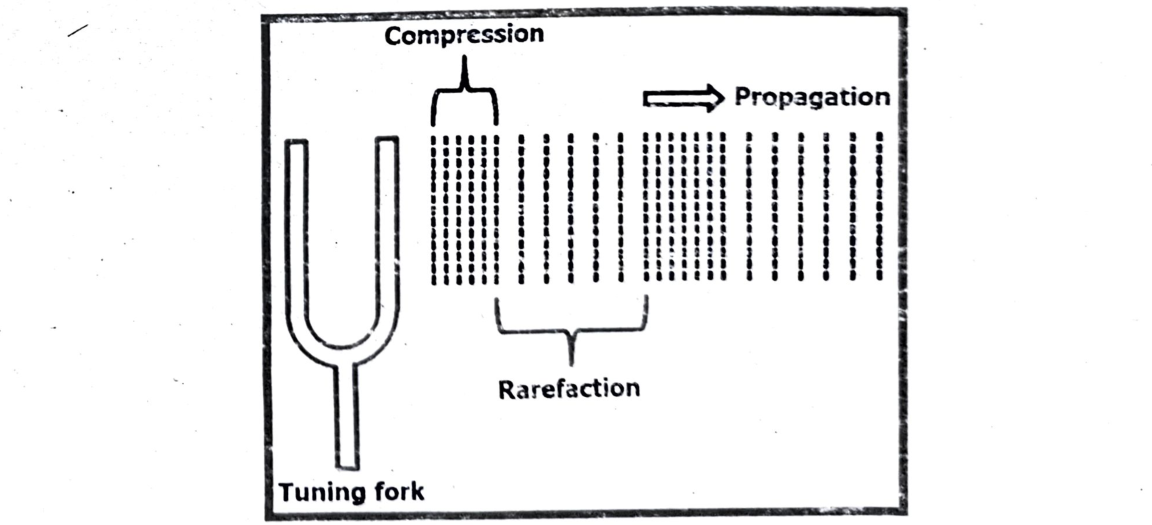
- Compressions and Rarefactions: Sound waves consist of alternating regions of compression (high pressure) and rarefaction (low pressure). Compression occurs when the particles of the medium are pushed closer together, and rarefaction occurs when the particles are spread further apart.
How Sound is Propagated:
- Source of Vibration: Sound is produced by a vibrating object. This could be anything from a loudspeaker cone to a tuning fork to your vocal cords.
- Disturbance in the Medium: The vibrating object causes the particles of the surrounding medium to vibrate.
- Transmission of Energy: The vibrating particles collide with neighboring particles, transferring energy and causing them to vibrate as well. This process continues, with the disturbance propagating through the medium as a wave.
- Compressions and Rarefactions: As the wave propagates, it creates alternating regions of compression and rarefaction in the medium.
- Reaching the Receiver: When the sound wave reaches a receiver (like your ear), it causes the receiver to vibrate. In the case of the ear, the sound wave causes the eardrum to vibrate, which is then processed by the inner ear and interpreted by the brain as sound.
Ans:
Changes in amplitude and frequency directly affect the loudness and pitch of sound waves, respectively. Amplitude determines loudness; a larger amplitude corresponds to a louder sound, while a smaller amplitude results in a quieter sound. Frequency, on the other hand, determines pitch; a higher frequency corresponds to a higher pitch (a “shriller” or “sharper” sound), and a lower frequency corresponds to a lower pitch (a “deeper” sound).
Elaboration:
(i) Amplitude and Loudness:
- Amplitude refers to the maximum displacement of a wave from its resting position.
- In sound waves, a larger amplitude means the air molecules are being displaced further, leading to a greater compression and rarefaction, which our ears perceive as a louder sound.
- Conversely, a smaller amplitude means less displacement, resulting in a softer sound.
- For example, a gentle breeze rustling leaves has a small amplitude, while a loud explosion has a large amplitude.
(ii) Frequency and Pitch:
- Frequency refers to the number of wave cycles that pass a point in a given amount of time (usually measured in Hertz).
- In sound waves, a higher frequency means more wave cycles are passing by in a given time, leading to a higher pitch.
- A lower frequency means fewer wave cycles pass by, resulting in a lower pitch.
- For example, a high-pitched whistle has a high frequency, while the deep rumble of a bass drum has a low frequency.
The relationship between frequency and pitch is logarithmic, meaning that a doubling of frequency doesn’t result in a doubling of perceived pitch, but rather a perceived “octave” higher.
In essence, amplitude controls how much energy a sound wave carries, and therefore how loud it is perceived, while frequency dictates the rate at which the sound wave vibrates, which determines whether it’s perceived as high or low in pitch.
Ans:
Quality of Sound (Timbre):
Quality of sound, also known as timbre, refers to the characteristic that allows us to distinguish between two sounds of the same pitch and loudness produced by different sources. The shape and material of a sound source significantly influence the waveform of the sound produced, which directly impacts the perceived quality.
How Shape Influences Waveform:
Vibrating Objects:
The shape of a vibrating object directly affects the way it vibrates and, consequently, the sound waves it generates. For example, a guitar string fixed at both ends will vibrate in different patterns depending on its length and thickness, producing different harmonics and overtones that contribute to the overall timbre.
Resonance:
The shape of a resonating chamber, like the body of a guitar or a violin, also plays a crucial role. Different shapes can amplify different frequencies, creating a unique sound signature for each instrument.
Complex Waveforms:
The shape of a sound wave, as visualized on an oscilloscope, reveals the complexity of the sound, including harmonics and overtones. These features are directly related to the shape of the vibrating object and the resonating chamber.
How Material Influences Waveform:
Density and Elasticity:
The density and elasticity of the material affect how sound waves propagate through it. Denser materials tend to slow down sound waves, while more elastic materials allow for more efficient transmission.
Damping:
Materials also differ in their ability to dampen or absorb sound vibrations. For instance, a soft material like foam will absorb more sound energy than a hard material like metal, resulting in a different timbre.
Vibration Patterns:
Different materials vibrate differently when struck or excited. These vibration patterns contribute to the unique sound quality of each material. For example, a metal plate will produce a ringing sound, while a wooden block will produce a duller thud.
Reflectivity:
Some materials are highly reflective, meaning they bounce sound waves back, while others are absorptive, meaning they dampen sound waves. The reflectivity of the material affects the overall sound quality by influencing the reverberation and decay of the sound.
In essence, the shape and material of a sound source work together to create a unique waveform that determines the sound’s quality or timbre. The complexity of the waveform, including its harmonics and overtones, is what allows us to distinguish between the sound of a flute and a violin, even if they are playing the same note at the same loudness.
Ans:
Speed of Sound in Different Media:
The speed of sound varies significantly between solids, liquids, and gases, generally traveling fastest in solids, slower in liquids, and slowest in gases. This difference is primarily due to the varying densities and elasticities of these mediums.
Why the difference?
Density:
Sound travels as a wave of compressions and rarefactions through a medium. In solids, molecules are packed much closer together than in liquids or gases. This allows sound waves to transfer energy (vibrations) more quickly from one molecule to the next, resulting in a faster speed of sound.
Elasticity:
Elasticity refers to a material’s ability to return to its original shape after being deformed. A more elastic medium allows for faster transmission of sound waves because the molecules can quickly restore their position after being disturbed. Solids tend to be more elastic than liquids, and liquids more elastic than gases.
Real-World Implications:
Hearing:
We hear sounds because sound waves travel through the air (a gas) to our ears. If sound traveled at the same speed in all media, it would be difficult to distinguish between sounds from different distances or sources.
Geophysical Exploration:
Seismic waves, which are essentially sound waves, travel at different speeds through different layers of the Earth. By analyzing these speed variations, geophysicists can map underground structures and locate resources like oil and gas.
Medical Imaging:
Ultrasound, a medical imaging technique, uses high-frequency sound waves to visualize internal organs. The speed of sound in different tissues affects how the images are formed. Understanding these speed variations is crucial for accurate diagnosis.
Sonar:
Sonar systems on ships use sound waves to detect objects underwater. The speed of sound in water influences how far and accurately the system can detect objects. Knowing the speed of sound in water is vital for navigation and underwater exploration.
Ans:
Reflection of Sound:
Reflection of sound is the phenomenon where sound waves bounce off a surface, changing direction. An echo is a distinct reflection of sound, heard as a separate sound after a time delay, while reverberation is the persistence of sound due to multiple reflections that blend together, making the sound seem to linger. Sound waves, like light waves, can be reflected when they encounter a surface. This reflection occurs when the wave encounters a medium (like a wall, a cliff, or even the surface of a body of water) that is more dense than the medium through which the sound is traveling. The angle of incidence (the angle at which the sound wave hits the surface) is equal to the angle of reflection (the angle at which the sound wave bounces off the surface).
(i) Echo:
An echo is a specific type of sound reflection. It occurs when the reflected sound wave returns to the listener with a noticeable time delay, allowing the listener to perceive the reflected sound as a distinct repetition of the original sound.
- Example: Shouting in a canyon or a large, empty room can produce a clear echo.
(ii) Reverberation:
Reverberation, on the other hand, is the persistence of sound due to multiple reflections within a space. These reflections reach the listener in rapid succession, creating a sense of prolongation or “coloring” of the original sound. Instead of hearing distinct repetitions like an echo, reverberation causes the sound to seem to linger or blend together.
- Example: Reverberation is commonly heard in concert halls, churches, and other large enclosed spaces.
Difference Between Echo and Reverberation:
| Echo | Reverberation |
|---|---|
| It is the reflection of a sound wave off a surface. | It is created by the reflection of sound waves created by the superposition of echoes. |
| It is clear and distinguishable. | It is less clear comparatively. |
| When the distance between the source and the reflecting body exceeds 50 feet, an echo is heard. | When the distance between the source and the reflecting body is relatively small, reverberation can be heard. |
| Echo is formed in both open and closed spaces. | Reverberation occurs in closed spaces with multiple reflecting objects. |
| The echoes can be used to calculate distance of the object. | The distance of a reflecting object cannot be determined by the reverberation, since the travel time is too small. |
| The minimum distance of a reflecting object is 17.2 m. | No specified minimum distance. |
Ans:
Echo (Reflection of Sound Waves):
An echo is a distinct reflection of a sound wave from a surface, heard after a noticeable time delay. It occurs when a sound wave travels from a source to a reflecting surface and back to the source (or a listener), and the time it takes for this round trip is long enough for the listener to perceive the reflected sound as a separate event from the original sound.
Experiment to Measure the Time Delay of an Echo:
Objective:
To measure the time delay between a sound and its echo and use this to calculate the distance to the reflecting surface.
Materials:
- A sound source (e.g., a hand clap, a whistle, or a loudspeaker connected to a signal generator)
- A flat, reflective surface (e.g., a large wall or a cliff face)
- A measuring tape or laser distance meter
- A stopwatch or a sound level meter with timing capabilities
Procedure:
- Set up the experiment: Choose a location with a clear, flat reflecting surface. Measure the approximate distance from the sound source to the reflecting surface using the measuring tape or laser distance meter.
- Position the sound source and receiver: Place the sound source and the receiver (either your ears or a sound level meter) at the same location.
- Produce a sound: Generate a sharp, loud sound using the sound source.
- Measure the time delay: Use the stopwatch or sound level meter to measure the time interval between the original sound and the arrival of the
- Repeat measurements: Repeat the measurement several times to improve accuracy. Calculate the average time delay.
- Calculate the distance: Use the following formula to calculate the distance to the reflecting surface:
$$\text{Distance}=\frac{\text{Speed of Sound}\times\text{Time Delay}}{2}$$
Where:
- Speed of Sound is approximately 343 m s−1 in air at room temperature.
- Time Delay is the average time measured in step 5.
- The factor of 2 is because the sound travels to the surface and back.
Example:
- Suppose the average time delay measured is 0.5 seconds.
- Using the formula:
$$\text{Distance}=\frac{343\ \text{m s}^{-1}\times0.5\ \text{s}}{2}=85.75\ \text{m}$$
This means the reflecting surface is approximately 85.75 meters away.
Applications of Echoes in Distance Determination (e.g., Sonar):
The principle of using echoes to determine distances is the basis for various technologies, including:
Sonar (Sound Navigation and Ranging):
Principle: Sonar systems are used underwater to detect objects, navigate, and map the seafloor. They emit sound pulses and measure the time it takes for the echoes to return from various objects or surfaces.
Process:
- Sound Emission: A sonar device emits a pulse of sound into the water.
- Echo Detection: The device listens for echoes returning from objects or the seafloor.
- Time Measurement: The time delay between the emitted pulse and the received echo is precisely measured.
- Distance Calculation: The distance to the object or surface is calculated using the formula:
$$\text{Distance}=\frac{\text{Speed of Sound in Water}\times\text{Time Delay}}{2}$$
The speed of sound in water is approximately 1500 m s−1, but it can vary depending on temperature, salinity, and pressure.
v. Applications:
- Navigation: Submarines and ships use sonar to navigate and avoid obstacles.
- Mapping: Sonar is used to create detailed maps of the ocean floor.
- Fishing: Fishermen use sonar to locate schools of fish.
- Search and Rescue: Sonar is used to locate sunken vessels or objects in search and rescue operations.
Ans:
Music is organized, structured sound that is generally considered pleasant and enjoyable, while noise is unwanted, unpleasant, and often disruptive sound. Noise can be a nuisance because it can interfere with daily activities, cause stress, and negatively impact health.
Elaboration:
(i) Music:
- Music is characterized by its structure, rhythm, and harmony, creating a pleasing experience for the listener.
- It often involves patterns and predictability that the human brain can easily process.
- Music can evoke emotions, provide enjoyment, and even have therapeutic benefits.
- The perception of music is subjective, with individual preferences varying greatly.
(ii) Noise:
- Noise is defined as unwanted or unpleasant sound.
- It can be loud, jarring, and disruptive to the senses, making it difficult to focus or relax.
- Noise can be a result of human activities (e.g., construction, traffic) or natural occurrences (e.g., loud animals).
- Excessive noise can lead to stress, sleep disturbance, hearing damage, and other health problems.
Noise as a Nuisance:
Noise can be a nuisance because it:
- Disrupts daily activities:
Noise can interfere with concentration, communication, and relaxation, making it difficult to work, study, or sleep.
- Causes stress and annoyance:
Loud or unexpected noises can trigger the body’s stress response, leading to increased heart rate, blood pressure, and anxiety.
- Negatively impacts health:
Prolonged exposure to excessive noise can contribute to hearing loss, cardiovascular problems, and other health issues.
- Interferes with enjoyment of life:
Noise can make it difficult to enjoy outdoor spaces, participate in recreational activities, or simply relax in one’s own home.
- Can be a legal issue:
In many places, excessive noise can be considered a public or private nuisance, leading to legal action or fines.
Difference between noise and music:
| Noise | Music |
|---|---|
| Random and unwanted sound that has no particular rhythm or melody. | An arrangement of sounds or notes that are pleasing to the ear. |
| Can be produced naturally or artificially. | Can be produced by musical instruments or the human voice. |
| Can cause disturbance, annoyance, or harm to human health. | Can entertain, soothe, or inspire emotions and ideas. |
| Does not follow any specific pattern or organization. | Follows a specific rhythm, melody, and harmony that make a coherent piece of music. |
| Usually perceived as unpleasant or annoying. | Usually perceived as pleasant or enjoyable. |
Ans:
Importance of Acoustic Protection:
Schools:
- Improved Learning: In classrooms, good acoustics are essential for clear communication between teachers and students. Excessive noise and reverberation can make it difficult for students to hear and understand instructions, leading to reduced learning outcomes.
- Enhanced Concentration: A quiet and acoustically comfortable learning environment can help students concentrate and focus on their work. Noise distractions can lead to frustration and decreased attention spans.
- Reduced Stress: High levels of noise can cause stress and anxiety in students, which can negatively impact their overall well-being and academic performance.
- Better Speech Intelligibility: Proper acoustics ensure that speech is clear and intelligible, which is particularly important for students with hearing impairments or learning disabilities.
Hospitals:
- Patient Comfort and Healing: A quiet and peaceful environment is crucial for patient comfort and healing. Noise can disrupt sleep, increase stress levels, and interfere with medical treatments.
- Improved Communication: Clear communication between doctors, nurses, and patients is essential for accurate diagnosis and treatment. Noise can make it difficult to hear and understand instructions, leading to errors and delays.
- Reduced Medical Errors: High levels of noise can contribute to medical errors by distracting healthcare professionals and making it difficult to concentrate.
- Privacy: Acoustic protection can help to ensure patient privacy by preventing conversations from being overheard.
- Staff Well-being: Excessive noise can also negatively impact the well-being of hospital staff, leading to fatigue, stress, and burnout.
Design Elements and Materials for Sound-Friendly Spaces:
Acoustic Panels:
- Use: Install acoustic panels on walls and ceilings to absorb sound and reduce reverberation.
- Types: Fabric-wrapped fiberglass or mineral wool panels, foam panels, and wood-slat panels.
Sound-Absorbing Ceilings:
- Use: Use suspended ceilings with high sound absorption coefficients to reduce noise levels in large spaces.
- Materials: Mineral fiber, fiberglass, or cellulose.
Carpeting and Rugs:
- Use: Cover hard floors with carpeting or rugs to absorb sound and reduce reflections.
- Benefits: Reduces impact noise and overall noise levels.
Acoustic Flooring:
- Use: Use specialized acoustic flooring materials that provide additional sound absorption and impact noise reduction.
- Materials: Rubber, cork, or resilient vinyl.
Heavy Curtains and Drapes:
- Use: Install heavy curtains or drapes over windows to absorb sound and reduce reflections.
- Benefits: Provides both acoustic and visual privacy.
Sound Isolation:
- Use: Seal gaps around doors and windows to prevent sound from entering or leaving the room.
- Techniques: Weather stripping, acoustic caulking, and soundproof doors and windows.
Double-Pane or Triple-Pane Windows:
- Use: Install double-pane or triple-pane windows to improve sound isolation and reduce noise from outside.
- Benefits: Effective in blocking external noise sources, such as traffic or construction.
Acoustic Doors:
- Use: Use solid-core doors or specialized acoustic doors with seals to reduce sound transmission between rooms.
Wall Construction:
- Techniques: Use staggered-stud wall construction or double-wall construction with insulation to reduce sound transmission between rooms.
Materials: Dense materials like concrete or gypsum board.
Layout and Design:
- Zoning: Separate noisy areas (e.g., cafeterias, gyms) from quiet areas (e.g. classrooms, patient rooms) to minimize noise intrusion.
- Buffer Zones: Create buffer zones or corridors between noisy and quiet areas to provide additional sound isolation.
- Orientation: Orient buildings away from major noise sources, such as highways or airports.
Furniture and Soft Furnishings:
- Use: Incorporate upholstered furniture, fabric-covered chairs, and soft furnishings to absorb sound.
- Benefits: Reduces reflections and creates a more comfortable acoustic environment.
Acoustic Barriers and Screens:
- Use: Use acoustic barriers or screens to block direct sound paths and reduce noise levels in open spaces.
- Applications: Cubicles, waiting areas, and reception areas.
HVAC Systems:
- Noise Control: Design HVAC systems to minimize noise generation and transmission.
- Techniques: Use vibration isolation mounts, sound attenuators, and duct lining.
White Noise Systems:
- Use: Install white noise systems to mask background noise and improve speech privacy.
- Applications: Open offices, waiting rooms, and counseling areas.
Ans:
Effects of Noise Pollution:
Noise pollution significantly impacts both human health and the environment, causing issues ranging from hearing loss and stress to disruptions in wildlife communication and ecosystems. Effective mitigation strategies involve controlling noise at the source, implementing noise barriers, promoting quieter technologies, and establishing noise regulations. Balancing development with acoustic quality requires careful urban planning, designating quiet zones, and prioritizing noise-sensitive infrastructure.
Effects of Noise Pollution:
(i) Human Health:
- Hearing Loss: Prolonged exposure to high noise levels can damage the delicate structures of the inner ear, leading to temporary or permanent hearing loss.
- Cardiovascular Problems: Noise pollution can increase blood pressure, heart rate, and stress hormones, contributing to hypertension, heart disease, and other cardiovascular issues.
- Sleep Disturbances: Noise can disrupt sleep patterns, leading to fatigue, reduced cognitive function, and increased risk of accidents.
- Mental Health: Noise pollution can cause stress, anxiety, and depression, impacting overall mental well-being.
- Cognitive Impairment: Noise can interfere with concentration, memory, and learning abilities, especially in children.
(ii) Environment:
- Wildlife Communication Disruption: Noise can interfere with animals' ability to communicate, find food, attract mates, and avoid predators.
- Stress in Animals: High noise levels can cause physiological stress in animals, impacting their immune systems and reproductive success.
- Ecosystem Disturbances: Noise pollution can alter animal behavior, reduce biodiversity, and disrupt the delicate balance of ecosystems.
- Marine Life Impact: Loud noises from ships, sonar, and other human activities can harm marine life, particularly whales and dolphins, which rely on sound for navigation and communication.
Mitigation Strategies:
Source Control:
- Quieter Machines: Investing in and using quieter machinery and vehicles in industries and transportation.
- Soundproofing: Implementing soundproofing measures in buildings, particularly in areas near noisy sources.
- Noise Barriers: Erecting noise barriers along roads and railways to reduce noise propagation.
- Traffic Management: Optimizing traffic flow, reducing speed limits, and promoting alternative transportation to minimize traffic noise.
- Regulations: Implementing and enforcing noise regulations to limit noise levels from various sources, such as construction, entertainment venues, and industrial facilities.
Receiver Control:
- Ear Protection: Providing earplugs or earmuffs for workers in noisy environments.
- Quiet Zones: Establishing designated quiet zones, such as parks and green spaces, where noise levels are minimized.
- Insulation: Using sound-absorbing materials in buildings to reduce noise transmission.
Urban Planning and Design:
- Acoustic Zoning: Separating residential areas from noisy industrial zones and transportation hubs.
- Green Infrastructure: Integrating green spaces like parks and trees to act as natural noise buffers.
- Quiet Pavements: Using specialized pavement materials that reduce tire noise.
- Prioritizing Noise-Sensitive Areas: Ensuring that schools, hospitals, and residential areas are located in quieter zones.
Behavioral Changes:
- Public Awareness: Educating the public about the effects of noise pollution and encouraging responsible behavior.
- Promoting Quiet Activities: Encouraging quieter recreational activities and discouraging loud noise-generating events in residential areas.
- Responsible Use of Technology: Reducing the volume of media devices and using noise-canceling technology.
Balancing Development with Acoustic Quality:
- Integrated Planning: Incorporating noise considerations into urban planning and development projects from the outset.
- Environmental Impact Assessments: Conducting thorough environmental impact assessments for all new development projects, including noise assessments.
- Community Engagement: Engaging with communities to understand their noise-related concerns and preferences when making planning decisions.
- Incentives for Quiet Technologies: Providing incentives for developers to adopt quieter technologies and construction methods.
Ans:
Infrasound and Ultrasound (Uses in Nature and Technology):
Infrasound (below 20 Hz):
- Nature: Some animals, like elephants, use infrasound to communicate over long distances. It can also be generated by natural events like earthquakes, volcanoes, and large storms.
- Technology: Infrasound is used in monitoring earthquakes, detecting explosions, and in some specialized forms of medical diagnosis. It can travel long distances with little attenuation.
Ultrasound (above 20,000 Hz):
- Nature: Bats and dolphins use ultrasound for echolocation to navigate and find prey.
- Technology: Ultrasound has widespread applications in medical imaging (sonograms), industrial nondestructive testing, sonar, and cleaning.
Implications for Human Hearing
- Infrasound: While humans cannot hear infrasound, high-intensity infrasound can cause physiological effects such as nausea, disorientation, anxiety, and even damage to internal organs. It can resonate with body organs.
- Ultrasound: Ultrasound is generally considered safe as it is inaudible and does not typically penetrate deeply into the body at the intensities used in most applications. However, prolonged exposure to high intensity ultrasound can cause heating effects and potential tissue damage.
Ans:
Sound waves are converted into electrical signals through a multi-step process involving the eardrum, middle ear bones, and specialized hair cells in the inner ear’s cochlea. The auditory nerve then carries these electrical signals to the brain for interpretation as sound.
Explanation:
Outer Ear:
Sound waves enter the outer ear and travel down the ear canal to the eardrum (tympanic membrane).
Eardrum Vibration:
The incoming sound waves cause the eardrum to vibrate.
Middle Ear Amplification:
These vibrations are transmitted to three tiny bones in the middle ear (malleus, incus, and stapes), which amplify the sound.
Inner Ear Activation:
The stapes, the last of the middle ear bones, pushes on the oval window, a membrane of the cochlea, which is a fluid-filled, snail-shaped structure in the inner ear.
Cochlear Fluid Movement:
This action causes ripples in the fluid inside the cochlea, creating a traveling wave that moves along the basilar membrane.
Hair Cell Stimulation:
Specialized sensory cells called hair cells, located on the basilar membrane, are activated by the movement of the fluid.
Signal Transduction:
When the stereocilia (tiny hairs on the hair cells) are bent by the fluid movement, they open ion channels, causing a change in the electrical charge of the hair cells.
Neurotransmitter Release:
This change in electrical charge triggers the release of neurotransmitters, chemicals that transmit signals.
Auditory Nerve Transmission:
The neurotransmitters stimulate the auditory nerve fibers, which carry the electrical signals to the brain.
Brain Interpretation:
The brain interprets these signals as sound. The auditory nerve plays a critical role in carrying these electrical signals from the inner ear to the brain, allowing us to perceive different sounds, pitches, and volumes.
In summary, the process involves converting sound pressure waves into mechanical vibrations, then into fluid waves within the cochlea, and finally into electrical signals by the hair cells, which are transmitted to the brain via the auditory nerve.