
Constructed Response Questions:
QII. Follow the directions to respond to the following questions.
Take some colloidal solution of sulphur from your Chemistry lab and fill the solution in some transparent beaker. Assemble the beaker between a light source ‘s’ and slit ‘C’ as shown in figure and illuminate the beaker from one side with white light.
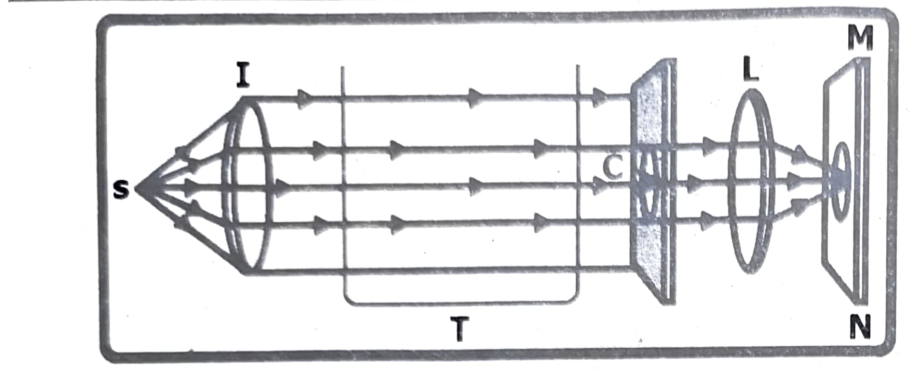
Qi. What color of the solution appears if seen from above? Why?
Qii. What color spot appears on the screen ‘N-M’ after the light passes through the whole beaker?
Qiii. What phenomenon is observed in this activity?
Ans:
i. What color of the solution appears if seen from above? Why?
The solution appears blue when viewed from above. This is due to Rayleigh scattering. Rayleigh scattering occurs when light is scattered by particles much smaller than its wavelength. In this case, the sulfur particles in the colloidal solution are small enough to scatter the shorter wavelengths of light (blue and violet) more strongly than the longer wavelengths (red and orange). When you look at the solution from above, you primarily see the scattered blue light.
ii. What color spot appears on the screen ‘N-M’ after the light passes through the whole beaker?
The color spot that appears on the screen ‘N-M’ will be reddish-orange. This is because the blue light has been scattered away by the sulfur particles in the solution. The remaining light that passes through the solution is enriched in the longer wavelengths, such as red and orange. This phenomenon is also related to Rayleigh scattering and is responsible for sunsets appearing reddish.
iii. What phenomenon is observed in this activity?
The phenomenon observed in this activity is Rayleigh scattering. As explained above, Rayleigh scattering is the scattering of electromagnetic radiation (including visible light) by particles of a much smaller wavelength. This phenomenon is responsible for the blue color of the sky, the reddish color of sunsets, and the color effects observed in colloidal solutions.
Short Questions:
Microwave ovens can interfere with Wi-Fi signals because they both operate on the same frequency range, specifically around 2.4 GHz. While microwave ovens are designed to contain most of their electromagnetic radiation, some leakage can occur, especially from older or poorly shielded units. This leakage, even if minimal, can disrupt Wi-Fi signals on the same frequency, leading to slower speeds or even connection drops.
An example of energy carried by an electromagnetic wave is the heat generated when food is cooked in a microwave oven. Microwaves, a type of electromagnetic radiation, transfer energy to the water molecules in food, causing them to vibrate and increase in temperature, thus heating the food.
Other Examples:
Other examples of electromagnetic waves carrying energy include the warmth from the sun (visible light and infrared radiation), the energy used to transmit radio and TV signals, and the energy used in medical imaging like X-rays.
Yes, it’s true that many birds possess feathers that reflect ultraviolet (UV) light, revealing patterns and colors invisible to the human eye. Humans can only see the visible light spectrum (roughly 380 to 750 nanometers), while UV light falls below this range, from about 10 to 400 nanometers. Birds, however, can perceive UV light, allowing them to see these hidden markings. This ability is crucial for various aspects of their lives, including communication.
No, the human body cannot detect most electromagnetic radiation outside the visible region of the spectrum. While the human eye is sensitive to a narrow band of wavelengths called visible light, other forms of electromagnetic radiation like radio waves, microwaves, infrared, ultraviolet, X-rays, and gamma rays are not directly perceived by our sensory organs. However, we can indirectly detect some forms of non-visible radiation, such as infrared, through the sensation of heat.
In sound, amplitude corresponds to the brightness of light. Amplitude refers to the maximum displacement of a wave from its equilibrium position.
- For sound waves, a larger amplitude means a louder sound, and for light waves, a larger amplitude means a brighter light.
- The amplitude of a light wave is related to the strength of the electric and magnetic fields that make up the wave.
- A larger amplitude means a stronger field, which our eyes perceive as brighter light.
A TV antenna’s orientation affects reception because antennas are directional and have a preferred direction for signal reception, known as the main beam. Orienting the antenna parallel to the wave front & perpendicular to the signal direction maximizes the amount of antenna exposed to the incoming signal, leading to stronger reception. A television antenna is most sensitive to electric fields that are aligned with its elements (the metal rods or loops). To receive the strongest signal, the antenna must be oriented so that its elements are parallel to the polarization direction of the incoming radio waves.
Microwaves are used for satellite TV because their shorter wavelengths allow for a more focused and efficient transmission of signals over long distances, including those to and from satellites. Radio waves, with longer wavelengths, are better suited for terrestrial TV broadcasting because they can travel further and diffract more easily around obstacles like buildings and terrain.
No, X-rays and gamma rays are not suitable for broadcasting radio and TV signals. While they are also electromagnetic waves, like radio waves, they have very short wavelengths and high frequencies, making them unsuitable for long-distance transmission and potentially harmful.
- X-rays and gamma rays have very short wavelengths and high frequencies, which means they travel only short distances and are easily absorbed or scattered by matter.
- In contrast, radio waves, with their longer wavelengths, are ideal for broadcasting because they can travel long distances and are generally harmless at the power levels used for broadcasting.
You can feel the energy of sunlight as warmth because your skin absorbs the electromagnetic radiation, converting it into heat. However, you don’t feel the momentum of sunlight because photons, while possessing momentum, have an extremely small mass, resulting in a negligible force when they strike your body.
The delay in audio transmission between a studio newscaster and a remote reporter is primarily caused by the finite speed of electromagnetic signals and the distance they must travel. This delay is noticeable because the signals, including sound and video, take time to propagate through cables or via satellite communication systems. Additionally, processing time at various points in the transmission chain, such as encoding and decoding, and potential buffering or jitter, can contribute to the overall delay.
No, the visible region is not a major portion of the electromagnetic spectrum. It actually represents a very small sliver of the entire range of electromagnetic radiation. The visible spectrum, which humans can see, ranges from approximately 400 to 700 nanometers, while the electromagnetic spectrum encompasses a vast range of wavelengths, from very long radio waves to extremely short gamma rays. This is only about 0.003 % of the entire spectrum, which includes much larger regions like radio waves, microwaves, infrared, ultraviolet, X-rays, and gamma rays, which cover much broader and more significant portions of the spectrum.
Yes, infrared light and radio waves also experience scattering in the atmosphere, but the extent of scattering differs significantly from visible light. Visible light is scattered more readily by atmospheric particles (like air molecules, dust, and water droplets) due to its shorter wavelengths, leading to phenomena like the blue sky. Infrared and radio waves, with their longer wavelengths, are scattered less, allowing them to travel through the atmosphere with greater ease, though they can still be affected by larger particles and atmospheric conditions.
In Summary:
- Scattering is wavelength-dependent: shorter wavelengths (like visible light) are scattered more than longer wavelengths (like infrared and radio waves).
- Atmospheric particles and gases can scatter, absorb, or reflect electromagnetic radiation.
- The degree of scattering affects how well different types of electromagnetic radiation can penetrate the atmosphere.
Radiation pressure exerted by an electromagnetic wave is greater on a perfectly reflecting surface than on a perfectly absorbing surface because the momentum change is doubled in reflection. When a wave is absorbed, it transfers its momentum to the surface, but when reflected, the wave reverses direction, leading to a greater change in momentum and thus higher pressure. In summary, the radiation pressure is greater for reflection because the change in momentum of the electromagnetic wave is twice as large compared to absorption.
Photons are produced when an electron transitions to a lower energy level within an atom, releasing the energy difference as a photon. This process occurs when electrons are excited to higher energy levels, typically by absorbing energy, and then spontaneously return to their original, lower energy levels. The energy difference between the two levels is emitted as a photon, a particle of light. Photons, the fundamental particles of light and all other forms of electromagnetic radiation, are produced whenever an electric charge is accelerated.
Clouds appear white because of how they scatter sunlight. When sunlight, which is a combination of all colors, enters a cloud, it interacts with the tiny water droplets or ice crystals that make up the cloud. These particles are roughly the same size as, or larger than, the wavelengths of visible light, causing Mie scattering. Mie scattering scatters all colors of light equally, resulting in a mixture of all colors being reflected back to our eyes, which we perceive as white.
Long Questions:
The electromagnetic spectrum encompasses a wide range of electromagnetic radiation, categorized by wavelength and frequency. All electromagnetic waves, regardless of their frequency or wavelength, travel at the speed of light (approximately $3.00 \times 10^8$ meters per second) in a vacuum. In air, their speed is very close to this value. The relationship between wavelength and frequency is inverse: higher frequency waves have shorter wavelengths, and vice versa.
Here's a breakdown:
- Radio waves: Longest wavelength, lowest frequency.
- Microwaves: Shorter wavelength and higher frequency than radio waves.
- Infrared: Shorter wavelength and higher frequency than microwaves.
- Visible light: The portion of the spectrum our eyes can see, with wavelengths ranging from ~400 nm to ~700 nm.
- Ultraviolet: Shorter wavelength and higher frequency than visible light.
- X-rays: Shorter wavelength and higher frequency than ultraviolet.
- Gamma rays: Shortest wavelength, highest frequency.
Key Relationship:
The speed of light ($c$), frequency ($f$), and wavelength ($\lambda$) are related by the equation:
$$c = \lambda f$$
Where, $c$ is the speed of light ($3.00 \times 10^8$ ms$^{-1}$).
Why is the speed of electromagnetic waves in air nearly the same as in a vacuum?
Electromagnetic waves, by definition, are disturbances in electric and magnetic fields. In a vacuum, there are no charged particles to interact with, so the waves propagate freely at the speed of light. Air, while containing molecules, is mostly empty space. The interaction of the electromagnetic wave with the relatively sparse air molecules is weak, causing a negligible change in the wave’s speed. The speed of light in air is only slightly less than in a vacuum, hence the approximation of them being the same.
Radio waves are uniquely important in communication and astronomy due to their ability to travel long distances, penetrate obstacles, and be easily detected. Their longer wavelengths allow them to diffract around objects and travel through various mediums, including the Earth’s atmosphere, making them ideal for both terrestrial and space-based communication and astronomical observation.
Communication:
Long-distance transmission:
Radio waves, with their longer wavelengths, can travel vast distances, making them essential for broadcasting radio and television signals, mobile phone communication, and long-range wireless networks.
Penetration and diffraction:
Unlike shorter wavelengths like visible light or infrared, radio waves can penetrate through walls, buildings, and even foliage, allowing for communication in various environments. They can also diffract, or bend around obstacles, which helps them reach receivers that might be out of direct line of sight.
Reduced interference:
While radio waves can be affected by atmospheric conditions, they generally experience less interference from dust, clouds, and other atmospheric particles compared to shorter wavelengths.
Modulation for information transfer:
Radio waves can be modulated (their amplitude, frequency, or phase altered) to carry information, enabling the transmission of audio, video, and data.
Astronomy:
Revealing hidden universe:
Radio waves can penetrate cosmic dust and gas clouds that block visible light, allowing astronomers to observe celestial objects and phenomena that would otherwise be invisible.
Observing the early universe:
Radio waves from distant galaxies can reveal information about the early universe, including the formation of stars and galaxies, and the distribution of matter.
Studying energetic phenomena:
Radio telescopes can detect radiation from powerful sources like quasars, pulsars, and black holes, providing insights into extreme astrophysical processes.
Radio interferometry:
Arrays of radio telescopes, like the Very Large Array (VLA), can be combined to create a virtual telescope with extremely high resolution, allowing for detailed imaging of celestial objects.
Radio astronomy’s role in black hole discovery:
Radio telescopes were crucial in capturing the first image of a black hole and its shadow, showcasing their unique ability to probe these enigmatic objects.
Other Electromagnetic Waves:
Microwaves:
While also used in communication (e.g., satellite communication, radar) and some astronomical observations, microwaves have shorter wavelengths and are more susceptible to atmospheric interference and require line-of-sight transmission.
Infrared, visible light, ultraviolet, X-rays, and gamma rays:
These shorter wavelengths are primarily used for specialized applications like medical imaging, material analysis, and studying high-energy phenomena in space. They are generally less effective for long-distance communication or for penetrating dense materials.
Atmospheric absorption:
Shorter wavelengths are more readily absorbed or scattered by the Earth’s atmosphere, limiting their use for many terrestrial and astronomical applications.
Microwaves are versatile due to their ability to heat materials rapidly and selectively, making them suitable for both household and industrial / scientific applications. While commonly used for quick food heating in homes, microwaves also play crucial roles in diverse fields like communication, medicine, and industrial processing. Their ability to interact with specific materials and their relatively short wavelengths contribute to their adaptability.
Household Applications:
Cooking and Reheating:
Microwaves are primarily known for their quick heating of food, making them convenient for reheating leftovers, defrosting items, and cooking simple meals.
Defrosting:
They can rapidly defrost frozen foods, which is often faster and more convenient than other methods.
Small Space Cooking:
Microwaves are space-efficient and suitable for smaller kitchens or for individuals with limited cooking needs.
Safety:
Many microwave ovens have safety features like automatic shut-off and safety locks, making them generally safe for household use, even with children.
Industrial and Scientific Applications:
Food Processing:
Microwaves are used in the food industry for pasteurization, drying, and even for creating Maillard reaction conjugates.
Materials Processing:
They are employed in sintering metals and ceramics, and in plasma processing for various applications.
Environmental Remediation:
Microwaves are used in treating sludge, medical waste, contaminated soil, and wastewater.
Medical Applications:
Microwaves are utilized in medical imaging (MRI, CT scans) and in microwave ablation for treating conditions like cancer.
Communication:
Microwaves are fundamental in transmitting wireless signals for cell phones and other communication systems.
Drying Processes:
Microwaves offer efficient and fast drying solutions across various industrial sectors.
Versatility Characteristics:
Selective Heating:
Microwaves can heat specific materials based on their dielectric properties, allowing for targeted heating in complex industrial processes.
Rapid Heating:
The ability to heat materials quickly is advantageous in both household and industrial settings, saving time and energy.
Non-Ionizing Radiation:
Microwaves are a form of non-ionizing radiation, making them safer for use in medical imaging and some industrial applications.
Small Wavelengths:
Their relatively short wavelengths allow for efficient energy transfer and enable their use in compact devices like mobile phones.
Ease of Control:
While some industrial applications require precise control, many household microwave ovens offer straightforward operation with simple controls.
While microwave ovens are a staple in modern kitchens, their underlying principles and characteristics have been leveraged to create a wide range of applications across various fields.
Infrared radiation is a type of electromagnetic radiation with wavelengths longer than visible light, ranging from 700 nanometers to 1 millimeter. It’s
essentially heat energy emitted by objects with temperatures above absolute zero. Infrared radiation is produced when atoms and molecules vibrate and radiate energy as they move. This can happen naturally from warm objects or artificially through various sources.Here’s a more detailed explanation:
What is infrared radiation:
- Infrared (IR) radiation is part of the electromagnetic spectrum, located between visible light and microwaves.
- It’s often referred to as “heat radiation” because it’s associated with the thermal energy of objects.
- All objects with a temperature above absolute zero (0 Kelvin or − 273.15°C) emit infrared radiation.
How infrared radiation produced:
- Natural sources:
- Thermal radiation: All objects with a temperature above absolute zero emit infrared radiation as their atoms and molecules vibrate. The hotter the object, the more infrared radiation it emits.
- Sunlight: About half of the sun’s energy output is in the infrared portion of the spectrum.
- Artificial sources:
- Heating devices: Toasters, electric heaters, and infrared lamps all produce infrared radiation.
- Incandescent light bulbs: These convert a significant portion of their electrical energy into infrared radiation.
- Lasers: Some lasers emit infrared radiation, often at specific wavelengths.
- Industrial processes: High-temperature industrial processes like steel and iron production also generate infrared radiation.
- Specialized devices: Infrared imaging devices, such as night vision goggles and thermal cameras, detect infrared radiation emitted by objects.
In essence, any object with a temperature above absolute zero emits infrared radiation, and various methods can be used to generate it artificially for different applications.
Characteristics of Infrared:
The following are the characteristics of infrared:
| Infrared Radiation | Characteristics |
|---|---|
| Origin | The infrared waves are the alteration in the electron’s movement. |
| Wavelength Range | Wavelength of infrared waves ranges from 710 nm to 1 mm. |
| Frequency | These waves have a frequency of 430 THz – 300 GHz. |
| Wave type | These are transverse Wave. |
| Speed | The speed of infrared waves are: 3 × 10⁸ ms−1. |
| Refraction | The infrared waves includes the properties of refraction. |
| Thermal Properties | The infrared waves includes the heat-inducing properties. |
| Absorption and Reflection | Infrared waves can either be reflected or absorbed based on the nature’s surface that it strikes. |
Visible light is the portion of the electromagnetic spectrum that is visible to the human eye. It encompasses a range of wavelengths from about 400 to 700 nanometers, corresponding to the colors of the rainbow. Visible light is crucial for life on Earth because it is the primary source of energy for photosynthesis, the process by which plants convert light into chemical energy to sustain themselves and form the base of most food chains.
Detailed Explanation:
What is Visible Light?
- Visible light is a form of electromagnetic radiation, just like radio waves, microwaves, and X-rays, but it’s the only part of the spectrum that our eyes can detect.
- It’s characterized by wavelengths ranging from approximately 400 nm (violet) to 700 nm (red).
- When white light (like sunlight) passes through a prism, it separates into the colors of the rainbow, with each color corresponding to a different wavelength.
Why is Visible Light Crucial for Life?
- Photosynthesis: Plants use visible light, particularly blue and red wavelengths, to convert carbon dioxide and water into glucose (a type of sugar) and oxygen. This process, called photosynthesis, is fundamental to the survival of plants and, indirectly, most other living organisms.
- Food Chains: Plants are the primary producers in most food chains, meaning they are the foundation upon which all other life forms rely. By harnessing sunlight, plants provide the energy and nutrients necessary for herbivores (plant-eaters), which in turn are eaten by carnivores (meat-eaters), and so on.
- Human Vision: Our ability to see the world around us, including colors, shapes, and details, is entirely dependent on visible light. Our eyes have specialized cells (cones and rods) that detect different wavelengths of visible light and convert them into signals that our brains interpret as images.
- Other Biological Processes: Sunlight also plays a role in other biological processes, such as regulating sleep-wake cycles, promoting the production of Vitamin D, and influencing mood.
In essence, without visible light, life as we know it would not exist on Earth. It’s the source of energy that fuels plant life, which in turn sustains all other forms of life.
Ultraviolet (UV) Radiation:
Ultraviolet (UV) radiation is a form of electromagnetic radiation with wavelengths shorter than those of visible light but longer than those of X-rays, ranging from about 10 nm to 400 nm.
Characteristics of UV Radiation:
- Wavelength: UV radiation is divided into three bands:
- UV-A (315-400 nm): Least energetic, reaches the Earth’s surface in the greatest amount.
- UV-B (280-315 nm): More energetic than UV-A, partially absorbed by the ozone layer.
- UV-C (100-280 nm): Most energetic, completely absorbed by the atmosphere and does not reach the Earth’s surface.
- Energy: UV radiation has higher energy than visible light but lower energy than X-rays and gamma rays.
- Non-Ionizing: UV radiation is non-ionizing, meaning it does not have enough energy to remove electrons from atoms, but it can still damage molecules, including DNA.
Applications of UV Radiation:
- Sterilization: UV-C radiation is highly effective at killing bacteria, viruses, and other microorganisms. It is used to sterilize medical equipment, food, and water.
- Vitamin D Synthesis: UV-B radiation is essential for the synthesis of vitamin D in the skin.
- Phototherapy: UV radiation is used to treat certain skin conditions, such as psoriasis and eczema.
- Curing: UV radiation is used to cure certain materials, such as adhesives and coatings.
- Tanning: UV-A radiation is used in tanning beds to darken the skin.
- Industrial and Scientific Uses: UV radiation is used in various industrial and scientific applications, such as UV spectroscopy and UV microscopy.
Risks of UV Radiation:
- Skin Cancer: Prolonged exposure to UV radiation can damage DNA in skin cells, leading to skin cancer.
- Sunburn: UV radiation can cause sunburn, which is an inflammatory response to damaged skin cells.
- Eye Damage: UV radiation can damage the eyes, leading to cataracts and other eye problems.
- Premature Aging: UV radiation can damage collagen and elastin in the skin, leading to premature aging and wrinkles.
- Immune Suppression: UV radiation can suppress the immune system, making individuals more susceptible to infections.
Balancing Advantages and Dangers:
- Limiting Exposure: Limit exposure to UV radiation, especially during peak hour (10 a. m to 4 p. m.).
- Sunscreen: Use sunscreen with a sun protection factor (SPF) of 30 or higher to protect the skin from UV radiation.
- Protective Clothing: Wear protective clothing, such as hats and long sleeves, to shield the skin from UV radiation.
- Sunglasses: Wear sunglasses that block UV radiation to protect the eyes.
- Regulation of Tanning Beds: Regulate the use of tanning beds to minimize exposure to UV radiation.
- Public Education: Educate the public about the risks and benefits of UV radiation.
- Technological Solutions: Use UV blocking films on windows and develop new technologies that leverage UV’s beneficial effects while minimizing the dangers.
X-rays, while a form of electromagnetic radiation like visible light, differ significantly due to their higher energy and shorter wavelengths. This allows them to penetrate matter more effectively and interact with atoms in a way that produces images useful in medical diagnostics and materials science. They are also distinguished by their production mechanisms, being generated by electron interactions outside the nucleus, unlike gamma rays which originate from nuclear processes.
Detailed Breakdown:
(i) Energy and Wavelength:
- X-rays possess significantly higher energy and shorter wavelengths compared to visible light and other forms of electromagnetic radiation like radio waves or infrared radiation.
- Their wavelengths typically range from 10 nanometers to 10 picometers.
- This high energy allows them to penetrate materials that visible light cannot.
(ii) Penetrating Power:
- X-rays can pass through many substances, including human tissue, making them useful for medical imaging.
- This penetrating power is due to their short wavelengths and high energy, which allows them to be
scattered or absorbed to varying degrees, producing an image based on density differences.
(iii) Production Mechanism:
- X-rays are typically produced when high-energy electrons collide with a target material, or when electrons rearrange within an atom.
- They are distinct from gamma rays, which are produced by nuclear reactions or radioactive decay.
(iv) Interaction with Matter:
- X-rays interact with matter primarily through ionization, where they can knock electrons out of atoms, potentially causing damage to living cells.
- This property also makes them useful for some therapeutic applications, like treating tumors.
(v) Applications:
- Medical Imaging: X-rays are widely used in radiography, CT scans, and other imaging techniques to visualize bones, organs, and other internal structures.
- Materials Science: X-rays are used to study the structure of materials at the atomic level, including crystal structures.
- Security: X-rays are used in airport security scanners to detect hidden objects in luggage.
- Scientific Research: X-rays are used in various research fields to study the properties of matter.
(vi) Safety Concerns:
- While beneficial, X-rays are ionizing radiation, and excessive exposure can be harmful.
- Precautions are taken to minimize radiation exposure during medical imaging and other applications.
In summary, X-rays are unique due to their short wavelengths, high energy, production mechanisms, ability to penetrate matter, ionizing nature, and specific applications in medical imaging, security, industrial inspection, and scientific research.
Gamma rays’ high energy and penetrating power make them crucial tools in nuclear science and astrophysics. They can probe the structure of atomic nuclei, reveal the composition of stars and galaxies, and provide insights into extreme cosmic events.
Nuclear Science Applications:
- Probing Nuclear Structure: Gamma rays interact with atomic nuclei, allowing scientists to study their energy levels and structure. For example, gamma spectroscopy helps identify the types and amounts of radioactive isotopes present in a sample.
- Nuclear Reactions: High-energy gamma rays can induce nuclear reactions, such as pair production (where a gamma ray converts into an electron-positron pair) or photodisintegration (where a nucleus breaks apart). These reactions provide information about nuclear properties and are used in various applications like medical imaging (PET scans).
- Sterilization & Medical Applications: Gamma rays’ ability to penetrate materials and damage DNA makes them useful for sterilizing medical equipment and food preservation. They are also used in radiation therapy to target and destroy cancerous tumors.
Astrophysics Applications:
- Tracing Stellar Processes: Gamma rays are produced by various energetic astrophysical phenomena, such as supernova explosions, neutron star collisions, and active galactic nuclei. By studying the gamma rays emitted from these sources, astronomers can learn about their properties and the processes that create them.
- Understanding Cosmic Rays: Gamma rays can be produced when cosmic rays (high-energy particles from space) interact with interstellar gas or radiation. Analyzing the gamma rays helps scientists trace the origin and propagation of cosmic rays.
- Exploring the Early Universe: Gamma-ray astronomy provides a unique window into the early universe, allowing us to study the formation of the first stars and galaxies.
- Studying Dark Matter: Some theoretical models predict that dark matter particles could annihilate or decay, producing gamma rays. Detecting these gamma rays could provide evidence for the existence of dark matter.
In summary, the high energy and penetrating power of gamma rays make them ideal for studying nuclear processes and extreme environments in the universe. Their applications range from cancer treatment and sterilization to probing the mysteries of black holes and supernova explosions.
The electromagnetic spectrum encompasses a wide range of radiation types, each with varying potential hazards. Ionizing radiation, characterized by its ability to strip electrons from atoms, is significantly more dangerous than non-ionizing radiation due to its potential to cause severe biological damage. This difference stems from the energy carried by each type of radiation and how that energy interacts with living tissues.
Ionizing Radiation Hazards:
- High Energy: Ionizing radiation (e.g., X-rays, gamma rays, alpha and beta particles) carries enough energy to break chemical bonds and ionize atoms, creating charged particles (ions).
- DNA Damage: This ionization can directly damage DNA molecules, leading to mutations and potentially cancer.
- Cellular Damage: Ionizing radiation can also damage cells by producing free radicals, highly reactive molecules that can further disrupt cellular structures and functions.
- Health Effects: Exposure can cause a range of health problems, including skin burns, radiation sickness, cancer, and genetic damage.
- Examples: Ionizing radiation is used in medical imaging (X-rays), cancer treatment, and nuclear power generation.
Non-Ionizing Radiation Hazards:
- Lower Energy: Non-ionizing radiation (e.g., radio waves, microwaves, infrared, visible light, ultraviolet) does not carry enough energy to directly ionize atoms.
- Thermal Effects: While not as severe as ionizing radiation, prolonged exposure to high-frequency or high-intensity non-ionizing radiation can cause heating and tissue damage, such as skin burns or cataracts.
- Sunburn and Skin Cancer: Ultraviolet (UV) radiation, a type of non-ionizing radiation, can cause sunburn and contribute to skin cancer.
- Eye Damage: Visible light, particularly high-energy visible (HEV) light, can damage the retina.
- No Ionization: Non-ionizing radiation primarily interacts with molecules by causing them to vibrate or rotate, rather than breaking them apart like ionizing radiation.
Why Ionizing Radiation is More Dangerous:
The primary reason ionizing radiation is more dangerous is its ability to directly damage DNA and create free radicals. DNA is the blueprint for cell function and survival, and mutations caused by ionizing radiation can lead to cell death, uncontrolled cell growth (cancer), or inherited genetic defects. While non-ionizing radiation can cause damage, it’s typically less severe and often limited to surface tissues or thermal effects.
Key Differences Summarized:
- Energy: Ionizing radiation has significantly higher energy than non-ionizing radiation.
- Ionization: Ionizing radiation can directly ionize atoms, while non-ionizing radiation primarily causes molecular vibrations.
- DNA Damage: Ionizing radiation is far more likely to cause DNA damage and mutations than non-ionizing radiation.
- Health Effects: Ionizing radiation can lead to a wider range of severe health effects, including cancer and genetic damage, while non-ionizing radiation is more likely to cause burns, skin damage, or eye damage.
In conclusion, while both ionizing and non-ionizing radiation can pose health risks, the potential for severe and lasting damage from ionizing radiation makes it a far more serious hazard, requiring careful management and protection measures.
The scattering of light in the atmosphere explains why the sky appears blue during the day and why its color changes at sunrise and sunset. Rayleigh scattering, where shorter wavelengths of light (blue and violet) are scattered more by air molecules, is the primary reason for the blue sky. As the sun’s light travels through more atmosphere at sunrise and sunset, longer wavelengths (red and orange) become more dominant, causing those colors to be more visible.
Detailed Explanation:
(i) Scattering and Wavelengths:
- Sunlight is composed of all colors of the visible spectrum, each with different wavelengths.
- Shorter wavelengths (blue and violet) are scattered more effectively by air molecules than longer wavelengths (red and orange).
- This phenomenon is known as Rayleigh scattering.
- The human eye is more sensitive to blue light than violet, so we perceive the scattered light as blue.
(ii) Sky Color During the Day:
- When the sun is high in the sky, sunlight travels through a relatively shorter path in the atmosphere.
- Blue light is scattered in all directions, making the sky appear blue from any angle.
- The other colors (red, orange, yellow) are less scattered and continue in their original direction.
(iii) Sky Color at Sunrise and Sunset:
- When the sun is near the horizon, its light travels through a much longer path in the atmosphere.
- More blue light is scattered away before reaching our eyes.
- The remaining light, rich in red and orange wavelengths, is what we see.
- This longer path also allows for more scattering by other particles like dust and pollutants, potentially enhancing the colors or leading to a milky appearance.
(iv) Other Factors:
- Altitude: At higher altitudes, there are fewer air molecules, so less scattering occurs, making the sky appear darker blue or even violet.
- Particles: Dust, pollutants, and water vapor can also scatter light, affecting the sky’s color, sometimes causing a milky or hazy appearance.
- Time of Year: Certain times of the year might have more aerosols (like dust) in the air, leading to more colorful sunsets, according to the UCAR Center for Science Education.
For long-term space exploration, nuclear thermal propulsion (NTP) is generally considered more viable than both chemical and radiation pressure propulsion. While radiation pressure propulsion has potential, it is currently limited by the need for massive solar sails and relies on the availability of sunlight, making it unsuitable for deep space missions or those near the outer planets. Chemical propulsion, while powerful for initial launch and orbital maneuvers, lacks the fuel efficiency for long journeys. NTP combines the high thrust of chemical rockets with the fuel efficiency of nuclear power, making it a promising option for deep space exploration.
Detailed Comparison:
Chemical Propulsion:
- How it works: Chemical rockets generate thrust by burning fuel and oxidizer, producing hot gas that expands and exits the nozzle.
- Advantages: High thrust for launch and orbital maneuvers; well-established technology.
- Disadvantages: Low specific impulse (fuel efficiency), meaning they require large amounts of propellant for long-duration missions.
Radiation Pressure Propulsion (using solar sails):
- How it works: Solar sails use the pressure of sunlight to propel a spacecraft. The large sail catches photons and is pushed along, requiring no propellant.
- Advantages: Potentially very high fuel efficiency, as it uses free solar energy.
- Disadvantages: Very low thrust, leading to incredibly long travel times; requires very large sails, making them difficult to deploy and maneuver.
Nuclear Thermal Propulsion (NTP):
- How it works: NTP uses a nuclear reactor to heat a propellant (typically hydrogen) to very high temperatures, which is then expelled through a nozzle to generate thrust.
- Advantages: High specific impulse compared to chemical rockets, allowing for faster travel times and/or larger payloads.
- Disadvantages: Requires developing and safely implementing nuclear reactors in space.
Why NTP is More Viable:
- Fuel Efficiency: NTP offers a significant improvement in fuel efficiency over chemical rockets, making it better suited for long-distance travel.
- Thrust and Speed: While not as high as chemical rockets, NTP provides enough thrust to enable shorter travel times compared to solar sails.
- Beyond Solar Power: NTP is not reliant on sunlight, making it suitable for missions to the outer solar system and beyond, where solar radiation is weak or absent.
- Payload Capacity: The higher fuel efficiency of NTP translates to a greater payload capacity for a given mission.
While radiation pressure propulsion is an interesting concept with potential benefits for certain types of missions, it is currently limited by its low thrust and reliance on sunlight. Chemical propulsion, though well-established, is not ideal for long-duration missions. NTP, with its combination of high fuel efficiency and reasonable thrust, is considered the most promising propulsion technology for deep space exploration in the future.