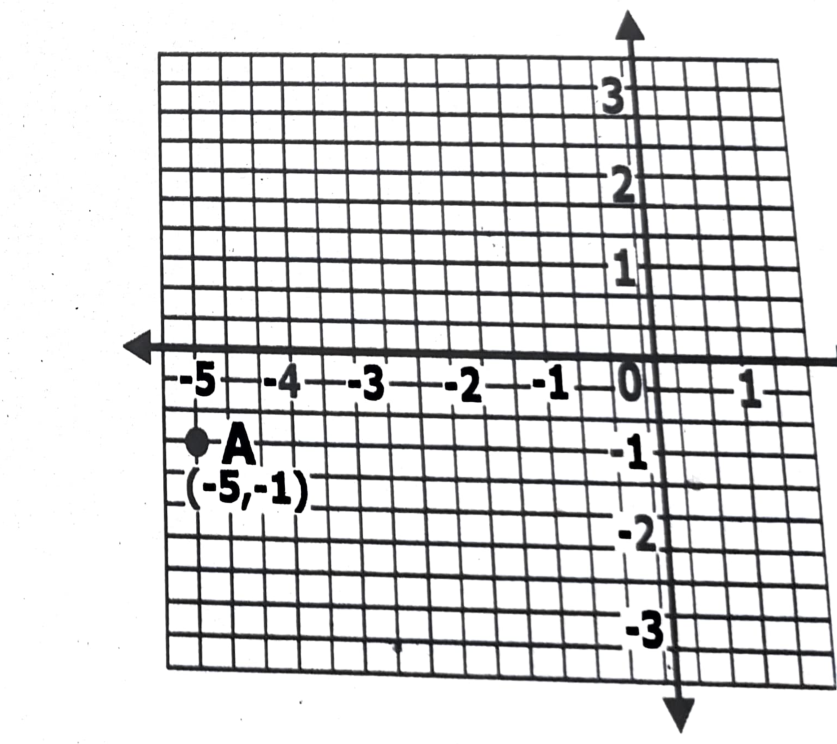
Q1. Find the additive inverse of each complex number.
a. $-4+5i$
Solution: $-4+5i$
Let $a+bi$ the additive inverse of $-4+5i$ then by additive inverse rule:
$(-4+5i)+(a+bi)=0+0i$
$(-4+a)+(5i+bi)=0+0i$
$\Rightarrow (-4+a)+(5+b)i=0+0i$
$\Rightarrow -4+a=0$ and $5+b=0$
$\Rightarrow a=4$ and $b=-5$
$\therefore a+bi=4-5i$
Hence, the additive inverse of $-4+5i$ is $4-5i$.
b. $-3-3i$
Solution: $-3-3i$
Let $a+bi$ the additive inverse of $-3-3i$ then by additive inverse rule:
$(-3-3i)+(a+bi)=0+0i$
$(-3+a)+(-3i+bi)=0+0i$
$\Rightarrow (-3+a)+(-3+b)i=0+0i$
$\Rightarrow -3+a=0$ and $-3+b=0$
$\Rightarrow a=3$ and $b=3$
$\therefore a+bi=3+3i$
Hence, the additive inverse of $-3-3i$ is $3+3i$.
c. $5-5i$
Solution: $5-5i$
Let $a+bi$ the additive inverse of $5-5i$ then by additive inverse rule:
$(5-5i)+(a+bi)=0+0i$
$(5+a)+(-5i+bi)=0+0i$
$\Rightarrow (5+a)+(-5+b)i=0+0i$
$\Rightarrow 5+a=0$ and $-5+b=0$
$\Rightarrow a=-5$ and $b=5$
$\therefore a+bi=-5+5i$
Hence, the additive inverse of $5-5i$ is $-5+5i$.
d. $4i$
Solution:
Let $a+bi$ the additive inverse of $4i$ then by additive inverse rule:
$(0+4i)+(a+bi)=0+0i$
$(0+a)+(4i+bi)=0+0i$
$\Rightarrow (a)+(4+b)i=0+0i$
$\Rightarrow a=0$ and $4+b=0$
$\Rightarrow a=0$ and $b=-4$
$\therefore a+bi=0-4i=-4i$
Hence, the additive inverse of $4i$ is $-4i$.
Q2. Show that each pair of complex numbers are multiplicative inverse of each other.
a. $2+3i,\ \frac{2-3i}{13}$
Solution: $2+3i,\ \frac{2-3i}{13}$
To show that the pair of complex numbers $2+3i$ and $\frac{2-3i}{13}$ are multiplicative inverses of each other, we need to multiply them together and see if the result is equal to 1.
Let $z_1=2+3i$ and $z_2=\frac{2-3i}{13}$. Then,
$\Rightarrow z_1\cdot z_2=(2+3i)\times\frac{2-3i}{13}=\frac{(2+3i)(2-3i)}{13}\quad\text{(i)}$
We multiply the complex numbers in the numerator:
$(2+3i)(2-3i)=2(2)+2(-3i)+3i(2)+3i(-3i)=4-6i+6i-9i^2$
Since $i^2=-1$, we have:
$\Rightarrow 4-6i+6i-9(-1)=4+9=13$
So the expression (i) becomes: $z_1\cdot z_2=\frac{13}{13}=1$
Since the product of the two complex numbers is 1, they are multiplicative inverses of each other.
b. $5-4i,\ \frac{5+4i}{41}$
Solution: $5-4i,\ \frac{5+4i}{41}$
To show that the pair of complex numbers $5-4i$ and $\frac{5+4i}{41}$ are multiplicative inverses of each other, we need to multiply them together and see if the result is equal to 1.
Let $z_1=5-4i$ and $z_2=\frac{5+4i}{41}$. Then,
$\Rightarrow z_1\cdot z_2=(5-4i)\cdot\frac{5+4i}{41}=\frac{(5-4i)(5+4i)}{41}\quad\text{(i)}$
We multiply the complex numbers in the numerator:
$\Rightarrow (5-4i)(5+4i)=5(5)+5(4i)-4i(5)-4i(4i)$
$=25+20i-20i-16i^2$
Since $i^2=-1$, we have:
$\Rightarrow 25+20i-20i-16(-1)=25+16=41$
So the expression (i) becomes: $z_1\cdot z_2=\frac{41}{41}=1$
Since the product of the two complex numbers is 1, they are multiplicative inverses of each other.
c. $6+8i,\ \frac{3-4i}{50}$
Solution: $6+8i,\ \frac{3-4i}{50}$
To show that the pair of complex numbers $6+8i$ and $\frac{3-4i}{50}$ are multiplicative inverses of each other, we need to multiply them together and see if the result is equal to 1.
Let $z_1=6+8i$ and $z_2=\frac{3-4i}{50}$. Then,
$\Rightarrow z_1\cdot z_2=(6+8i)\cdot\frac{3-4i}{50}=\frac{(6+8i)(3-4i)}{50}\quad\text{(i)}$
We multiply the complex numbers in the numerator:
$\Rightarrow (6+8i)(3-4i)=6(3)+6(-4i)+8i(3)+8i(-4i)$
$=18-24i+24i-32i^2$
Since $i^2=-1$, we have:
$\Rightarrow 18-24i+24i-32(-1)=18+32=50$
So the expression (i) becomes: $z_1\cdot z_2=\frac{50}{50}=1$
Since the product of the two complex numbers is 1, they are multiplicative inverses of each other.
Q3. Find the multiplicative inverse of each complex number.
a. $1+i$
Solution: $1+i$
The multiplicative inverse of a complex number $z$ is $\frac{1}{z}$.
The reciprocal of $1+i$ is $\frac{1}{1+i}$. The complex conjugate of $1+i$ is $1-i$.
$\Rightarrow\quad \frac{1}{1+i}=\frac{1}{1+i}\times\frac{1-i}{1-i}=\frac{1-i}{(1+i)(1-i)}$
Since $i^2=-1$, we have:
$=\frac{1-i}{(1)^2-i^2}=\frac{1-i}{1-(-1)}=\frac{1-i}{2}=\frac{1}{2}-\frac{1}{2}i$
Thus, the multiplicative inverse of $1+i$ is $\frac{1}{2}-\frac{1}{2}i$.
Verification:
Now, we check the answer by multiplying it by the original number:
$\Rightarrow\quad (1+i)\left(\frac{1}{2}-\frac{1}{2}i\right)=1\left(\frac{1}{2}-\frac{1}{2}i\right)+i\left(\frac{1}{2}-\frac{1}{2}i\right)$
$=\frac{1}{2}-\frac{1}{2}i+\frac{1}{2}i-\frac{1}{2}i^2=\frac{1}{2}-\frac{1}{2}i+\frac{1}{2}i+\frac{1}{2}$
$=\frac{1}{2}+\frac{1}{2}=1$
Since the product is 1, the multiplicative inverse is correct.
b. $7-3i$
Solution: $7-3i$
The multiplicative inverse of a complex number $z$ is $\frac{1}{z}$. The reciprocal of $7-3i$ is $\frac{1}{7-3i}$. The complex conjugate of $7-3i$ is $7+3i$.
$\Rightarrow\quad \frac{1}{7-3i}=\frac{1}{7-3i}\times\frac{7+3i}{7+3i}=\frac{7+3i}{(7-3i)(7+3i)}$
Since $i^2=-1$, we have:
$=\frac{7+3i}{(7)^2-(3i)^2}=\frac{7+3i}{49-9i^2}=\frac{7+3i}{49-9(-1)}$
$=\frac{7+3i}{49+9}=\frac{7+3i}{58}=\frac{7}{58}+\frac{3}{58}i$
Thus, the multiplicative inverse of $7-3i$ is $\frac{7}{58}+\frac{3}{58}i$.
Verification:
Now, we check the answer by multiplying it by the original number:
$\Rightarrow\quad (7-3i)\left(\frac{7}{58}+\frac{3}{58}i\right)=7\left(\frac{7}{58}+\frac{3}{58}i\right)-3i\left(\frac{7}{58}+\frac{3}{58}i\right)$
$=\frac{49}{58}+\frac{21}{58}i-\frac{21}{58}i-\frac{9}{58}i^2$
$=\frac{49}{58}+\frac{21}{58}i-\frac{21}{58}i+\frac{9}{58}$
$=\frac{49}{58}+\frac{9}{58}=\frac{58}{58}=1$
Since the product is 1, the multiplicative inverse is correct.
c. $10-12i$
Solution: $10-12i$
The multiplicative inverse of a complex number $z$ is $\frac{1}{z}$. The reciprocal of $10-12i$ is $\frac{1}{10-12i}$. The complex conjugate of $10-12i$ is $10+12i$.
$\Rightarrow\quad \frac{1}{10-12i}=\frac{1}{10-12i}\times\frac{10+12i}{10+12i}=\frac{10+12i}{(10-12i)(10+12i)}$
Since $i^2=-1$, we have:
$=\frac{10+12i}{(10)^2-(12i)^2}=\frac{10+12i}{100-144i^2}=\frac{10+12i}{100-144(-1)}=\frac{10+12i}{100+144}$
$=\frac{10+12i}{244}=\frac{10}{244}+\frac{12}{244}i=\frac{5}{122}+\frac{3}{61}i$
Thus, the multiplicative inverse of $10-12i$ is $\frac{5}{122}+\frac{3}{61}i$.
Verification:
Now, we check the answer by multiplying it by the original number:
$\Rightarrow\quad (10-12i)\left(\frac{5}{122}+\frac{3}{61}i\right)=10\left(\frac{5}{122}+\frac{6}{122}i\right)-12i\left(\frac{5}{122}+\frac{6}{122}i\right)$
$=\frac{50}{122}+\frac{60}{122}i-\frac{60}{122}i-\frac{72}{122}i^2=\frac{50}{122}+\frac{60}{122}i-\frac{60}{122}i+\frac{72}{122}$
$=\frac{50}{122}+\frac{72}{122}=\frac{122}{122}=1$
Since the product is 1, the multiplicative inverse is correct.
d. $\frac{2}{5-i}$
Solution: $\frac{2}{5-i}$
The multiplicative inverse of a complex number $z$ is $\frac{1}{z}$.
The reciprocal of $\frac{2}{5-i}$ is $\frac{1}{\frac{2}{5-i}}=\frac{5-i}{2}$.
Now, we need to write this in the standard form $a+bi$.
$\Rightarrow\quad \frac{5-i}{2}=\frac{5}{2}-\frac{1}{2}i$
Thus, the multiplicative inverse of $\frac{2}{5-i}$ is $\frac{5}{2}-\frac{1}{2}i$.
Verification:
Now, we check the answer by multiplying it by the original number:
$\Rightarrow\quad \left(\frac{2}{5-i}\right)\left(\frac{5-i}{2}\right)=\frac{2(5-i)}{2(5-i)}=1$
Since the product is 1, the multiplicative inverse is correct.
The final answer is $\frac{5}{2}-\frac{1}{2}i$.
e. $\frac{-i}{2-3i}$
Solution: $\frac{-i}{2-3i}$
The multiplicative inverse of a complex number $z$ is $\frac{1}{z}$.
The reciprocal of $\frac{-i}{2-3i}$ is $\frac{1}{\frac{-i}{2-3i}}=\frac{2-3i}{-i}$.
To simplify this expression, we need to multiply both the numerator and the denominator by the complex conjugate of the denominator. The complex conjugate of $-i$ is $i$.
$\Rightarrow\quad \frac{2-3i}{-i}=\frac{2-3i}{-i}\times\frac{i}{i}=\frac{(2-3i)i}{-i^2}=\frac{2i-3i^2}{-(-1)}=\frac{2i-3(-1)}{1}=2i+3=3+2i$
Thus, the multiplicative inverse of $\frac{-i}{2-3i}$ is $3+2i$.
Verification:
Now, we check the answer by multiplying it by the original number:
$\Rightarrow\quad \left(\frac{-i}{2-3i}\right)(3+2i)=\frac{-i(3+2i)}{2-3i}=\frac{-3i-2i^2}{2-3i}=\frac{-3i-2(-1)}{2-3i}=\frac{2-3i}{2-3i}=1$
Since the product is 1, the multiplicative inverse is correct.
f. $a-bi$
Solution: $a-bi$
The multiplicative inverse of a complex number $z$ is $\frac{1}{z}$.
The reciprocal of $a-bi$ is $\frac{1}{a-bi}$.
The complex conjugate of $a-bi$ is $a+bi$.
$\Rightarrow\quad \frac{1}{a-bi}=\frac{1}{a-bi}\times\frac{a+bi}{a+bi}=\frac{a+bi}{(a-bi)(a+bi)}$
Using the difference of squares formula, $(x-y)(x+y)=x^2-y^2$, we have:
$\Rightarrow\quad (a-bi)(a+bi)=a^2-(bi)^2=a^2-b^2i^2$
Since $i^2=-1$, we have:
$\Rightarrow\quad a^2-b^2i^2=a^2-b^2(-1)=a^2+b^2$
So,
$\Rightarrow\quad \frac{a+bi}{(a)^2-(bi)^2}=\frac{a+bi}{a^2-b^2i^2}=\frac{a+bi}{a^2-b^2(-1)}=\frac{a+bi}{a^2+b^2}=\frac{a}{a^2+b^2}+\frac{b}{a^2+b^2}i$
Thus, the multiplicative inverse of $a-bi$ is $\frac{a}{a^2+b^2}+\frac{b}{a^2+b^2}i$.
Verification:
Now, we check the answer by multiplying it by the original number:
$\Rightarrow\quad (a-bi)\left(\frac{a}{a^2+b^2}+\frac{b}{a^2+b^2}i\right)=a\left(\frac{a}{a^2+b^2}+\frac{b}{a^2+b^2}i\right)-bi\left(\frac{a}{a^2+b^2}+\frac{b}{a^2+b^2}i\right)$
$=\frac{a^2}{a^2+b^2}+\frac{ab}{a^2+b^2}i-\frac{ab}{a^2+b^2}i-\frac{b^2}{a^2+b^2}i^2=\frac{a^2}{a^2+b^2}+\frac{ab}{a^2+b^2}i-\frac{ab}{a^2+b^2}i+\frac{b^2}{a^2+b^2}$
$=\frac{a^2}{a^2+b^2}+\frac{b^2}{a^2+b^2}=\frac{a^2+b^2}{a^2+b^2}=1$
Since the product is 1, the multiplicative inverse is correct.
The final answer is $\frac{a}{a^2+b^2}+\frac{b}{a^2+b^2}i$.
Q4. Find the product of each complex number and its conjugate.
a. $4$
Solution: $4$
Identify the complex number:
The given complex number is $4$. We can rewrite this as $4+0i$, where the real part is $4$ and the imaginary part is $0$.
Find the complex conjugate:
The complex conjugate of $4+0i$ is $4-0i$, which is simply $4$.
Multiply the complex number by its conjugate:
Multiply $4$ by its conjugate $4$.
$\Rightarrow\quad 4\cdot 4=16$
b. $1-i$
Solution: $1-i$
Identify the complex number:
The given complex number is $1-i$. Here, the real part is $1$ and the imaginary part is $-1$.
Find the complex conjugate:
The complex conjugate of $1-i$ is $1+i$. We obtain this by changing the sign of the imaginary part.
Multiply the complex number by its conjugate:
Multiply $(1-i)$ by its conjugate $(1+i)$.
$\Rightarrow\quad (1-i)(1+i)=(1)^2-(i)^2=1-i^2$
Since $i^2=-1$, we have:
$\Rightarrow\quad 1-(-1)=1+1=2$
c. $7i$
Solution: $7i$
Find the complex conjugate:
The complex conjugate of a complex number $a+bi$ is $a-bi$.
We can rewrite $7i$ as $0+7i$.
Therefore, the complex conjugate of $7i$ is $0-7i$, which simplifies to $-7i$.
Multiply the complex number by its conjugate:
$\Rightarrow\quad (7i)\cdot(-7i)=-49i^2$
Simplify, remembering that $i^2=-1$:
$\Rightarrow\quad -49i^2=-49(-1)=49$
Therefore, the product of the complex number $7i$ and its conjugate is $49$.
d. $6-2i$
Solution: $6-2i$
Find the complex conjugate:
The complex conjugate of a complex number $a+bi$ is $a-bi$.
Therefore, the complex conjugate of $a-bi$ is $a+bi$.
The complex conjugate of $6-2i$ is $6+2i$.
Multiply the complex number by its conjugate:
$\Rightarrow\quad (6-2i)(6+2i)=(6)^2-(2i)^2=36-4i^2$
Simplify, remembering that $i^2=-1$:
$=36-4(-1)=36+4=40$
Therefore, the product of the complex number $6-2i$ and its conjugate is $40$.
e. $10+9i$
Solution: $10+9i$
Find the complex conjugate:
The complex conjugate of a complex number $a+bi$ is $a-bi$.
Therefore, the complex conjugate of $10+9i$ is $10-9i$.
Multiply the complex number by its conjugate:
$\Rightarrow\quad (10+9i)(10-9i)=(10)^2-(9i)^2=10-81i^2$
Simplify, remembering that $i^2=-1$:
$=100-81(-1)=100+81=181$
Therefore, the product of the complex number $10+9i$ and its conjugate is $181$.
f. $-4-11i$
Solution: $-4-11i$
Find the complex conjugate:
The complex conjugate of a complex number $a+bi$ is $a-bi$.
Therefore, the complex conjugate of $-4-11i$ is $-4+11i$.
Multiply the complex number by its conjugate:
$(-4-11i)(-4+11i)=(-4)^2-(11i)^2=16-121i^2$
Simplify, remembering that $i^2=-1$:
$=16-121(-1)=16+121=137$
Therefore, the product of the complex number $-4-11i$ and its conjugate is $137$.
Q5. If $z_1=1-2i$ and $z_2=2+i$:
a. Show that:
i. $\overline{z_1\cdot z_2}=\overline{z_1}\cdot\overline{z_2}$
Solution: $\overline{z_1\cdot z_2}=\overline{z_1}\cdot\overline{z_2}$
$\Rightarrow\quad z_1=1-2i$ and $z_2=2+i$
Calculate $z_1\cdot z_2$:
$\Rightarrow\quad z_1\cdot z_2=(1-2i)(2+i)=1(2)+1(i)-2i(2)-2i(i)$
$=2+i-4i-2i^2$
Since $i^2=-1$, we have $2+i-4i+2=4-3i$.
Calculate $\overline{z_1\cdot z_2}$:
$\Rightarrow\quad \overline{z_1\cdot z_2}=\overline{4-3i}=4+3i\qquad (1)$
Now calculate $\overline{z_1}$ and $\overline{z_2}$.
$\Rightarrow\quad \overline{z_1}=\overline{1-2i}=1+2i$
$\Rightarrow\quad \overline{z_2}=\overline{2+i}=2-i$
Calculate $\overline{z_1}\cdot\overline{z_2}$:
$\Rightarrow\quad \overline{z_1}\cdot\overline{z_2}=(1+2i)(2-i)=1(2)+1(-i)+2i(2)+2i(-i)$
$=2-i+4i-2i^2$
Since $i^2=-1$, we have $2-i+4i+2=4+3i\qquad (2)$.
Compare the results (1) and (2).
We found that $\overline{z_1\cdot z_2}=4+3i$ and $\overline{z_1}\cdot\overline{z_2}=4+3i$.
Therefore, $\overline{z_1\cdot z_2}=\overline{z_1}\cdot\overline{z_2}$ is verified.
ii. $\overline{\left(\frac{z_1}{z_2}\right)}=\frac{\overline{z_1}}{\overline{z_2}}$
Solution: $\overline{\left(\frac{z_1}{z_2}\right)}=\frac{\overline{z_1}}{\overline{z_2}}$
$\Rightarrow\quad z_1=1-2i$ and $z_2=2+i$
Calculate $\frac{z_1}{z_2}$:
$\Rightarrow\quad \frac{z_1}{z_2}=\frac{1-2i}{2+i}\quad\Rightarrow\quad \frac{z_1}{z_2}=\frac{1-2i}{2+i}\times\frac{2-i}{2-i}=\frac{(1-2i)(2-i)}{(2+i)(2-i)}$
Expanding the numerator:
$\Rightarrow\quad (1-2i)(2-i)=1(2)+1(-i)-2i(2)-2i(-i)$
$=2-i-4i+2i^2=2-5i-2=-5i$
Expanding the denominator:
$\Rightarrow\quad (2+i)(2-i)=2(2)+2(-i)+i(2)+i(-i)$
$=4-2i+2i-i^2=4+1=5$
So, $\frac{z_1}{z_2}=\frac{-5i}{5}=-i\qquad (1)$
Calculate $\overline{\left(\frac{z_1}{z_2}\right)}$:
$\Rightarrow\quad \overline{\left(\frac{z_1}{z_2}\right)}=\overline{-i}=i$
Calculate $\overline{z_1}$ and $\overline{z_2}$:
$\Rightarrow\quad \overline{z_1}=\overline{1-2i}=1+2i\qquad\Rightarrow\qquad \overline{z_2}=\overline{2+i}=2-i$
Calculate $\frac{\overline{z_1}}{\overline{z_2}}$:
$\Rightarrow\quad \frac{\overline{z_1}}{\overline{z_2}}=\frac{1+2i}{2-i}\quad\Rightarrow\quad \frac{1+2i}{2-i}\times\frac{2+i}{2+i}=\frac{(1+2i)(2+i)}{(2-i)(2+i)}$
Expanding the numerator:
$\Rightarrow\quad (1+2i)(2+i)=1(2)+1(i)+2i(2)+2i(i)$
$=2+i+4i+2i^2=2+5i-2=5i$
Expanding the denominator:
$\Rightarrow\quad (2-i)(2+i)=2(2)+2i-i(2)-i(i)$
$=4+2i-2i-i^2=4+1=5$
So, $\frac{\overline{z_1}}{\overline{z_2}}=\frac{5i}{5}=i\qquad (2)$
Compare the results (1) and (2).
We found that $\overline{\left(\frac{z_1}{z_2}\right)}=i$ and $\frac{\overline{z_1}}{\overline{z_2}}=i$. Therefore, $\overline{\left(\frac{z_1}{z_2}\right)}=\frac{\overline{z_1}}{\overline{z_2}}$ is verified.
iii. $|z_1|=|-z_1|=|\overline{z_1}|=|-\overline{z_1}|$
Solution: $z_1=1-2i$
Calculate $|z_1|$:
$\Rightarrow\quad |z_1|=|1-2i|=\sqrt{1^2+(-2)^2}=\sqrt{1+4}=\sqrt{5}$
Calculate $-z_1$:
$\Rightarrow\quad -z_1=-(1-2i)=-1+2i$
Calculate $|-z_1|$:
$\Rightarrow\quad |-z_1|=|-1+2i|=\sqrt{(-1)^2+2^2}=\sqrt{1+4}=\sqrt{5}$
Calculate $\overline{z_1}$:
$\Rightarrow\quad \overline{z_1}=\overline{1-2i}=1+2i$
Calculate $|\overline{z_1}|$:
$\Rightarrow\quad |\overline{z_1}|=|1+2i|=\sqrt{1^2+2^2}=\sqrt{1+4}=\sqrt{5}$
Calculate $-\overline{z_1}$:
$\Rightarrow\quad -\overline{z_1}=-(1+2i)=-1-2i$
Calculate $| -\overline{z_1}|$:
$\Rightarrow\quad | -\overline{z_1}|=|-1-2i|=\sqrt{(-1)^2+(-2)^2}=\sqrt{1+4}=\sqrt{5}$
Compare the results.
We found that $|z_1|=\sqrt{5}$, $|-z_1|=\sqrt{5}$, $|\overline{z_1}|=\sqrt{5}$ and $| -\overline{z_1}|=\sqrt{5}$.
Therefore, $|z_1|=|-z_1|=|\overline{z_1}|=| -\overline{z_1}|$ is verified.
iv. $z_2\cdot\overline{z_2}=|z_2|^2$
Solution: $z_2=2+i$
Calculate $\overline{z_2}$:
$\Rightarrow\quad \overline{z_2}=\overline{2+i}=2-i$
Calculate $z_2\cdot\overline{z_2}$:
$\Rightarrow\quad z_2\cdot\overline{z_2}=(2+i)(2-i)=2(2)+2(-i)+i(2)+i(-i)$
$=4-2i+2i-i^2$
Since $i^2=-1$, we have $4+1=5$
Calculate $|z_2|$:
$\Rightarrow\quad |z_2|=|2+i|=\sqrt{2^2+1^2}=\sqrt{4+1}=\sqrt{5}$
Calculate $|z_2|^2$:
$\Rightarrow\quad |z_2|^2=(\sqrt{5})^2=5$
Compare the results.
We found that $z_2\cdot\overline{z_2}=5$ and $|z_2|^2=5$.
Therefore, $z_2\cdot\overline{z_2}=|z_2|^2$ is verified.
b. Find:
i. $|z_1+z_2|$
Solution:
$\Rightarrow\quad z_1=1-2i$ and $z_2=2+i$
First, let’s find the sum of $z_1$ and $z_2$:
$\Rightarrow\quad z_1+z_2=(1-2i)+(2+i)=(1+2)+(-2i+i)=3-i$
The magnitude of a complex number $a+bi$ is given by $\sqrt{a^2+b^2}$. In this case, $a=3$ and $b=-1$.
$\Rightarrow\quad |z_1+z_2|=|3-i|=\sqrt{3^2+(-1)^2}=\sqrt{9+1}=\sqrt{10}$
Thus, $|z_1+z_2|=\sqrt{10}$.
ii. $|z_1z_2|$
Solution:
$\Rightarrow\quad z_1=1-2i$ and $z_2=2+i$
We can find the product $z_1z_2$ first:
$\Rightarrow\quad z_1z_2=(1-2i)(2+i)=1(2)+1(i)-2i(2)-2i(i)$
$=2+i-4i-2i^2=2-3i-2(-1)=2-3i+2$
Now we find the magnitude of $4-3i$:
$\Rightarrow\quad |z_1z_2|=|4-3i|=\sqrt{4^2+(-3)^2}=\sqrt{16+9}=\sqrt{25}=5$
Alternatively, we can find the magnitudes of $z_1$ and $z_2$ separately and then multiply them.
$\Rightarrow\quad |z_1|=|1-2i|=\sqrt{1^2+(-2)^2}=\sqrt{1+4}=\sqrt{5}$
$\Rightarrow\quad |z_2|=|2+i|=\sqrt{2^2+1^2}=\sqrt{4+1}=\sqrt{5}$
Then, $|z_1z_2|=|z_1||z_2|=\sqrt{5}\cdot\sqrt{5}=5$.
iii. $\left|\frac{z_1}{z_2}\right|$
Solution:
$\Rightarrow\quad z_1=1-2i$ and $z_2=2+i$
We can find the quotient $\frac{z_1}{z_2}$ first:
$\Rightarrow\quad \frac{z_1}{z_2}=\frac{1-2i}{2+i}=\frac{(1-2i)(2-i)}{(2+i)(2-i)}=\frac{2-i-4i+2i^2}{4-i^2}=\frac{2-5i-2}{4+1}=\frac{-5i}{5}=-i$
Now we find the magnitude of $-i$:
$\Rightarrow\quad \left|\frac{z_1}{z_2}\right|=|-i|=\sqrt{0^2+(-1)^2}=\sqrt{0+1}=\sqrt{1}=1$
Q6. Represent the numbers in the complex plane.
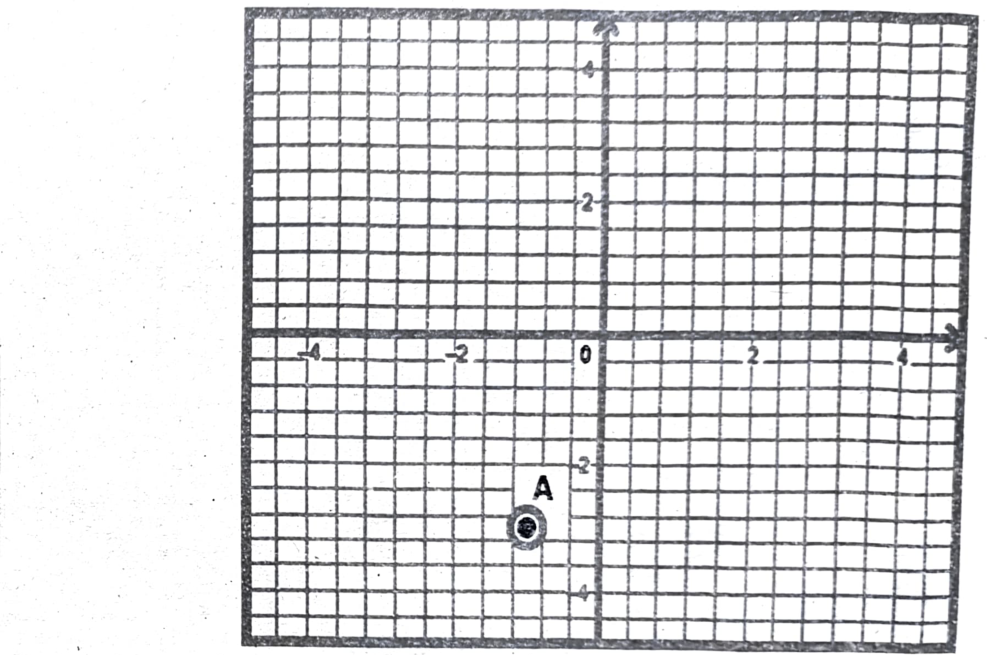
a. $-1-3i$
Solution:
To represent the complex number $-1-3i$ in the complex plane, we plot the point with coordinates $A(-1,-3)$. The $x$-coordinate is the real part, and the $y$-coordinate is the imaginary part.
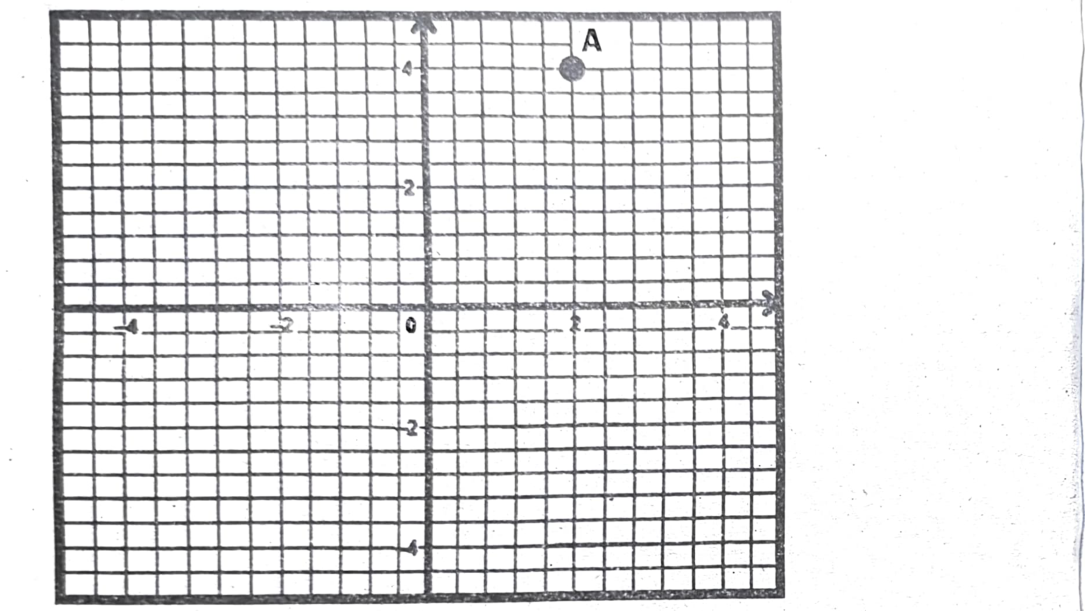
b. $2+4i$
Solution:
To represent the complex number $2+4i$ in the complex plane, we plot the point with coordinates $A(2,4)$. The $x$-coordinate is the real part, and the $y$-coordinate is the imaginary part.
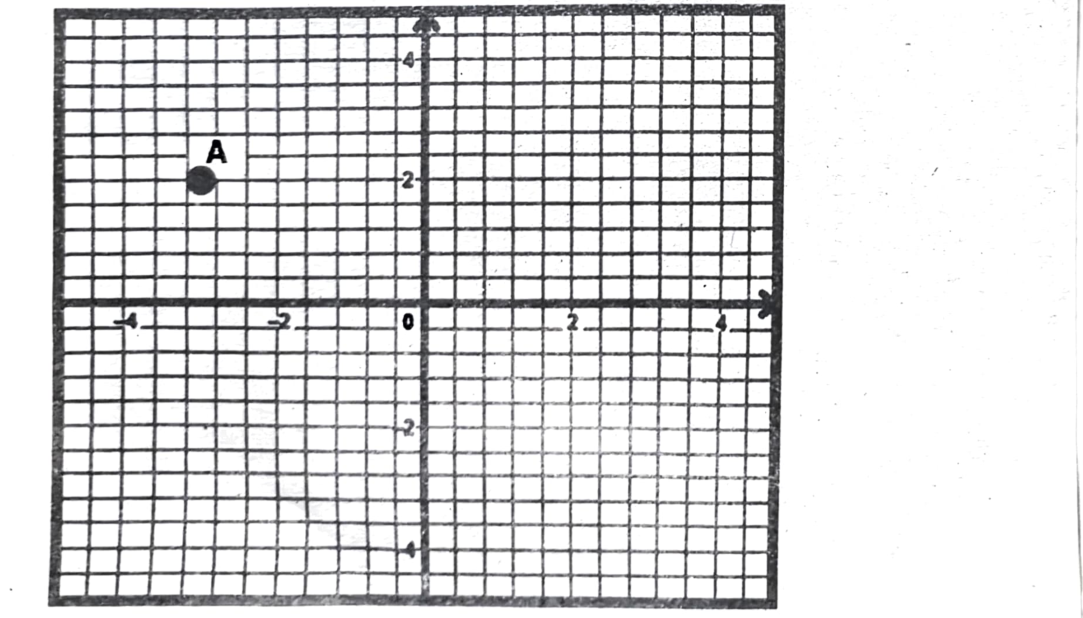
c. $-3+2i$
Solution:
To represent the complex number $-3+2i$ in the complex plane, we plot the point with coordinates $A(-3,2)$. The $x$-coordinate is the real part, and the $y$-coordinate is the imaginary part.
d. $2-3i$
Solution:
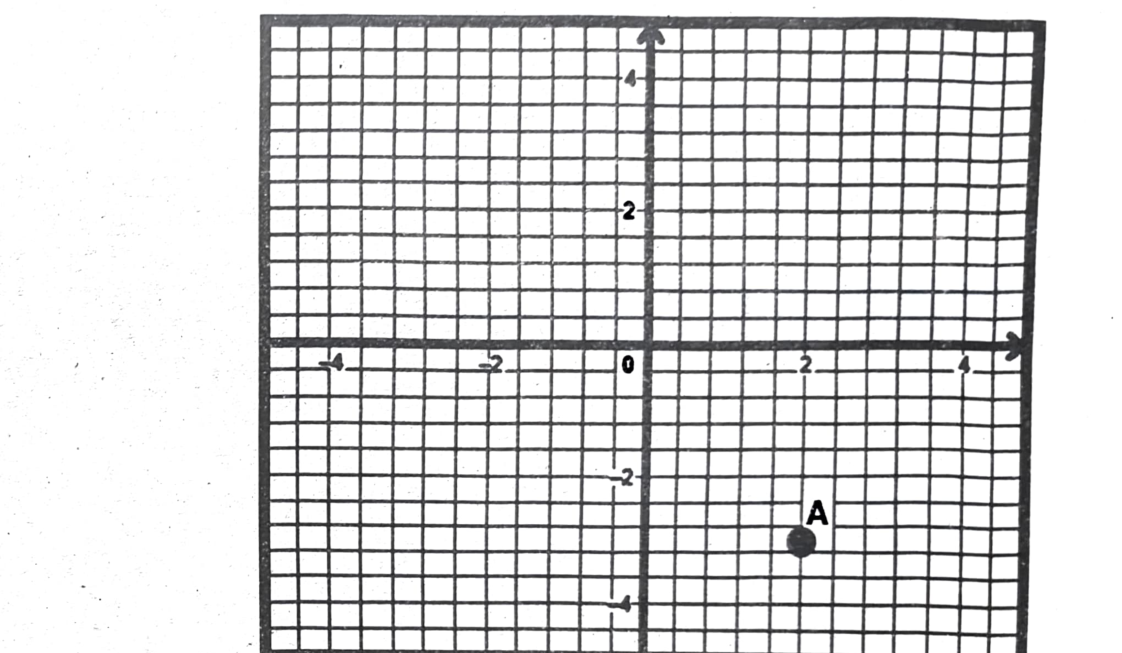
To represent the complex number $2-3i$ in the complex plane, we plot the point with coordinates $A(2,-3)$. The $x$-coordinate is the real part, and the $y$-coordinate is the imaginary part.
e. $2i$
Solution:
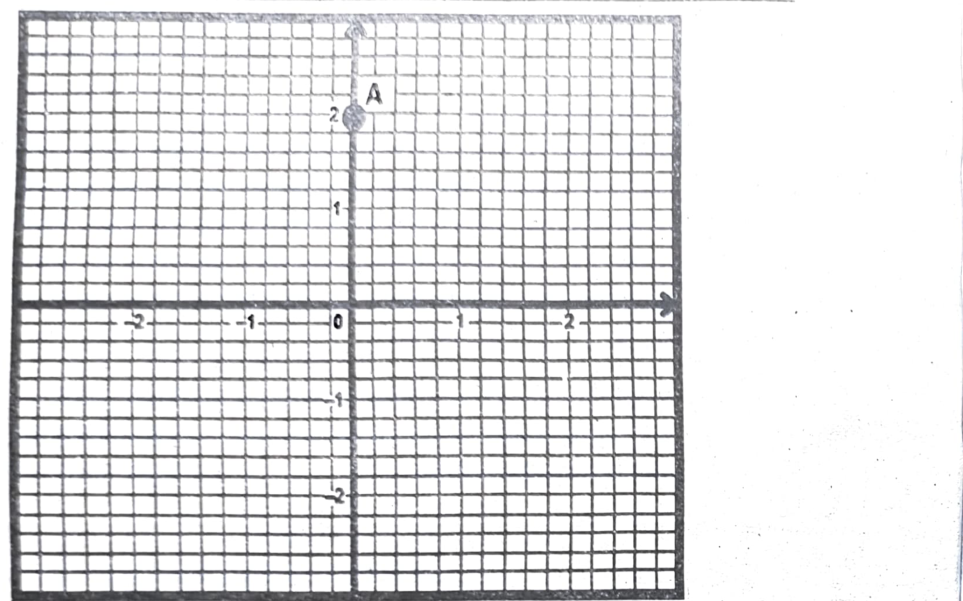
The complex number is $2i$, which can be written as $0+2i$. To graph the complex number $2i$ in the complex plane, we plot the point $A(0,2)$, where the $x$-axis represents the real part and the $y$-axis represents the imaginary part.
f. $-3i$
Solution:
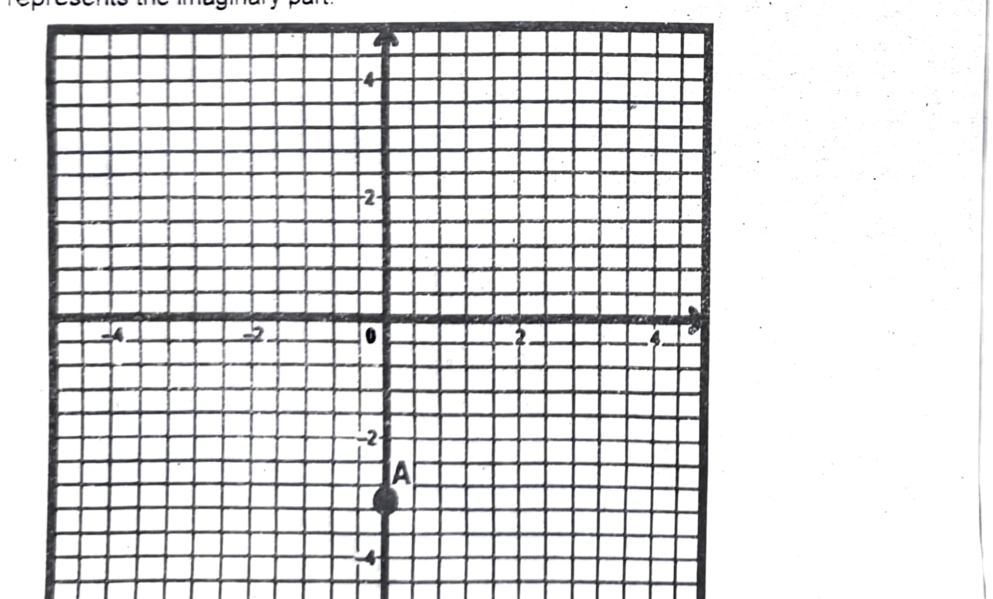
The complex number is $-3i$, which can be written as $0-3i$. To graph the complex number $-3i$ in the complex plane, we plot the point $A(0,-3)$, where the $x$-axis represents the real part and the $y$-axis represents the imaginary part.
g. $2$
Solution:
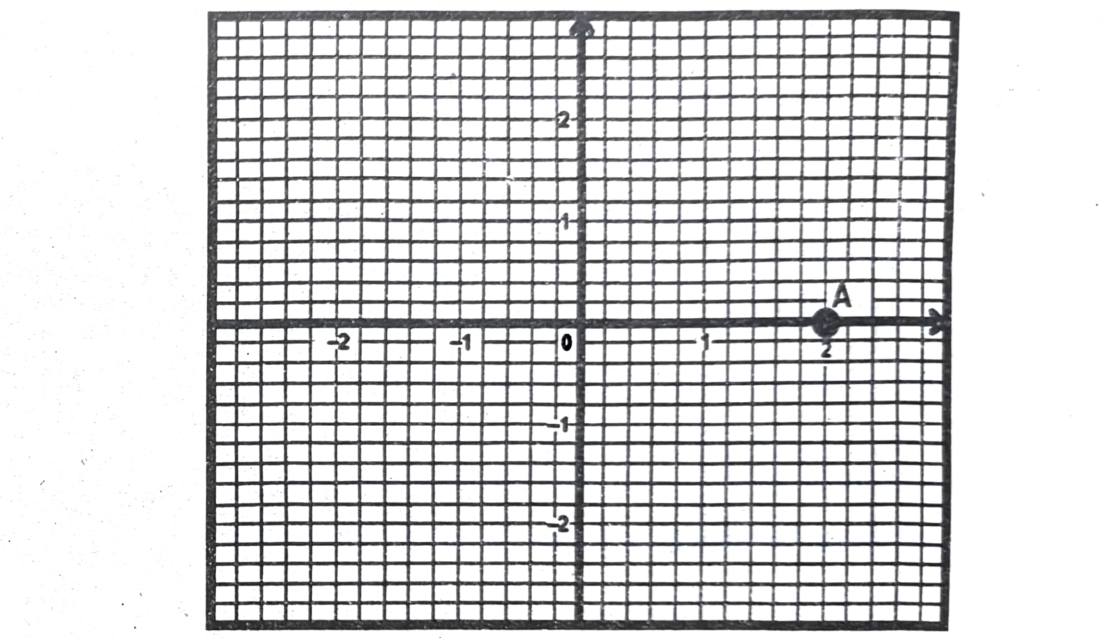
To represent the number $2$ in the complex plane, we consider it as a complex number $z=2+0i$. The complex plane has a real axis (horizontal) and an imaginary axis (vertical). The complex number $z=a+bi$ is represented by the point $(a,b)$ in the complex plane. In our case, $z=2+0i$, so $a=2$ and $b=0$. The point representing this complex number is $A(2,0)$. This point lies on the real axis, 2 units away from the origin.
Q7. Separate into real and imaginary parts of each complex number.
a. $(\sqrt{2}-\sqrt{3}i)^2$
Solution: $(\sqrt{2}-\sqrt{3}i)^2$
$\Rightarrow\quad (\sqrt{2}-\sqrt{3}i)^2=(\sqrt{2}-\sqrt{3}i)(\sqrt{2}-\sqrt{3}i)$
$=(\sqrt{2})(\sqrt{2})+(\sqrt{2})(-\sqrt{3}i)+(-\sqrt{3}i)(\sqrt{2})+(-\sqrt{3}i)(-\sqrt{3}i)$
$=2-\sqrt{6}i-\sqrt{6}i+3i^2$
$=2-2\sqrt{6}i-3=-1-2\sqrt{6}i$
The complex number is now in the form $a+bi$, where $a$ is the real part and $b$ is the imaginary part.
In this case, $a=-1$ and $b=-2\sqrt{6}$.
Therefore, the real part is $-1$ and the imaginary part is $-2\sqrt{6}$.
Real part $=R_e=-1$;  imaginary part $=I_m=-2\sqrt{6}$
b. $(\sqrt{2}+i)^2$
Solution: $(\sqrt{2}+i)^2$
$\Rightarrow\quad (\sqrt{2}+i)^2=(\sqrt{2}+i)(\sqrt{2}+i)$
$=(\sqrt{2})(\sqrt{2})+(\sqrt{2})(i)+(\sqrt{2})(i)+(i)(i)$
$=2+\sqrt{2}i+\sqrt{2}i+i^2$
$=2-1+2\sqrt{2}i$;  $[\because\ i^2=-1]$
$=1+2\sqrt{2}i$
The complex number is now in the form $a+bi$, where $a$ is the real part and $b$ is the imaginary part.
In this case, $a=1$ and $b=2\sqrt{2}$.
Therefore, the real part is $-1$ and the imaginary part is $-2\sqrt{6}$.
Real part $=R_e=1$;  imaginary part $=I_m=2\sqrt{2}$
c. $\dfrac{(2+3i)^2}{1-3i}$
Solution:
First, expand the numerator:
$\Rightarrow\quad (2+3i)^2=(2+3i)(2+3i)=4+6i+6i+9i^2$
$=4+12i-9=-5+12i$
Now, we have:
$\dfrac{-5+12i}{1-3i}$
To rationalize the denominator, we multiply both the numerator and denominator by the conjugate of the denominator, which is $1+3i$.
$\Rightarrow\quad \dfrac{-5+12i}{1-3i}\times\dfrac{1+3i}{1+3i}=\dfrac{(-5+12i)(1+3i)}{(1-3i)(1+3i)}$
$=\dfrac{-5-15i+12i+36i^2}{1+3i-3i-9i^2}=\dfrac{-5-15i+12i+36i^2}{1+3i-3i-9i^2}$;  $[\because\ i^2=-1]$
$=\dfrac{-5-3i-36}{1+9}=\dfrac{-41-3i}{10}=-\dfrac{41}{10}-\dfrac{3}{10}i$
The complex number is now in the form $a+bi$, where $a$ is the real part and $b$ is the imaginary part.
In this case, $a=-\dfrac{41}{10}$ and $b=-\dfrac{3}{10}$.
Therefore, the real part is $-\dfrac{41}{10}$ and the imaginary part is $-\dfrac{3}{10}$.
Real part $=R_e=-\dfrac{41}{10}$;  imaginary part $=I_m=-\dfrac{3}{10}$
d. $\left[\frac{1}{2}+\frac{\sqrt{3}}{2}i\right]^2$
Solution: $\left[\frac{1}{2}+\frac{\sqrt{3}}{2}i\right]^2$
$\Rightarrow\quad \left(\frac{1}{2}+\frac{\sqrt{3}}{2}i\right)^2=\left(\frac{1}{2}+\frac{\sqrt{3}}{2}i\right)\left(\frac{1}{2}+\frac{\sqrt{3}}{2}i\right)$
$=\left(\frac{1}{2}\right)\left(\frac{1}{2}\right)+\left(\frac{1}{2}\right)\left(\frac{\sqrt{3}}{2}i\right)+\left(\frac{\sqrt{3}}{2}i\right)\left(\frac{1}{2}\right)+\left(\frac{\sqrt{3}}{2}i\right)\left(\frac{\sqrt{3}}{2}i\right)$
$=\frac{1}{4}+\frac{\sqrt{3}}{4}i+\frac{\sqrt{3}}{4}i+\frac{3}{4}i^2=\frac{1}{4}-\frac{3}{4}+\frac{2\sqrt{3}}{4}i$;  $[\because\ i^2=-1]$
$=-\frac{2}{4}+\frac{\sqrt{3}}{2}i=-\frac{1}{2}+\frac{\sqrt{3}}{2}i$
The complex number is now in the form $a+bi$, where $a$ is the real part and $b$ is the imaginary part.
In this case, $a=-\frac{1}{2}$ and $b=\frac{\sqrt{3}}{2}$.
Therefore, the real part is $-\frac{1}{2}$ and the imaginary part is $\frac{\sqrt{3}}{2}$.
Real part $=R_e=-\frac{1}{2}$;  Imaginary part $=I_m=\frac{\sqrt{3}}{2}$
e. $\frac{1-i}{(i)^2}$
Solution: $\frac{1-i}{(i)^2}$
We know that $i^2=-1$, so we have:
$\Rightarrow\quad \frac{1-i}{(i)^2}=\frac{1-i}{-1}$;  $[\because\ i^2=-1]$
Now, we can divide both the real and imaginary parts of the numerator by $-1$.
$\Rightarrow\quad \frac{1}{-1}-\frac{i}{-1}=-1+i$
The complex number is now in the form $a+bi$, where $a$ is the real part and $b$ is the imaginary part.
In this case, $a=-1$ and $b=1$.
Therefore, the real part is $-1$ and the imaginary part is $1$.
Real part $=R_e=-1$;  Imaginary part $=1$
f. $\frac{1}{i(1-i)^2}$
Solution: $\frac{1}{i(1-i)^2}$
First, expand $(1-i)^2$:
$\Rightarrow\quad (1-i)^2=(1-i)(1-i)=1-i-i+i^2$
$=1-2i-1=-2i$;  $[\because\ i^2=-1]$
Now, we have:
$\Rightarrow\quad \frac{1}{i(-2i)}=\frac{1}{-2i^2}=\frac{1}{-2(-1)}=\frac{1}{2}$
The complex number is now in the form $a+bi$, where $a$ is the real part and $b$ is the imaginary part.
In this case, $a=\frac{1}{2}$ and $b=0$.
Therefore, the real part is $\frac{1}{2}$ and the imaginary part is $0$.
Real part $=R_e=\frac{1}{2}$;  Imaginary part $=0$
g. $\frac{(1+i)^2}{(1-2i)^2}$
Solution: $\frac{(1+i)^2}{(1-2i)^2}$
Expand the numerator and denominator:
$\Rightarrow\quad (1+i)^2=1+2i+i^2=1+2i-1=2i$;  $[\because\ i^2=-1]$
$\Rightarrow\quad (1-2i)^2=1-4i+(2i)^2=1-4i+4i^2=1-4i-4=-3-4i$
So, we have:
$\frac{(1+i)^2}{(1-2i)^2}=\frac{2i}{-3-4i}$
To get rid of the imaginary part in the denominator, multiply both the numerator and denominator by the conjugate of $-3-4i$, which is $-3+4i$.
$\Rightarrow\quad \frac{2i}{-3-4i}\times\frac{-3+4i}{-3+4i}=\frac{2i(-3+4i)}{(-3-4i)(-3+4i)}$
Simplify.
Numerator:
$\Rightarrow\quad 2i(-3+4i)=-6i+8i^2=-6i-8=-8-6i$
Denominator:
$\Rightarrow\quad (-3-4i)(-3+4i)=(-3)^2-(4i)^2=9-16i^2=9+16=25$
So, we have:
$\frac{-8-6i}{25}$
Separate into real and imaginary parts:
$\Rightarrow\quad \frac{-8-6i}{25}=-\frac{8}{25}-\frac{6}{25}i$
Real part $=R_e=-\frac{8}{25}$;  Imaginary part $=-\frac{6}{25}$
Q8. Taking any complex number and show that:
a. $z\cdot\overline{z}$ is a real number.
Solution:
Let $z=a+bi$ be any complex number, where $a$ and $b$ are real numbers. Then the complex conjugate of $z$ is $\overline{z}=a-bi$.
Now, let's compute the product of $z$ and $\overline{z}$.
$\Rightarrow\quad z\cdot\overline{z}=(a+bi)(a-bi)$
Using the difference of squares formula, we have:
$\Rightarrow\quad z\cdot\overline{z}=a^2-(bi)^2=a^2-b^2i^2$
Since $i^2=-1$, we get:
$\Rightarrow\quad z\cdot\overline{z}=a^2-b^2(-1)=a^2+b^2$
Since $a$ and $b$ are real numbers, $a^2$ and $b^2$ are also real numbers. Therefore, $a^2+b^2$ is a real number. Thus, we have shown that the product of a complex number $z$ and its complex conjugate $\overline{z}$ is a real number.
$\Rightarrow\quad z\cdot\overline{z}=a^2+b^2$
This is also equal to the square of the magnitude of $z$, i.e., $|z|^2=a^2+b^2$.
b. $z^2+(\overline{z})^2$ is a real number.
Solution:
Let $z=a+bi$ be a complex number, where $a$ and $b$ are real numbers. Then the complex conjugate of $z$ is $\overline{z}=a-bi$. We want to show that $z^2+(\overline{z})^2$ is a real number.
First, we compute $z^2$.
$\Rightarrow\quad z^2=(a+bi)^2=a^2+2abi+(bi)^2=a^2+2abi-b^2$
$=(a^2-b^2)+2abi$
Next, we compute $(\overline{z})^2$.
$\Rightarrow\quad (\overline{z})^2=(a-bi)^2=a^2-2abi+(bi)^2=a^2-2abi-b^2$
$=(a^2-b^2)-2abi$
Now, we add $z^2$ and $(\overline{z})^2$.
$\Rightarrow\quad z^2+(\overline{z})^2=[(a^2-b^2)+2abi]+[(a^2-b^2)-2abi]$
$=(a^2-b^2)+(a^2-b^2)+2abi-2abi=2(a^2-b^2)$
Since $a$ and $b$ are real numbers, $a^2$ and $b^2$ are also real numbers. Therefore, $a^2-b^2$ is a real number, and $2(a^2-b^2)$ is also a real number. Thus, we have shown that $z^2+(\overline{z})^2$ is a real number.
c. $(z-\overline{z})^2$ is a real number.
Solution:
Let $z=a+bi$ be a complex number, where $a$ and $b$ are real numbers. Then the complex conjugate of $z$ is $\overline{z}=a-bi$. We want to show that $(z-\overline{z})^2$ is a real number.
First, we compute $-z$.
$\Rightarrow\quad z-\overline{z}=(a+bi)-(a-bi)=a+bi-a+bi=2bi$
Now, we compute $(z-\overline{z})^2$.
$\Rightarrow\quad (z-\overline{z})^2=(2bi)^2=(2b)^2i^2=4b^2i^2$
Since $i^2=-1$, we have:
$\Rightarrow\quad (z-\overline{z})^2=4b^2(-1)=-4b^2$
Since $b$ is a real number, $b^2$ is also a real number. Therefore, $-4b^2$ is a real number. Thus, we have shown that $(z-\overline{z})^2$ is a real number.
d. $|z|$ and $|\overline{z}|$ are real numbers.
Solution:
Let $z=a+bi$ be a complex number, where $a$ and $b$ are real numbers. Then the complex conjugate of $z$ is $\overline{z}=a-bi$.
The magnitude of $z$, denoted by $|z|$, is defined as: $z=a+bi$.
$\Rightarrow\quad |z|=\sqrt{a^2+b^2}$
Since $a$ and $b$ are real numbers, $a^2$ and $b^2$ are also real numbers. The sum of two real numbers is a real number, so $a^2+b^2$ is a real number. The square root of a non-negative real number is also a real number. Therefore, $|z|=\sqrt{a^2+b^2}$ is a real number.
The magnitude of $\overline{z}$, denoted by $|\overline{z}|$, is defined as: $\overline{z}=a-bi$.
$\Rightarrow\quad |\overline{z}|=\sqrt{a^2+(-b)^2}=\sqrt{a^2+b^2}$
Since $a$ and $b$ are real numbers, $a^2$ and $b^2$ are also real numbers. The sum of two real numbers is a real number, so $a^2+b^2$ is a real number. The square root of a non-negative real number is also a real number. Therefore, $|\overline{z}|=\sqrt{a^2+b^2}$ is a real number.
Note that $|z|=|\overline{z}|$. Thus, we have shown that $|z|$ and $|\overline{z}|$ are real numbers.
e. $z^2-(\overline{z})^2$ is an imaginary number.
Solution:
Let $z=a+bi$ be a complex number, where $a$ and $b$ are real numbers. Then the complex conjugate of $z$ is $\overline{z}=a-bi$. We want to show that $z^2-(\overline{z})^2$ is an imaginary number.
First, we compute $z^2$.
$\Rightarrow\quad z^2=(a+bi)^2=a^2+2abi+(bi)^2=a^2+2abi-b^2$
$=(a^2-b^2)+2abi$
Next, we compute $(\overline{z})^2$.
$\Rightarrow\quad (\overline{z})^2=(a-bi)^2=a^2-2abi+(bi)^2=a^2-2abi-b^2$
$=(a^2-b^2)-2abi$
Now, we subtract $(\overline{z})^2$ from $z^2$.
$\Rightarrow\quad z^2-(\overline{z})^2=[(a^2-b^2)+2abi]-[(a^2-b^2)-2abi]$
$\Rightarrow\quad z^2-(\overline{z})^2=(a^2-b^2)-(a^2-b^2)+2abi-(-2abi)$
$\Rightarrow\quad z^2-(\overline{z})^2=a^2-b^2-a^2+b^2+2abi+2abi=4abi$ The result is $4abi$. This is an imaginary number because it is a real number ($4ab$) multiplied by the imaginary unit $i$. If $a=0$ or $b=0$, then $4abi=0$, which is a real number. However, if $a\ne 0$ and $b\ne 0$, then $4abi$ is a purely imaginary number.
Thus, $z^2-(\overline{z})^2$ is an imaginary number.
Q9. Represent sum and difference of complex numbers graphically.
(i) $z_1=5+3i$ and $z_2=2-3i$
Solution:
Given:
$z_1=5+3i=(5,3)\qquad;\qquad z_2=2-3i=(2,-3)$
First, let’s find the sum $z_1+z_2$.
$\Rightarrow\quad z_1+z_2=(5+3i)+(2-3i)=(5+2)+(3i-3i)=7+0i=(7,0)$
Next, let’s find the difference $z_1-z_2$.
$\Rightarrow\quad z_1-z_2=(5+3i)-(2-3i)=(5-2)+[3i-(-3i)]=3+6i$
Graphical Representation:
Now, let’s illustrate these operations graphically using vectors in the complex plane. We will represent each complex number as a vector from the origin to the point corresponding to the complex number.
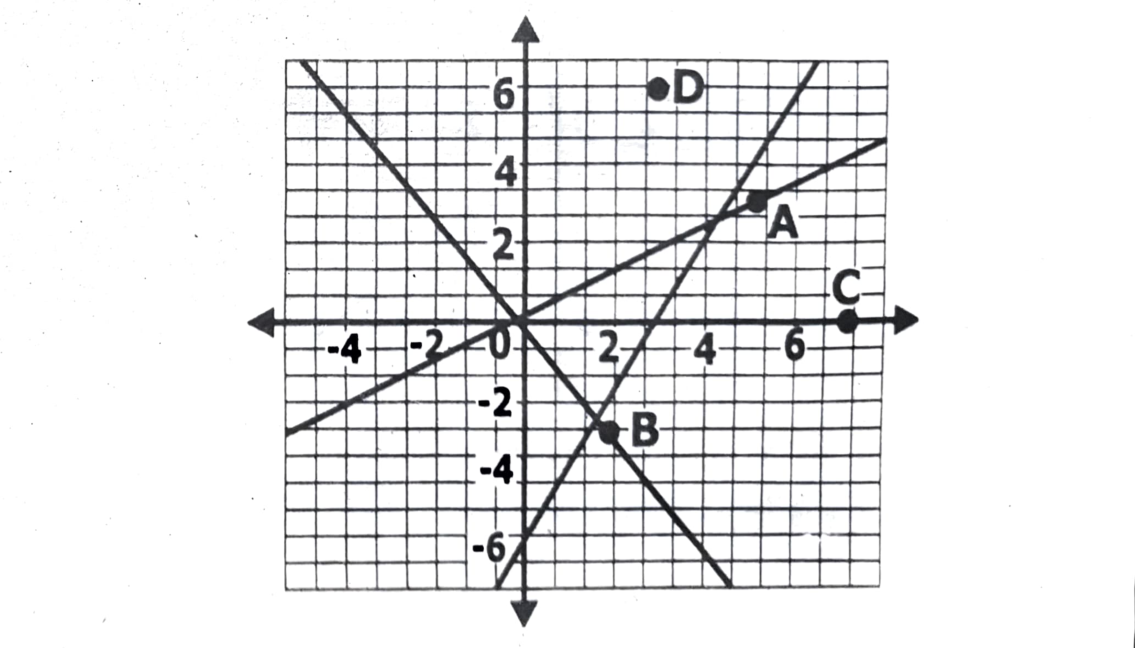
$\Rightarrow\quad z_1=5+3i$ is represented by the vector from $O(0,0)$ to $A(5,3)$.
$\Rightarrow\quad z_2=2-3i$ is represented by the vector from $O(0,0)$ to $B(2,-3)$.
$\Rightarrow\quad z_1+z_2=7$ is represented by the vector from $O(0,0)$ to $C(7,0)$.
$\Rightarrow\quad z_1-z_2=3+6i$ is represented by the vector from $O(0,0)$ to $D(3,6)$.
(ii) $z_1=-3+2i$ and $z_2=4+3i$
Solution:
Given:
$z_1=-3+2i\qquad;\qquad z_2=4+3i$
First, let’s find the sum $z_1+z_2$.
$z_1+z_2=(-3+2i)+(4+3i)=(-3+4)+(2i+3i)=1+5i$
Next, let’s find the difference $z_1-z_2$.
$z_1-z_2=(-3+2i)-(4+3i)=(-3-4)+(2i-3i)=-7-i$
Graphical Representation:
Now, let’s illustrate these operations graphically using vectors in the complex plane. We will represent each complex number as a vector from the origin to the point corresponding to the complex number.
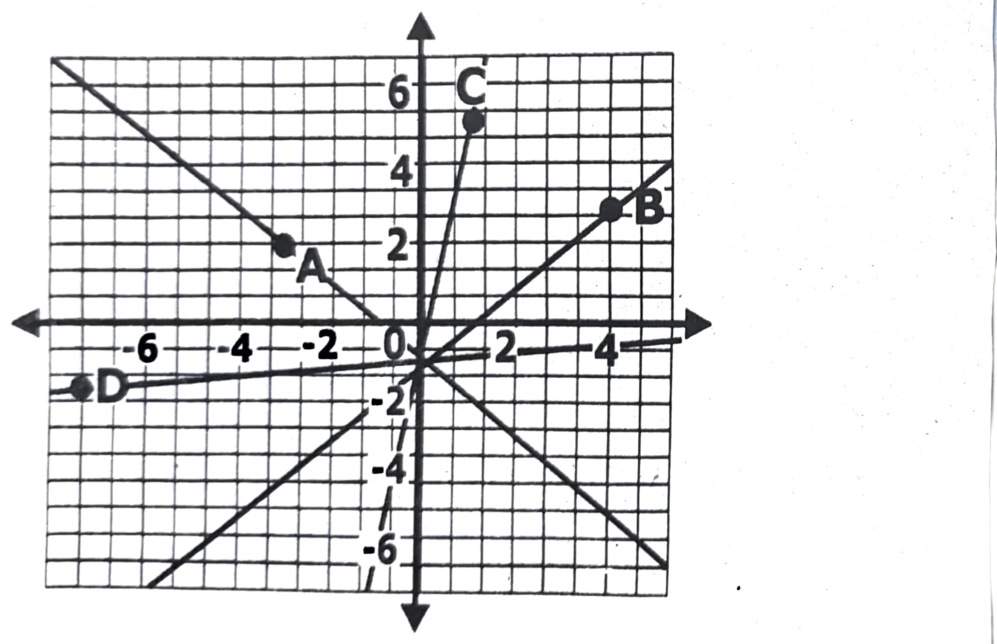
$\Rightarrow\quad z_1=-3+2i$ is represented by the vector from $O(0,0)$ to $A(-3,2)$.
$\Rightarrow\quad z_2=4+3i$ is represented by the vector from $O(0,0)$ to $B(4,3)$.
$\Rightarrow\quad z_1+z_2=1+5i$ is represented by the vector from $O(0,0)$ to $C(1,5)$.
$\Rightarrow\quad z_1-z_2=-7-i$ is represented by the vector from $O(0,0)$ to $D(-7,-1)$.
Q10. Represent product of complex numbers graphically.
(i) $z_1=4+2i$ and $z_2=-2+3i$
Solution:
First, we need to calculate the product $z_1z_2$ where $z_1=4+2i$ and $z_2=-2+3i$.
$\Rightarrow\quad z_1z_2=(4+2i)(-2+3i)$
$=4(-2)+4(3i)+2i(-2)+2i(3i)=-8+12i-4i+6i^2$
Since $i^2=-1$, we have:
$\Rightarrow\quad z_1z_2=-8+8i-6=-14+8i$
Now, we need to express $z_1$, $z_2$ and $z_1z_2$ in polar form. The polar form of a complex number $z=a+bi$ is given by $z=r(\cos\theta+i\sin\theta)$, where:
$\Rightarrow\quad r=\sqrt{a^2+b^2}\qquad\text{and}\qquad\theta=\tan^{-1}\left(\frac{b}{a}\right)$
For $z_1=4+2i$
- $r_1=\sqrt{4^2+2^2}=\sqrt{16+4}=\sqrt{20}=2\sqrt{5}$
- $\theta_1=\tan^{-1}\left(\frac{2}{4}\right)=\tan^{-1}\left(\frac{1}{2}\right)\approx26.57^\circ$
So, $z_1=2\sqrt{5}(\cos27^\circ+i\sin27^\circ)$ (rounded to the nearest degree).
For $z_2=-2+3i$
- $r_2=\sqrt{(-2)^2+3^2}=\sqrt{4+9}=\sqrt{13}$
- $\theta_2=\tan^{-1}\left(\frac{3}{-2}\right)$
Since the complex number is in the second quadrant, we add $180^\circ$ to the result.
$\Rightarrow\quad\theta_2=\tan^{-1}(-1.5)\approx-56.31^\circ$
So, $\theta_2=-56.31^\circ+180^\circ\approx123.69^\circ$
So, $z_2=\sqrt{13}(\cos124^\circ+i\sin124^\circ)$ (rounded to the nearest degree).
For $z_1z_2=-14+8i$
- $r_3=\sqrt{(-14)^2+8^2}=\sqrt{196+64}=\sqrt{260}=2\sqrt{65}$
- $\theta_3=\tan^{-1}\left(\frac{8}{-14}\right)$
Since the complex number is in the second quadrant, we add $180^\circ$ to the result.
$\Rightarrow\quad\theta_3=\tan^{-1}\left(-\frac{4}{7}\right)\approx-29.74^\circ$
So, $\theta_3=-29.74^\circ+180^\circ\approx150.26^\circ$
So, $z_1z_2=2\sqrt{65}(\cos150^\circ+i\sin150^\circ)$ (rounded to nearest degree).
Therefore,
$\Rightarrow\quad z_1=2\sqrt{5}(\cos27^\circ+i\sin27^\circ)$
$\Rightarrow\quad z_2=\sqrt{13}(\cos124^\circ+i\sin124^\circ)$
$\Rightarrow\quad z_1z_2=2\sqrt{65}(\cos150^\circ+i\sin150^\circ)$
Graphical Representation:
Now, let's represent these complex numbers graphically,
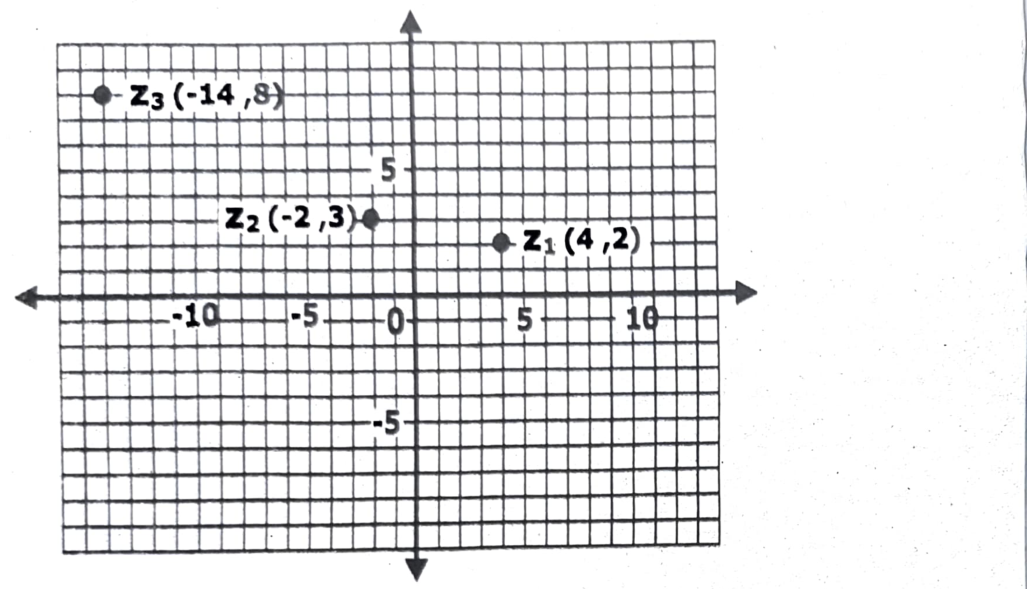
$\Rightarrow\quad z_1=4+2i=(4,2)\ ;\quad z_2=-2+3i\ (-2,3)$
$\Rightarrow\quad z_3=z_1z_2=-14+8i=(-14,8)$
(ii) $z_1=-2+4i$ and $z_2=3-i$
Solution:
First, we need to calculate the product $z_1z_2$ where $z_1=-2+4i$ and $z_2=3-i$.
$\Rightarrow\quad z_1z_2=(-2+4i)(3-i)$
$=-2(3)-2(-i)+4i(3)+4i(-i)=-6+2i+12i-4i^2$
Since $i^2=-1$, we have:
$\Rightarrow\quad z_1z_2=-6+14i+4=-2+14i$
Now, we need to express $z_1$, $z_2$, and $z_1z_2$ in polar form. The polar form of a complex number $z=a+bi$ is given by $z=r(\cos\theta+i\sin\theta)$, where:
$\Rightarrow\quad r=\sqrt{a^2+b^2}\qquad\text{and}\qquad\theta=\tan^{-1}\left(\frac{b}{a}\right)$
For $z_1=-2+4i$
- $r_1=\sqrt{(-2)^2+4^2}=\sqrt{4+16}=\sqrt{20}=2\sqrt{5}$
- $\theta_1=\tan^{-1}\left(\frac{4}{-2}\right)=\tan^{-1}(-2)$
Since the complex number is in the second quadrant, we add $180^\circ$ to the result.
$\Rightarrow\quad\theta_1\approx-63.43^\circ+180^\circ\approx116.57^\circ$
So, $z_1=2\sqrt{5}(\cos 117^\circ+i\sin 117^\circ)$ (rounded to the nearest degree).
For $z_2=3-i$
- $r_2=\sqrt{3^2+(-1)^2}=\sqrt{9+1}=\sqrt{10}$
- $\theta_2=\tan^{-1}\left(\frac{-1}{3}\right)\approx -18.43^\circ$
Since the complex number is in the fourth quadrant, we can also express this as $360^\circ-18.43^\circ\approx341.57^\circ$.
So, $z_2=\sqrt{10}(\cos342^\circ+i\sin342^\circ)$ (rounded to the nearest degree).
For $z_1z_2=-2+14i$
- $r_3=\sqrt{(-2)^2+14^2}=\sqrt{4+196}=\sqrt{200}=10\sqrt{2}$
- $\theta_3=\tan^{-1}\left(\frac{14}{-2}\right)=\tan^{-1}(-7)$
Since the complex number is in the second quadrant, we add $180^\circ$ to the result.
$\theta_3\approx-81.87^\circ+180^\circ\approx98.13^\circ$
So, $z_1z_2=10\sqrt{2}(\cos98^\circ+i\sin98^\circ)$ (rounded to the nearest degree).
Therefore:
$z_1=2\sqrt{5}(\cos117^\circ+i\sin117^\circ)$
$z_2=\sqrt{10}(\cos342^\circ+i\sin342^\circ)$
$z_1z_2=10\sqrt{2}(\cos98^\circ+i\sin98^\circ)$
Graphical Representation:
Now, let’s represent these complex numbers graphically.
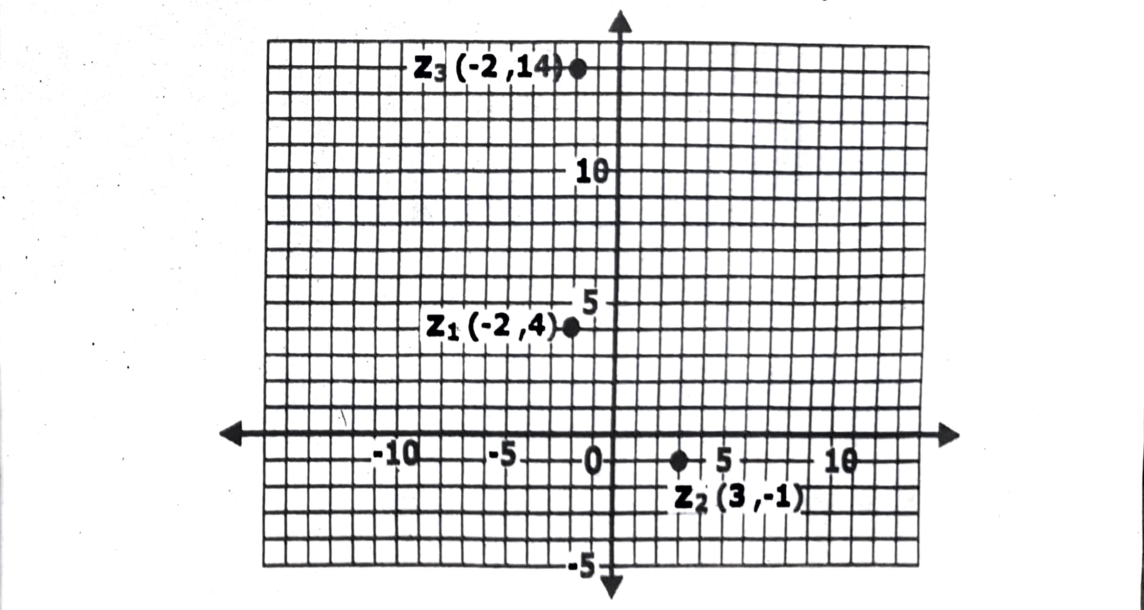
$z_1=-2+4i=(-2,4)$; $z_2=3-i=(3,-1)$.
$z_3=z_1z_2=-2+14i=(-2,14)$.
Q11. Represent $\frac{z_1}{z_2}$ graphically when:
(I) $z_1=6-4i$ and $z_2=3$
Solution:
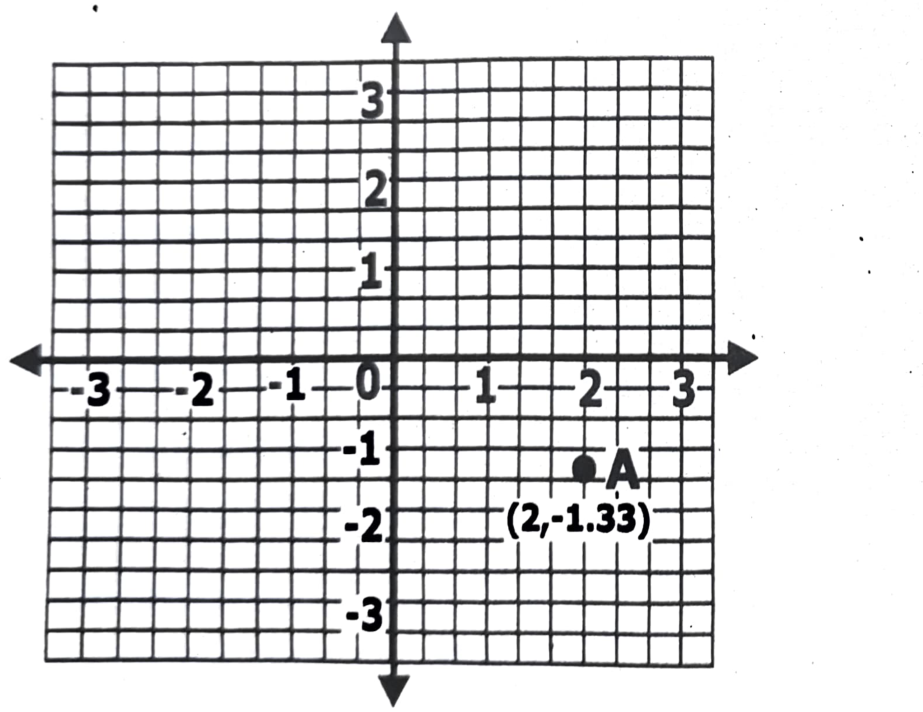
We are asked to represent $\frac{z_1}{z_2}$ graphically when $z_1=6-4i$ and $z_2=3$.
First, we compute $\frac{z_1}{z_2}$:
$\frac{z_1}{z_2}=\frac{6-4i}{3}=\frac{6}{3}-\frac{4}{3}i=2-\frac{4}{3}i$
To represent this complex number graphically, we plot the point $\left(2,-\frac{4}{3}\right)$ on the complex plane, where the $x$-axis represents the real part and the $y$-axis represents the imaginary part.
(II) $z_1=-4-6i$ and $z_2=1+i$
Solution:
We are asked to represent $\frac{z_1}{z_2}$ graphically when $z_1=-4-6i$ and $z_2=1+i$.
First, we compute $\frac{z_1}{z_2}$:
$\Rightarrow\quad \frac{z_1}{z_2}=\frac{-4-6i}{1+i}$
To divide complex numbers, we multiply the numerator and denominator by the conjugate of the denominator:
$\Rightarrow\quad \frac{-4-6i}{1+i}=\frac{(-4-6i)(1-i)}{(1+i)(1-i)}=\frac{-4+4i-6i+6i^2}{1-i^2}$
$=\frac{-4-2i-6}{1-(-1)}=\frac{-10-2i}{2}=-5-i$
To represent this complex number graphically, we plot the point $(-5,-1)$ on the complex plane, where the $x$-axis represents the real part and the $y$-axis represents the imaginary part.